Supreme Court Warns Against Overreliance on Artificial Intelligence
Source:The Hindu ↗
Why It Matters
The integration of Artificial Intelligence in justice delivery systems poses profound ethical and constitutional questions. Aspiring civil servants must understand how to balance technological efficiency (like e-courts) with safeguards against algorithmic bias, misinformation (hallucinations), and the erosion of human accountability in governance.
Summary
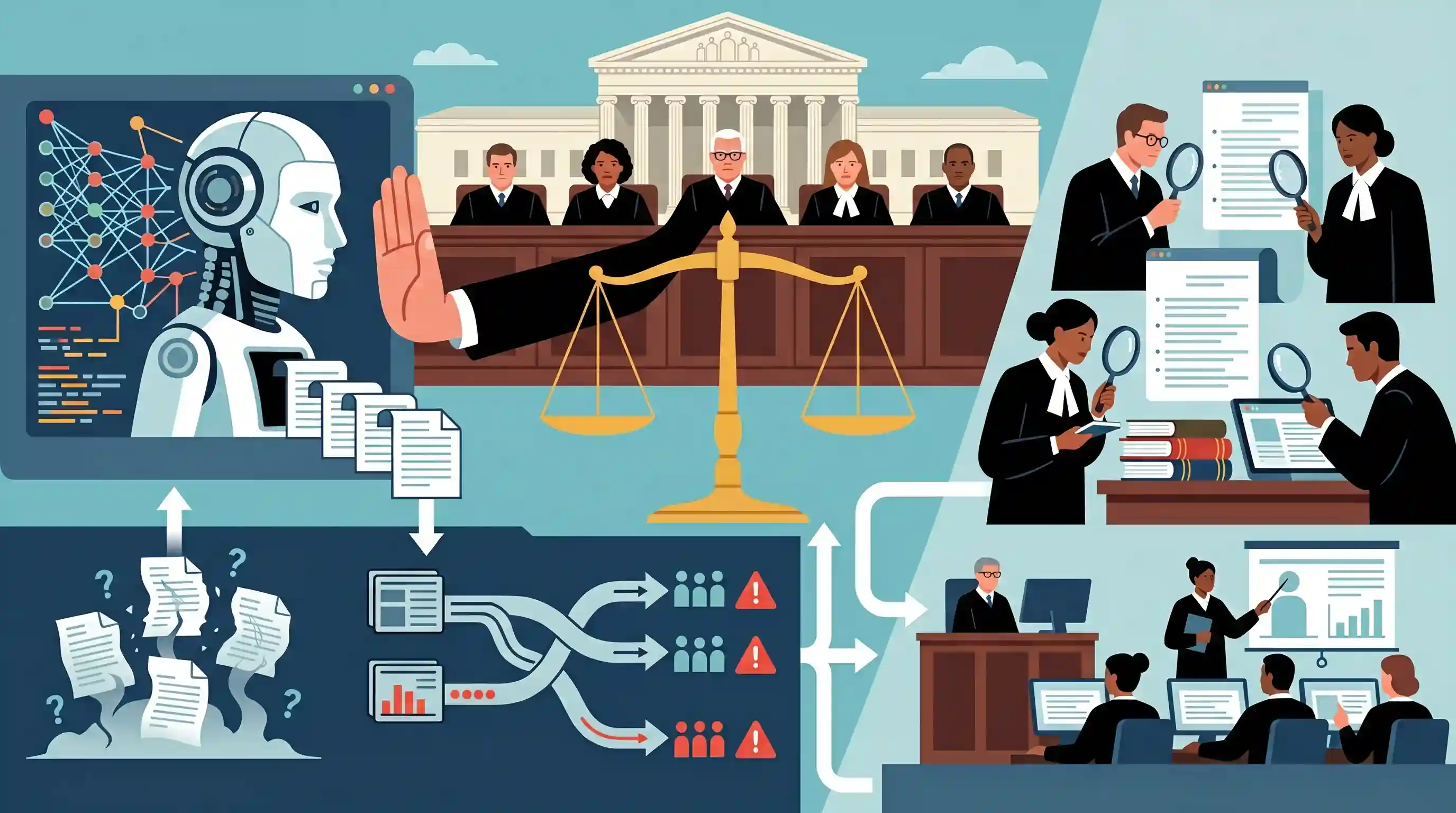
The Supreme Court of India has affirmed that while technology serves as a tool for efficiency, it will not allow Generative Artificial Intelligence (GenAI) to overpower the judicial process. Responding to a petition demanding strict regulations on GenAI in courts, the bench acknowledged risks such as 'AI hallucinations'—where AI generates fictitious case laws and judgments—along with algorithmic bias. The Court underscored the responsibility of the Bar to independently verify AI-generated legal research and noted that training initiatives for judicial officers are ongoing to safely navigate technological advancements without compromising justice delivery.
Key Points
- The Supreme Court of India emphasized that judges will not allow Generative AI to overpower the judicial administration or compromise human judgment.
- A petition highlighted the risks of unregulated Generative AI in the legal field, including 'AI hallucinations' that can generate fake case laws and fictitious judgments.
- The petitioner raised concerns about algorithmic bias and potential threats to constitutional and human rights stemming from opaque AI systems.
- The Court noted that the Bar has a responsibility to verify legal research produced by AI, warning against instances where lower courts were presented with non-existent Supreme Court rulings.
- The Court directed the petitioner to submit suggestions for regulatory guidelines on the administrative side to ensure transparent, secure, and uniform AI usage in courts.
Important Terms
Supreme Court of India

The highest judicial authority in India under the Constitution, acting as the final interpreter of law and guardian of fundamental rights.
UPSC context
GS Paper II (Polity); essential for understanding judicial independence, constitutional interpretation, and the oversight of emerging technologies like AI.
Generative Artificial Intelligence (GenAI)
Advanced AI systems capable of creating original content (text, legal research, etc.) by learning patterns from massive datasets.
UPSC context
GS Paper III (S&T/Ethics); tests knowledge of disruptive technologies, data privacy, and the ethical governance of automated systems.
AI Hallucination
Instances where AI generates factually incorrect or fabricated information, such as non-existent case laws, presented with convincing but false authority.
UPSC context
GS Paper III (S&T Ethics); critical for analyzing the risks of misinformation and the requirement for "human-in-the-loop" verification in professional fields.
Algorithmic Bias
Systematic errors where AI models replicate or amplify historical social prejudices (e.g., caste or gender) found in their training data.
UPSC context
GS Paper II (Polity/Justice); concerns Article 14 (Equality before Law) and potential discrimination in bail or sentencing outcomes.
SUPACE and SUVAS
AI-powered tools developed by the Supreme Court to assist judges with legal research (SUPACE) and translate judgments into vernacular languages (SUVAS).
UPSC context
GS Paper II (Governance/e-Governance); concrete examples of technological interventions to improve judicial efficiency and "Access to Justice."
Justice Delivery System
The institutional framework through which legal rights are enforced; currently facing challenges like a backlog of over five crore cases.
UPSC context
GS Paper II (Governance); focuses on judicial reforms, reducing pendency, and the role of technology in ensuring speedy adjudication.
Prelims Trap
The Supreme Court has banned the use of Generative AI in the legal sector due to the rising threat of AI hallucinations.
The Supreme Court has NOT banned GenAI. It merely cautioned against over-reliance, mandating strict human oversight and independent verification of AI-generated legal research by the Bar.
Static Concepts Connected
What are the key AI portals launched by the Supreme Court of India?
- SUPACE: Supreme Court Portal for Assistance in Court Efficiency; designed exclusively for fact-finding and research to assist judges. It does not engage in decision-making.
- SUVAS: Supreme Court Vidhik Anuvaad Software; a machine-learning tool translating judicial documents, orders, and judgments from English into vernacular languages to improve public access.
What are the core technical risks of Generative AI in governance?
- AI Hallucinations: Phenomenon where AI confidently generates false, nonsensical, or entirely fabricated information—such as citing non-existent judicial precedents.
- Algorithmic Bias: Systematic, repeatable errors creating unfair outcomes, usually stemming from historical prejudices or skewed demographics embedded in the AI's training data.
- Black-Box Effect: The inability of developers or users to understand how an AI model arrived at a specific conclusion, limiting transparency and accountability.
Cross-Topic Patterns
Algorithmic bias + Article 14 rights
The 'black-box' nature of AI raises constitutional concerns. If algorithmic bias systematically disadvantages certain groups in bail or sentencing assessments, it directly violates the Right to Equality under Article 14.
e-Courts Phase III + Judicial pendency
Integrating AI tools directly aligns with Phase III of the e-Courts project, which emphasizes smart analytics, digital infrastructure, and predictive tools to address India's chronic judicial pendency.

Expect a Prelims pair-matching question on SUPACE vs SUVAS, alongside a GS-2 Mains question on how algorithmic bias impacts Article 14.
Linked PYQs · 4
Linked PYQs · 4
- 2024MainsGS4
The application of Artificial Intelligence as a dependable source of input for administrative rational decision-making is a debatable issue. Critically examine the statement from the ethical point of view.
- 2023MainsGS3
Introduce the concept of Artificial Intelligence (AI). How does Al help clinical diagnosis? Do you perceive any threat to privacy of the individual in the use of Al in healthcare?
- 2025MainsGS2
e-governance projects have a built-in bias towards technology and back-end integration than user-centric designs. Examine.
- 2023MainsGS2
e-governance, as a critical tool of governance, has ushered in effectiveness, transparency and accountability in governments. What inadequacies hamper the enhancement of these features ?
