Electoral Roll Revisions and Judicial Tribunals in West Bengal
Source:Indian Express ↗
Why It Matters
This case study is highly relevant for GS-2 as it touches upon the institutional autonomy and functioning of the ECI, federal friction (ECI vs. State Govt), judicial intervention (Article 142), and the governance challenges posed by relying on centralized algorithms for determining voter eligibility without adequate safeguards.
Summary
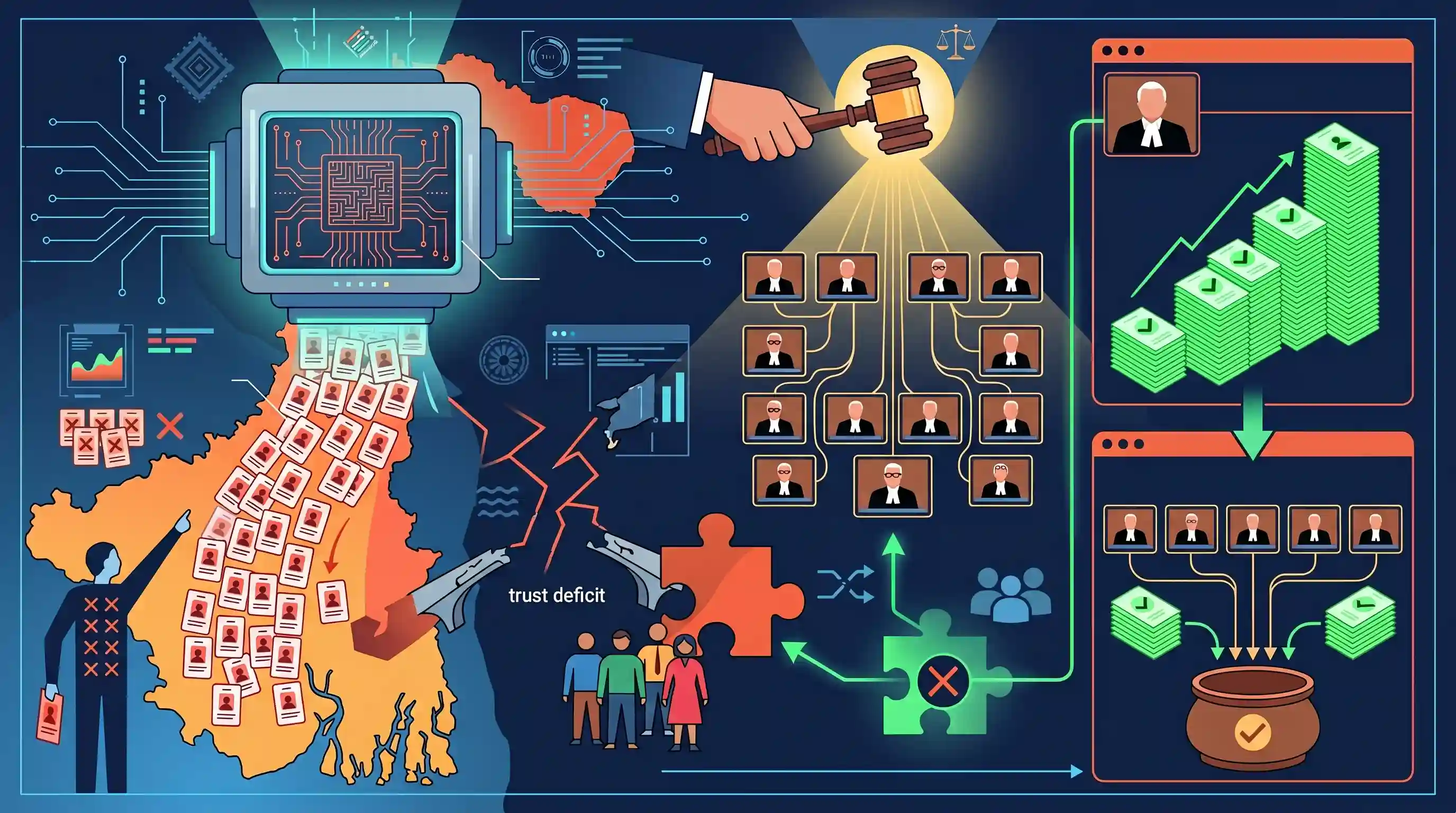
The article reports on a significant discrepancy involving electoral roll revisions in West Bengal. Former Calcutta High Court Chief Justice TS Sivagnanam, heading a special appellate tribunal, reinstated 1,717 deleted voters—yet the Election Commission of India (ECI) added only 1,607 voters in total across all 19 tribunals. The tribunals were originally established by the Supreme Court invoking Article 142 due to a 'trust deficit' between the ECI and the state government following the deletion of over 27.16 lakh voters based on a centralized ECI algorithm. This event highlights crucial issues regarding the use of technology in governance, bureaucratic hurdles in upholding the right to vote, and the judiciary stepping into executive domains to resolve constitutional friction.
Key Points
- The ECI used a centralized algorithm to flag logical errors in the electoral rolls, leading to the deletion of over 27.16 lakh voters in West Bengal.
- A deep trust deficit between the West Bengal state government and the ECI prompted the Supreme Court to invoke extraordinary powers under Article 142 to set up judicial tribunals for overseeing the electoral rolls revision (SIR).
- Justice (Retd) TS Sivagnanam's appellate tribunal alone ordered the reinstatement of 1,717 voters, yet the EC ultimately added only 1,607 names across all 19 tribunals, exposing severe implementation gaps.
- The situation reflects the systemic challenges of integrating algorithmic decision-making into the electoral process, especially where it impacts fundamental democratic rights like voting.
Important Terms
Article 142 of the Constitution

Article 142 grants the Supreme Court extraordinary power to pass any decree or order necessary for doing "complete justice" in any cause or matter pending before it.
UPSC context
GS II: Judiciary. Tests knowledge of extraordinary jurisdiction, judicial activism, and the Court's role in filling legislative or executive vacuums.
Representation of the People Act (1950)
The Representation of the People Act, 1950 provides the legal framework for the allocation of seats, delimitation of constituencies, and the preparation/revision of electoral rolls in India.
UPSC context
GS II: Electoral Reforms. Essential for understanding the statutory basis of voter eligibility and registration processes.
Election Commission of India (ECI)
A permanent, independent constitutional body (Article 324) responsible for the "superintendence, direction, and control" of elections to Parliament, State Legislatures, and the President/Vice-President offices.
UPSC context
GS II: Constitutional Bodies. Focuses on institutional autonomy, powers under Article 324, and challenges in maintaining free and fair elections.
Special Intensive Revision (SIR)
A unique, non-routine electoral exercise directed by the ECI to clean electoral rolls, often involving house-to-house verification or algorithmic checks for duplicate/ineligible entries.
UPSC context
GS II: Governance. Relevant to discussions on administrative hurdles, e-governance (algorithms in roll purges), and protection of the universal adult franchise.
Judicial Activism
The proactive role played by the judiciary in protecting or expanding the rights of citizens and ensuring the executive/legislature performs its constitutional duties.
UPSC context
GS II: Separation of Powers. Tests the understanding of when the judiciary can step into executive domains to resolve constitutional friction.
Prelims Trap
"The Election Commission has its own independent permanent administrative cadre to revise state electoral rolls."
Under Article 324, the ECI does not have dedicated state-level staff. It relies entirely on the state government's administrative machinery (CEOs, DEOs, BLOs) working on deputation.
Static Concepts Connected
What is the primary scope of the Representation of the People Act, 1950?
- Electoral Rolls: Focuses entirely on the preparation, revision, and updating of electoral rolls for Parliamentary and Assembly constituencies.
- Voter Qualifications: Outlines the core qualifications and disqualifications (e.g., ordinarily resident, sound mind) for registering as a voter.
- Delimitation & Seats: Provides the statutory framework for the allocation of seats and the delimitation of constituencies.
How does Article 142 empower the Supreme Court in executive vacuums?
- Complete Justice: Allows the Supreme Court to pass any decree or order necessary for doing complete justice in any pending matter.
- Institutional Gap-filling: Often invoked to create temporary frameworks (like special appellate tribunals) when executive friction or legislative gaps threaten fundamental or constitutional rights.
- All-India Enforceability: These orders are enforceable throughout the territory of India as prescribed by Parliament or the President.
Cross-Topic Patterns
Algorithmic exclusion in rights and welfare
The ECI's algorithm-driven voter deletion mirrors Aadhaar-based exclusion errors in PDS and MGNREGA, highlighting the tension between automated e-governance efficiency and the protection of constitutional rights.
Federal friction in Article 324 execution
The "trust deficit" highlights the structural vulnerability of Article 324, demonstrating how centralized constitutional bodies like the ECI can be paralyzed when forced to rely on state-level bureaucracy for implementation.

Expect a 2026 Mains question on the friction between Article 324 ECI powers and algorithmic e-governance in protecting Article 326 rights.
Linked PYQs · 5
Linked PYQs · 5
- 2022MainsGS2
Discuss the procedures to decide the disputes arising out of the election of a Member of the Parliament or State Legislature under The Representation of the People Act, 1951. What are the grounds on which the election of any returned candidate may be declared void ? What remedy is available to the aggrieved party against the decision ? Refer to the case laws.
- 2017PrelimsGS1
Right to vote and to be elected in India is a
- 2020MainsGS2
Judicial Legislation is antithetical to the doctrine of separation of powers as envisaged in the Indian Constitution. In this context justify the filing of large number of public interest petitions praying for issuing guidelines to executive authorities.
- 2025MainsGS2
e-governance projects have a built-in bias towards technology and back-end integration than user-centric designs. Examine.
- 2022MainsGS2
Discuss the role of the Election Commission of India in the light of the evolution of the Model Code of Conduct.
