US Court Protects Yemeni Refugees From Losing Special Status
Source:The Hindu ↗
Why It Matters
This development is pertinent to UPSC GS Paper 2 (International Relations and Policies of Developed Countries) as it highlights the changing dynamics of U.S. immigration policy, its impact on global refugees, and the ongoing geopolitical and humanitarian crisis in the Middle East (specifically Yemen). It provides a concrete example of executive policies clashing with judicial interpretations of human rights obligations.
Summary
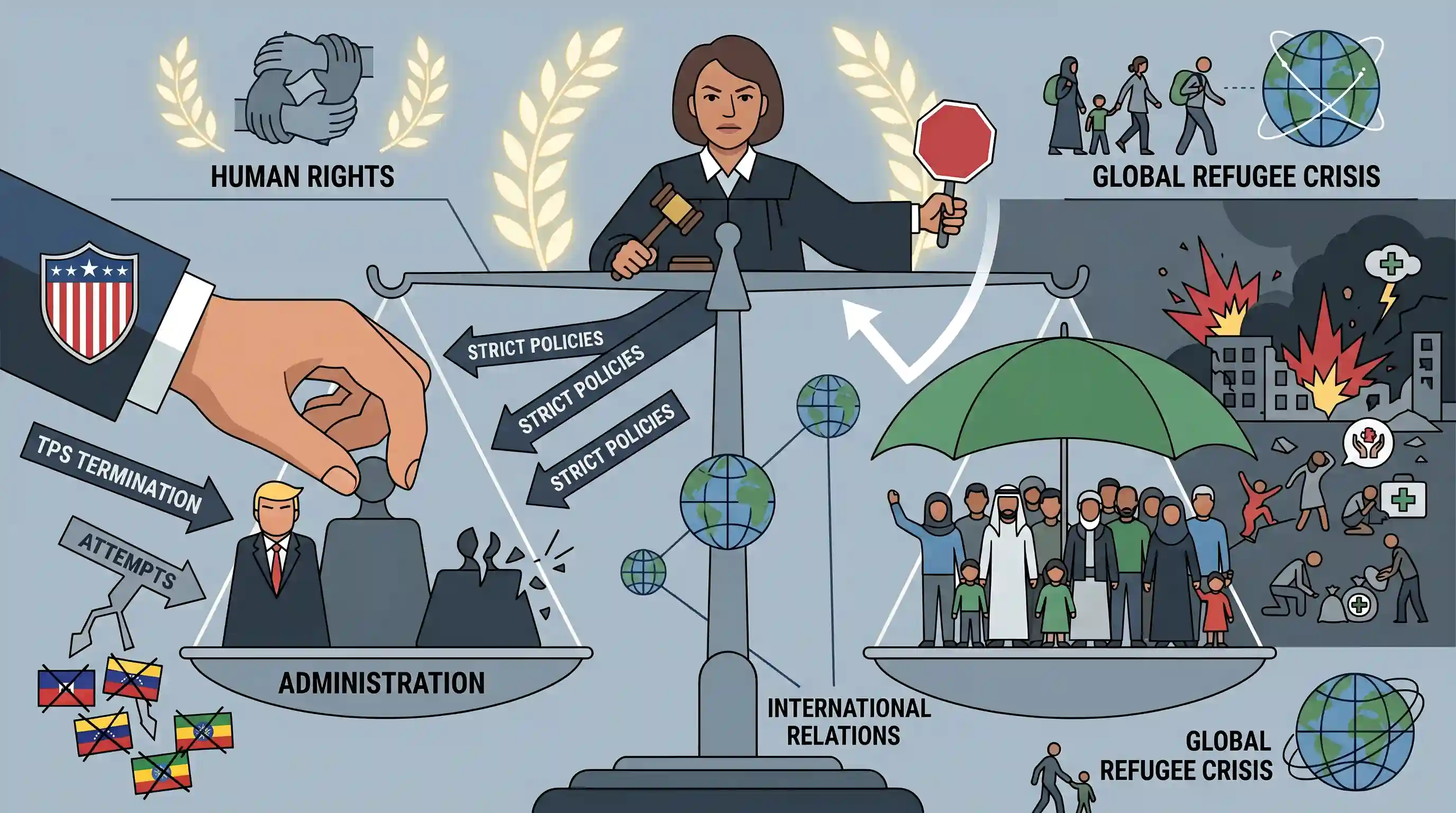
A U.S. federal judge has halted the Trump administration's attempt to terminate Temporary Protected Status (TPS) for around 3,000 Yemeni refugees. The court noted that returning these individuals to Yemen would subject them to extreme danger given the country's ongoing civil war and severe humanitarian crisis. The Trump administration has consistently sought to curtail TPS protections, having previously ended them for citizens of Haiti, Venezuela, and Ethiopia. The case highlights the tension between humanitarian obligations and the administration's stringent immigration and border control policies, driven in part by Homeland Security Secretary Kristi Noem's push for a broader travel ban.
Key Points
- A U.S. federal judge has blocked the Trump administration's efforts to end the Temporary Protected Status (TPS) for approximately 3,000 Yemeni refugees.
- The judge argued that terminating the status and forcing deportations would endanger the lives of the refugees due to the ongoing humanitarian crisis and civil war in Yemen.
- The Trump administration has actively sought to roll back TPS programs, having already terminated the status for nationals from countries like Haiti, Venezuela, and Ethiopia.
- Internal documents revealed that political motivations overshadowed humanitarian assessments, with Homeland Security Secretary Kristi Noem proposing a broader travel ban affecting Yemen.
Important Terms
Temporary Protected Status (TPS)

A U.S. federal program providing temporary legal status, work permits, and deportation protection to nationals from countries facing armed conflict, environmental disasters, or extraordinary conditions.
UPSC context
GS Paper II: International Relations and Policies of Developed Countries; tests understanding of humanitarian immigration mechanisms and global displacement.
Department of Homeland Security (DHS)
The U.S. cabinet-level department responsible for public security, border control, and immigration enforcement; its secretary has the authority to designate or terminate TPS for foreign countries.
UPSC context
GS Paper II: Important International Institutions; highlights the intersection of national security, foreign policy, and executive governance.
Trump administration
The executive branch of the U.S. government under Donald Trump, characterized by 'America First' policies, stringent border controls, and efforts to reduce humanitarian parole and protection programs.
UPSC context
GS Paper II: Effect of policies and politics of developed countries on India’s interests and global governance.
Judicial Review
The power of courts to examine and potentially invalidate executive or legislative actions; here, used to block the termination of TPS on grounds of procedural failure or animus.
UPSC context
GS Paper II: Comparison of the Indian constitutional scheme with other countries; tests knowledge of checks and balances.
Humanitarian Crisis
A widespread, severe threat to the health, safety, or well-being of a large group, often caused by conflict or disaster, necessitating international aid and protection.
UPSC context
GS Paper II: International Relations and Human Rights; relevant for ethical governance and global social issues.
Refugee Crisis
A situation involving large-scale movement of people forced to flee their homes due to persecution, war, or violence, placing immense pressure on host nations and international agencies.
UPSC context
GS Paper II: Global issues affecting India and world; critical for topics like forced migration and international ethics.
Prelims Trap
"India manages its refugee populations under the framework of the 1951 UN Refugee Convention."
India is NOT a signatory to the 1951 Convention or 1967 Protocol. It lacks specific national refugee legislation, managing them under the Foreigners Act, 1946.
Static Concepts Connected
What is the Principle of Non-refoulement?
- Core Meaning: Prohibits returning individuals to a country where they face persecution, torture, or threats to their life and freedom.
- Legal Origin: It is customary international law, formally codified in Article 33 of the 1951 UN Refugee Convention.
- Indian Stance: Though India isn't a signatory, the Supreme Court has occasionally interpreted this principle as implicit under Article 21 (Right to Life).
Why is Yemen's geopolitical location critical?
- Maritime Chokepoint: It borders the Bab el-Mandeb strait, linking the Red Sea to the Gulf of Aden and the Arabian Sea.
- Trade Arteries: It acts as an essential gateway for global commercial and energy shipping routing through the Suez Canal between Europe and Asia.
- Geopolitical Hotspot: Its coastline proximity to the Horn of Africa and Saudi Arabia makes it a prime arena for regional proxy wars (Iran-Saudi rivalry).
Cross-Topic Patterns
Human rights vs Border security
The US policy clash mirrors India’s domestic debates (e.g., Rohingya deportations), testing the limits of non-refoulement against sovereign immigration laws like the Foreigners Act.
Red Sea instability and global trade
The ongoing civil war in Yemen routinely spills into the Bab el-Mandeb, connecting a local humanitarian crisis to global supply chain disruptions and inflation.

Expect a Prelims statement linking the 1951 Refugee Convention to India's Foreigners Act, or map questions on Bab el-Mandeb strait.
Linked PYQs · 2
Linked PYQs · 2
- 2023PrelimsGS1
Consider the following pairs: Area of conflict mentioned in news Country where it is located 1. Donbas : Syria 2. Kachin : Ethiopia 3. Tigray : North Yemen How many of the above pairs are correctly matched?
- 2021MainsGS2
Though the Human Rights Commissions have contributed immensely to the protection of human rights in India, yet they have failed to assert themselves against the mighty and powerful. Analyzing their structural and practical limitations, suggest remedial measures.
