US Court Halts Executive Order on Birthright Citizenship
Source:Indian Express ↗
Why It Matters
The event offers a tangible comparative perspective on citizenship acquisition principles (like jus soli) and illustrates the functional mechanisms of separation of powers, specifically the judiciary's role in checking executive orders, which is directly relevant to GS Paper 2 topics on Polity and Governance.
Summary
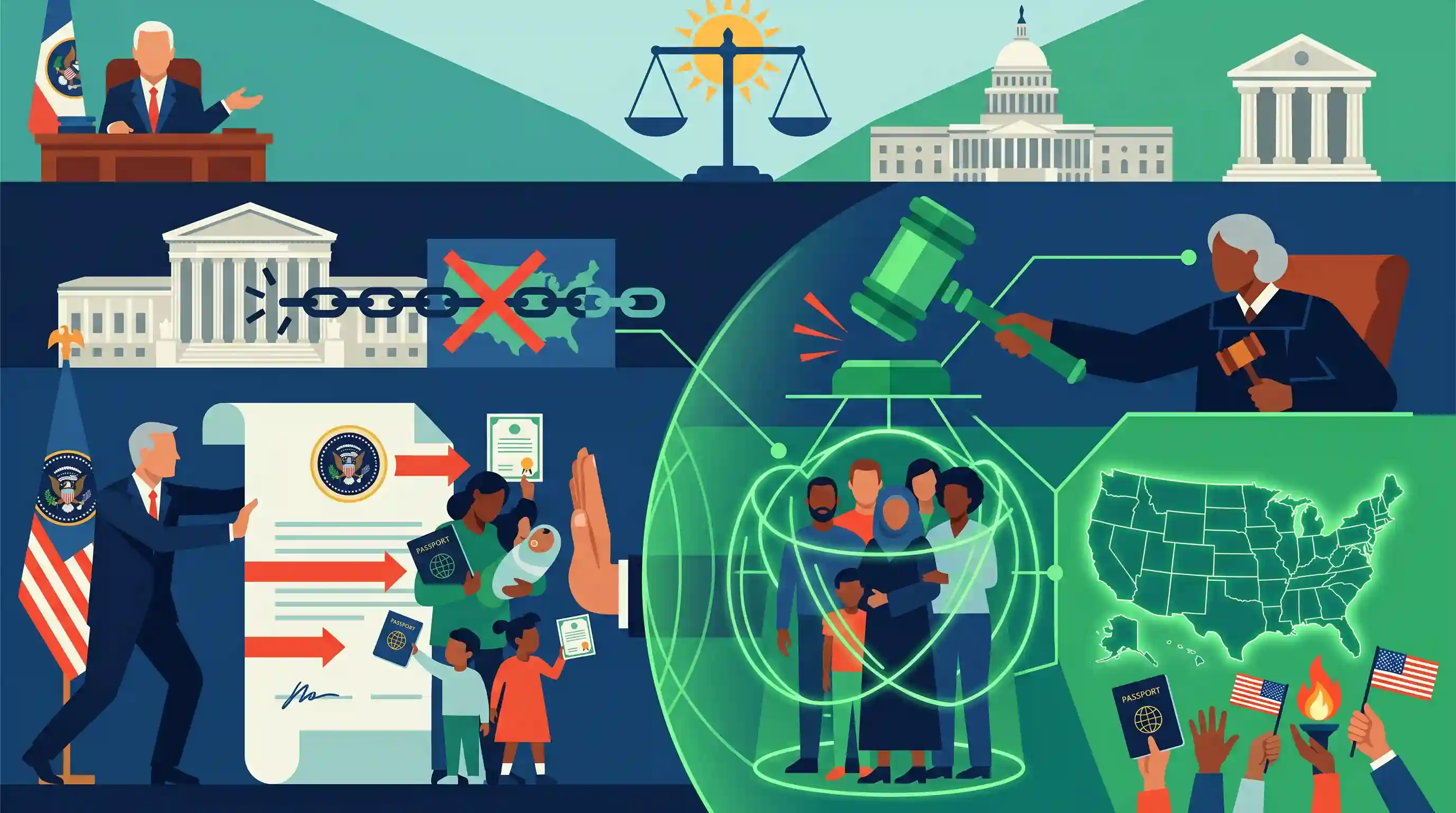
A US District Judge issued an injunction halting President Donald Trump's executive order aimed at ending birthright citizenship. The decision is notable as it successfully navigated a recent US Supreme Court ruling that severely restricted the power of lower courts to issue nationwide injunctions. By officially certifying the plaintiffs as a nationwide class, the district judge bypassed the Supreme Court's limitations. This case highlights ongoing political and legal disputes over US citizenship principles (jus soli) and exemplifies the complex dynamics of judicial review, separation of powers, and the hierarchy of courts—key themes in comparative constitutional law.
Key Points
- A US District Court judge temporarily blocked President Trump's executive order that sought to end birthright citizenship.
- The injunction was granted despite a recent US Supreme Court ruling that restricted the ability of lower court judges to issue nationwide injunctions.
- The district judge navigated around the apex court's restriction by certifying the plaintiffs as a nationwide class.
- The issue highlights tensions in comparative constitutional law concerning executive orders, judicial review, and the scope of lower courts' powers relative to apex courts.
Important Terms
Birthright Citizenship (Jus Soli)

The legal principle ( 'right of the soil') where citizenship is automatically granted to individuals born within a country's territory, regardless of their parents' nationality.
UPSC context
GS Paper II: Citizenship and Comparative Constitution. Tests understanding of US 14th Amendment vs. India's shift away from automatic birthright citizenship.
Jus Sanguinis
A citizenship principle ('right of blood') where nationality is determined by the citizenship of one or both parents rather than the place of birth.
UPSC context
GS Paper II: Citizenship Act amendments (1987, 2004). Relevant for comparing India's restrictive citizenship laws with global standards.
Nationwide Injunction
A court order that prohibits the federal government from enforcing a law or policy against anyone nationwide, not just the specific plaintiffs in the case.
UPSC context
GS Paper II: Judiciary. High-yield topic regarding 'Judicial Overreach' versus 'Judicial Restraint' and the hierarchy of courts.
Judicial Review
The power of the judiciary to examine and invalidate legislative or executive actions that are found to be inconsistent with the Constitution.
UPSC context
GS Paper II: Basic Structure Doctrine. Fundamental to both Indian and US constitutionalism and the protection of fundamental rights.
Separation of Powers
A constitutional doctrine dividing government responsibilities into three branches (Legislative, Executive, Judiciary) to provide a system of checks and balances.
UPSC context
GS Paper II: Constitutional Governance. Crucial for understanding conflicts between executive orders and judicial halts.
Class Certification
A procedural mechanism where a judge designates specific plaintiffs to represent an entire group of similarly situated people, making the court's ruling applicable to the whole class.
UPSC context
GS Paper II: Judicial Process. Relevant for how courts can broaden the impact of their rulings despite jurisdictional limitations.
Prelims Trap
"Only a citizen by birth is eligible to hold the office of the President of India."
While the US Constitution limits the presidency to 'natural-born citizens', Article 58 of the Indian Constitution allows both citizens by birth and naturalized citizens to become President.
Static Concepts Connected
How has India's citizenship principle evolved since 1950?
- Initial Jus Soli: Originally, birth on Indian soil guaranteed citizenship regardless of parentage (1950-1987).
- Shift to Bloodline: The 1986 amendment added a requirement that at least one parent must be an Indian citizen to curb illegal immigration.
- Current Stance: The 2003 amendment mandates that one parent is an Indian citizen and the other is not an illegal migrant at the time of birth.
What is the territorial reach of a High Court striking down a Central law?
- Pan-India Impact: If an Indian High Court strikes down a Central Act as unconstitutional, the judgment applies uniformly across the entire territory of India.
- Kusum Ingots Case: This principle prevents a central law from being valid in one state and invalid in another, ensuring constitutional uniformity.
- Subject to Stay: The pan-India invalidation remains in force unless and until the Supreme Court issues a stay on the High Court's order.
Cross-Topic Patterns
Ordinances vs US Executive Orders
Unlike US executive orders that bypass the legislature entirely, Indian Ordinances (Article 123) are temporary laws strictly requiring parliamentary ratification, highlighting distinct separation of powers models.
CAA 2019 & Jus Sanguinis Evolution
India's progressive shift from 'jus soli' (soil) to 'jus sanguinis' (blood) since 1986 provides the structural context for evaluating the Citizenship Amendment Act (2019) and debates around illegal immigration.

Expect a comparative Prelims question contrasting India's High Court powers with US courts, or naturalized citizenship for executive posts.
Linked PYQs · 3
Linked PYQs · 3
- 2020MainsGS2
Judicial Legislation is antithetical to the doctrine of separation of powers as envisaged in the Indian Constitution. In this context justify the filing of large number of public interest petitions praying for issuing guidelines to executive authorities.
- 2015MainsGS2
Resorting to ordinances has always raised concern on violation of the spirit of separation of powers doctrine. While noting the rationales justifying the power to promulgate ordinances, analyze whether the decisions of the Supreme Court on the issue have further facilitated resorting to this power. Should the power to promulgate ordinances be repealed?
- 2021PrelimsGS1
With reference to India, consider the following statements : 1. There is only one citizenship and one domicile. 2. A citizen by birth only can become the Head of State. 3. A foreigner once granted the citizenship cannot be deprived of it under any circumstances. Which of the statements given above is/are correct?
