JSA Demands Regulation on Hospital Charges and Medicine Prices
Source:Indian Express ↗
Why It Matters
This article is directly relevant to GS Paper II under issues relating to health, human resources, and the social sector, particularly concerning public policy interventions against the commercialisation of healthcare and rising out-of-pocket expenditure.
Summary
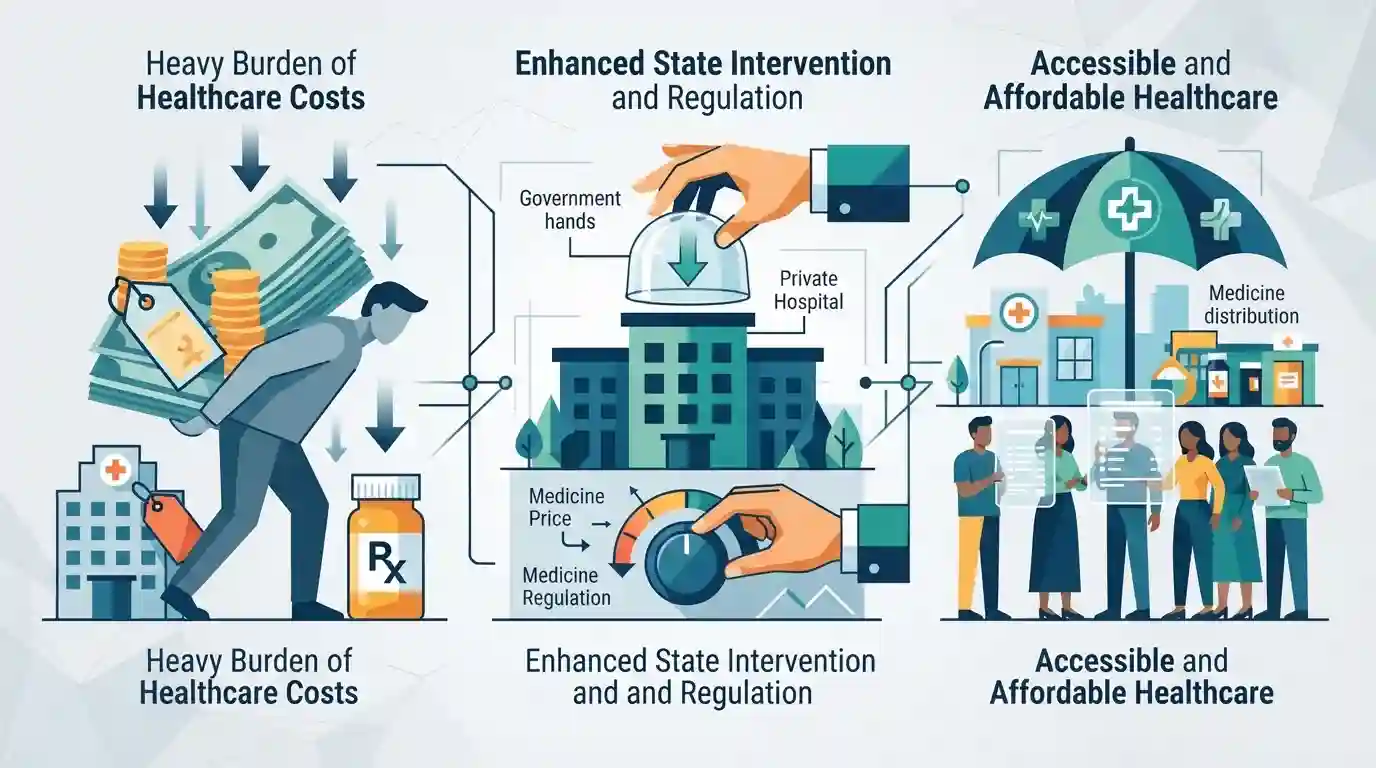
The Jana Swasthya Abhiyan (JSA) Working Group on Access to Medicines and Treatment has strongly advocated for capping hospital charges in private healthcare and implementing rigorous regulations on medicine prices. Highlighting the heavy burden of out-of-pocket expenditure on ordinary citizens, the group called for enhanced state intervention, better price controls on pharmaceuticals, and transparent billing systems to make healthcare accessible and affordable.
Key Points
- The Jana Swasthya Abhiyan (JSA) Working Group on Access to Medicines and Treatment has demanded the imposition of strict ceilings on hospital charges in private healthcare institutions.
- The group emphasized the urgent need for tighter government regulation on medicine prices and trade margins to curb excessive profiteering.
- It highlighted how high out-of-pocket expenditure on healthcare and medicines pushes vulnerable populations into poverty, necessitating systemic reforms.
- Recommendations include expanding the scope of price-capped essential medicines and ensuring transparent billing practices across all healthcare facilities.
Important Terms
Jana Swasthya Abhiyan (JSA)

A national network of independent public health advocates, grassroots organizations, and researchers campaigning for universal healthcare, the Right to Health, and equity in India's medical system.
UPSC context
UPSC GS Paper II (Social Sector/Health): Tests knowledge of civil society movements, healthcare advocacy, and equity in public service delivery.
Drug Price Control Order (DPCO)
Regulatory orders issued under the Essential Commodities Act to cap and monitor the prices of essential medicines and formulations, enforced by the NPPA.
UPSC context
UPSC GS Paper II (Government Policies/Interventions): Tests regulatory mechanisms for pharmaceutical pricing, out-of-pocket expenditure, and accessibility.
Clinical Establishments Act
Central legislation enacted in 2010 to mandate registration and set minimum infrastructure and service standards across all public and private clinical establishments in India.
UPSC context
UPSC GS Paper II (Health Governance): Evaluates regulatory frameworks for standardizing healthcare delivery, pricing transparency, and accountability in private hospitals.
Static Concepts Connected
How does the National Pharmaceutical Pricing Authority (NPPA) regulate drug prices in India?
- Statutory Backing: Administers and enforces the Drugs (Prices Control) Order (DPCO) issued under the Essential Commodities Act.
- Ceiling Prices: Fixes and enforces ceiling prices for scheduled formulations listed in the National List of Essential Medicines (NLEM).
- Non-Scheduled Drugs: Monitors non-scheduled drug prices to ensure annual price increases do not exceed permissible thresholds (typically WPI).
Cross-Topic Patterns
Healthcare Price Capping & Federalism Governance
Private hospital price capping debates directly intersect with federalist implementation challenges of the Clinical Establishments Act across states.
OOPE Health Burden & Inclusive Growth Traps
High OOP expenditure on medicines fuels poverty traps, undermining human capital development targets under inclusive growth.

NPPA powers + DPCO ceiling price exemptions + OOPE trends frequently appear in matching or multi-statement Prelims items.
Linked PYQs · 1
Linked PYQs · 1
- 2024MainsGS2
In a crucial domain like the public healthcare system the Indian State should play a vital role to contain the adverse impact of marketisation of the system. Suggest some measures through which the State can enhance the reach of public healthcare at the grassroots level.
