JPC Recommendation on Minister Removal After Custody
Source:The Hindu ↗
Why It Matters
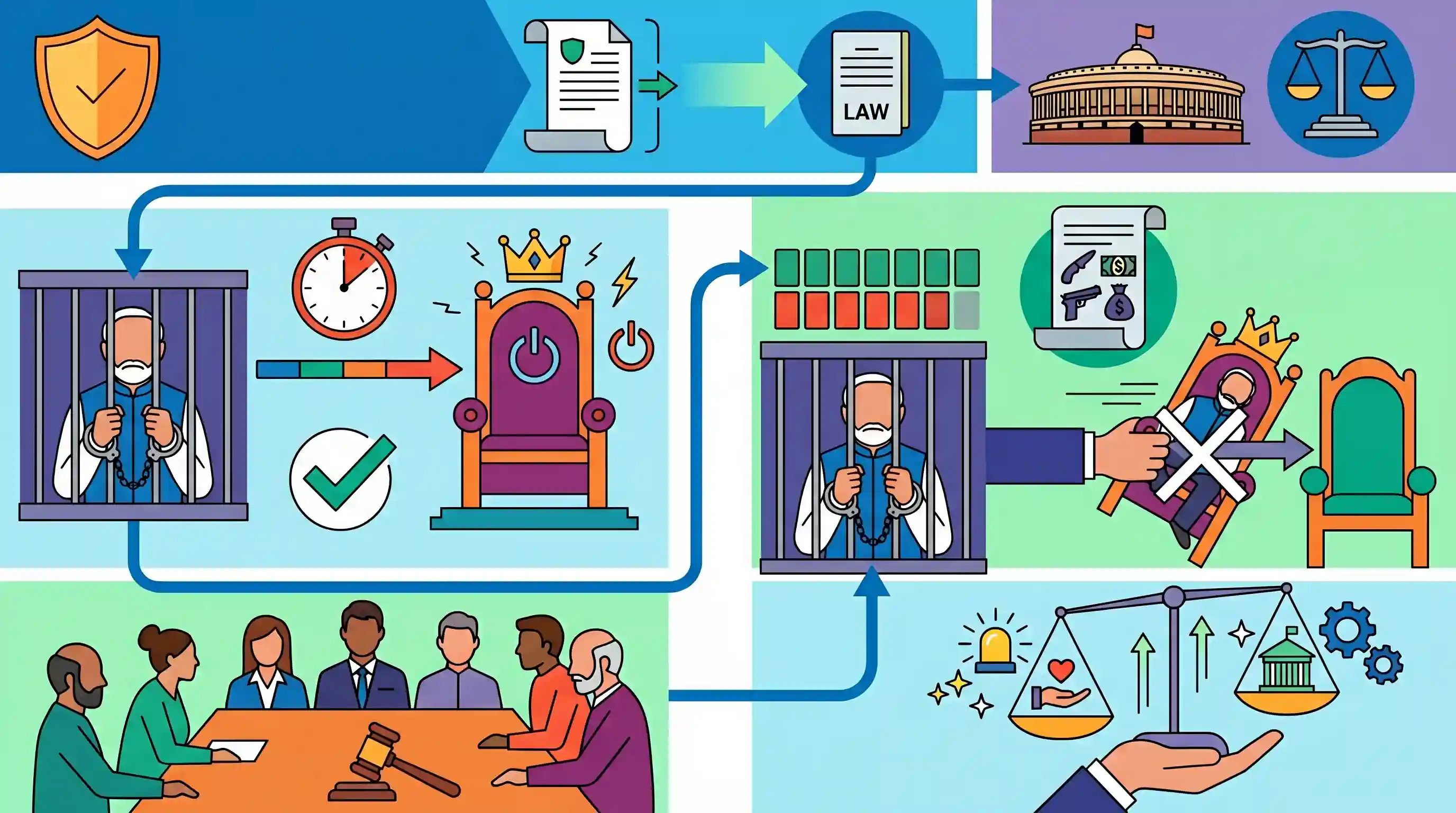
This amendment directly addresses a constitutional vacuum where a sitting Chief Minister or Minister could legally govern from jail while in custody, a scenario that recently triggered intense constitutional debates. The JPC's report holds significance for UPSC aspirants studying parliamentary oversight, Article 75 and 164 of the Constitution, and reforms related to political morality and the Representation of the People Act, 1951.
Summary
The Joint Parliamentary Committee (JPC) examining the Constitution (130th Amendment) Bill, 2025, is poised to retain a key clause mandating the removal of a Prime Minister, Chief Minister, or Minister from office if they remain arrested in custody for 30 consecutive days for serious offences. Proponents argue this strengthens morality and good governance, while opposition parties boycotted the panel, citing a lack of accommodation for their views. The bill addresses a constitutional loophole that currently permits arrested ministers to remain in power unless convicted.
Key Points
- The Joint Parliamentary Committee (JPC) examining the Constitution (130th Amendment) Bill, 2025, is likely to recommend retaining a major clause regarding the removal of Ministers, Chief Ministers, and the Prime Minister from office if they remain in custody for 30 consecutive days after arrest for a serious offence.
- Chaired by BJP MP Aparajita Sarangi, the 31-member panel held 10 rounds of meetings since December 2025 and is expected to finalize its draft report before the Monsoon Session of Parliament starting on July 20, 2026.
- Committee sources argue that 30 days is a reasonable timeframe for an accused minister to seek bail and that the provision is aligned with the principles of natural justice. To prevent potential political weaponization, the committee is expected to issue a protective caveat.
- The opposition (INDIA bloc members) largely boycotted the committee meetings, alleging that the ruling alliance used its numerical majority on the panel to override opposition views.
- Currently, under Section 8 of the Representation of the People Act (RPA), 1951, disqualification occurs only upon actual conviction (with a sentence of 2 years or more). This amendment addresses a constitutional grey area where ministers are arrested but continue to hold office while in custody.
Important Terms
Joint Parliamentary Committee

An ad-hoc parliamentary committee comprising members from both Houses of Parliament (Lok Sabha and Rajya Sabha) set up to examine a specific bill or investigate an issue and report back to Parliament.
UPSC context
GS Paper II (Polity) — Parliamentary Committees, their functioning, executive accountability, and legislative scrutiny.
Constitution (130th Amendment) Bill, 2025
A proposed legislation seeking the automatic removal of a Prime Minister, Chief Minister, or minister if they remain arrested in custody for 30 consecutive days for serious offences carrying five or more years of imprisonment.
UPSC context
GS Paper II (Polity) — Constitutional amendment process, executive accountability, federalism, separation of powers, and basic structure challenges.
Decriminalisation of Politics
Legal and institutional reforms designed to prevent individuals facing serious criminal charges or having criminal records from contesting elections or holding ministerial offices in government.
UPSC context
GS Paper II (Polity/Elections) — Electoral reforms, criminalisation of politics, and upholding public trust in representative democracy.
Pleasure Doctrine
A constitutional principle under Articles 75 and 164 stating that Union and State ministers hold office at the discretionary "pleasure" of the President and Governor, respectively.
UPSC context
GS Paper II (Polity) — Cabinet responsibility, Union and State Executive, and discretionary powers of the executive.
Separation of Powers
A core doctrine of the Indian Constitution's basic structure that demarcates distinct functions and spheres of authority among the legislature, executive, and judiciary to prevent arbitrary exercise of power.
UPSC context
GS Paper II (Polity) — Separation of powers between organs, basic structure doctrine, and dispute redressal mechanisms.
Prelims Trap
The Prime Minister and Chief Ministers enjoy absolute immunity from criminal arrest and prosecution during their tenure in office under Article 361.
Article 361 exclusively covers the President and State Governors. No such protection from criminal arrest or prosecution exists for the Prime Minister, Chief Ministers, or other ministers.
Static Concepts Connected
What is the scope of constitutional immunity under Article 361?
- Protected entities: Applies strictly to the President of India and the Governors of States during their term of office.
- Criminal proceedings: No criminal proceedings whatsoever can be instituted or continued in any court against them during their term.
- Arrest immunity: No process for the arrest or imprisonment of the President or Governor can be issued from any court during their term.
- Ministerial exclusion: Prime Ministers, Chief Ministers, and Union/State ministers do not enjoy this immunity and can be arrested under due process of law.
What are the landmark Supreme Court rulings on legislative disqualification and criminalisation?
- Lily Thomas (2013): Struck down Section 8(4) of the RPA 1951, removing the 3-month protection window that allowed convicted sitting legislators to avoid immediate disqualification.
- Manoj Narula (2014): Invoked 'constitutional trust', advising Prime Ministers and Chief Ministers not to appoint tainted individuals with criminal antecedents as ministers.
- Public Interest (2018): Clarified that judiciary cannot add new disqualification criteria; it directed Parliament to make laws preventing individuals with criminal charges from contesting.
Cross-Topic Patterns
Federal friction & executive stability
Mandating the automatic removal of Chief Ministers during pre-conviction custody could intensify federal disputes, especially when central investigative agencies initiate the arrests.
Judicial doctrines vs. legislative amendments
The bill seeks to codify the "constitutional trust" doctrine established in Manoj Narula (2014), balancing legislative supremacy against judicial calls for ethical governance.

The distinction between executive immunity under Article 361 and ministerial disqualifications under RPA will likely be tested in 2026.
Linked PYQs · 4
Linked PYQs · 4
- 2021MainsGS2
Do Department-related Parliamentary Standing Committees keep the administration on its toes and inspire reverence for parliamentary control? Evaluate the working of such committees with suitable examples.
- 2020MainsGS2
There is a need for simplification of procedure for disqualification of persons found guilty of corrupt practices under the Representation of Peoples Act". Comment.
- 2019PrelimsGS1
Consider the following statements: 1. The Parliament (Prevention of Disqualification) Act, 1959 exempts several posts from disqualification on the grounds of 'Office of Profit'. 2. The above-mentioned Act was amended five times. 3. The term 'Office of Profit' is well-defined in the Constitution of India. Which of the statements given above is/are correct?
- 2025PrelimsGS1
Consider the following statements : I. If any question arises as to whether a Member of the House of the People has become subject to disqualification under the 10th Schedule, the President's decision in accordance with the opinion of the Council of Union Ministers shall be final. II. There is no mention of the word 'political party' in the Constitution of India. Which of the statements given above is/are correct?
