Political Leadership and Ethnic Reconciliation Challenges in Manipur
Source:The Hindu ↗
Why It Matters
This article provides a critical case study for UPSC aspirants on the interplay between constitutional mechanisms (Article 356 limits) and the management of deep-rooted ethnic conflicts. It illustrates the complexities of governance and internal security in North-Eastern states.
Summary
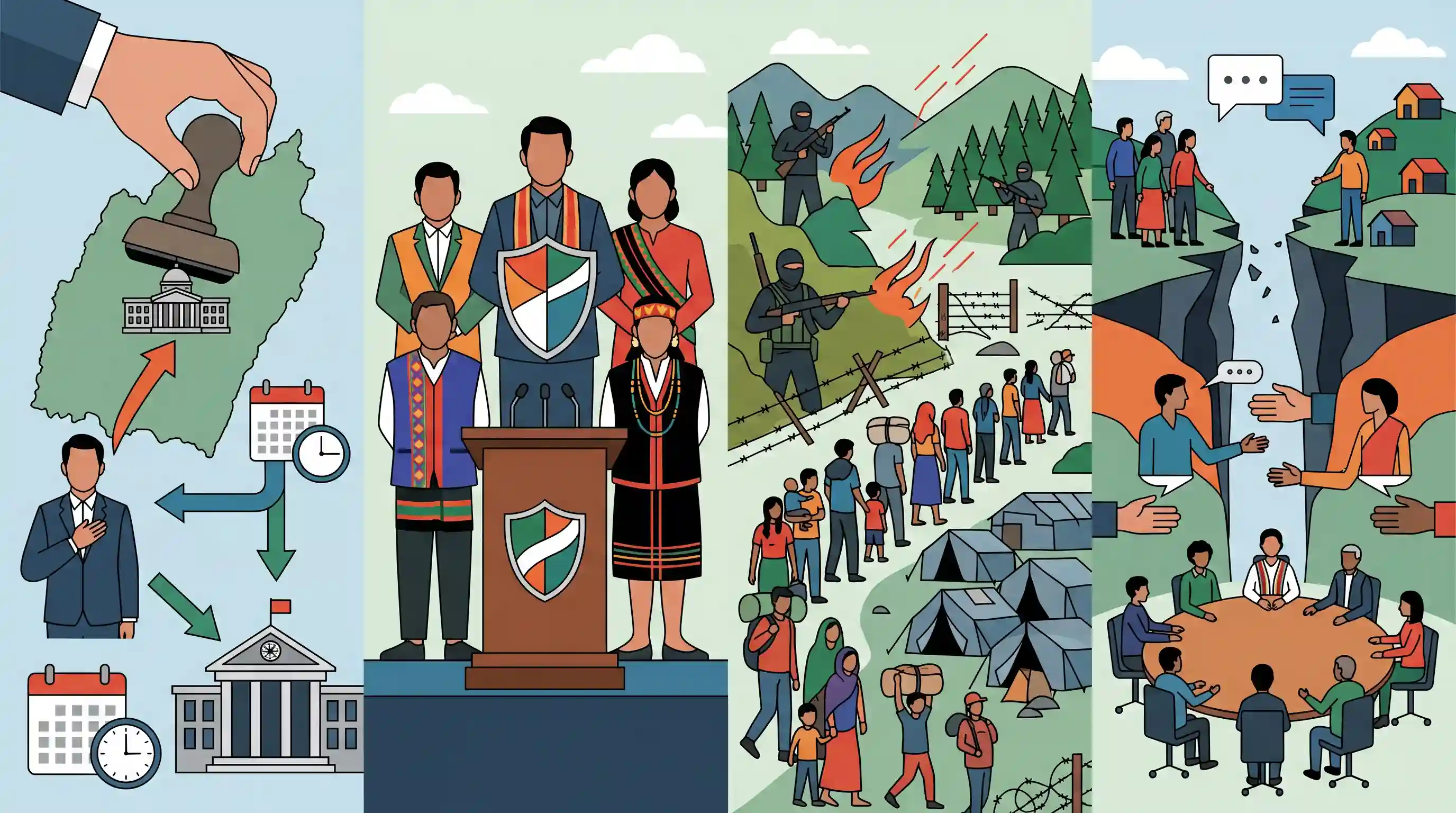
Following the revocation of President's Rule in Manipur, Yumnam Khemchand Singh has been appointed as the new Chief Minister. The move circumvents the need for a constitutional amendment to extend central rule while aiming to restore democratic governance ahead of assembly elections. The new leadership features deputies from the Kuki-Zo and Naga communities to project inclusivity. However, severe internal security and humanitarian crises persist, marked by the influence of armed radical groups and the massive displacement of 60,000 people. True reconciliation between the Meitei and Kuki-Zo communities demands more than political optics; it requires sustained dialogue to bridge the trust deficit and address demands for separate administration.
Key Points
- President's Rule in Manipur was revoked just under a year after it was imposed, allowing Yumnam Khemchand Singh (BJP) to be sworn in as the 13th Chief Minister.
- The revocation avoided the necessity of passing a Constitution Amendment Bill in Parliament, which is required to extend President's Rule beyond one year.
- Leadership appointments were designed to foster inclusivity, featuring two Deputy Chief Ministers representing the Kuki-Zo (Nemcha Kipgen) and Naga (Losii Dikho) communities.
- The state faces severe internal security challenges, with armed radical groups retaining influence and only 9,000 of the 60,000 displaced persons having returned home due to a profound trust deficit.
- The editorial emphasizes that token political appointments are insufficient; true stability requires inclusive dialogue to address contentious issues like Kuki-Zo demands for a separate administration and to reconcile the Meitei and Kuki-Zo communities.
Important Terms
Article 356 (President's Rule)

Provision allowing the Union government to assume direct control of a state's administration when its constitutional machinery fails, typically placing the Governor in charge of executive functions.
UPSC context
GS-II Polity; crucial for understanding Union-State relations, federalism, and the limits of emergency powers.
Separate Administration
A political demand by Manipur's Kuki-Zo community for a distinct administrative structure—such as a Union Territory—independent of the Meitei-dominated state government to ensure autonomy and security.
UPSC context
GS-III Internal Security; relates to regionalism, ethnic conflict, and the constitutional challenges of territorial integrity.
Article 371C
A special constitutional provision for Manipur that empowers the President to establish a Hill Areas Committee of tribal legislators to protect the interests of tribes in the state's hilly regions.
UPSC context
GS-II Polity; key example of asymmetric federalism and protection of tribal rights in the North-East.
Kuki-Zo
An umbrella identity for hill tribes in Manipur (including Kuki, Zomi, and Hmar) sharing ethnic and cultural links with the Mizo people of India and the Chin people of Myanmar.
UPSC context
GS-III Internal Security; vital for analyzing ethnic demographics and conflict origins in India's border states.
Suspension of Operations (SoO) Agreement
A tripartite ceasefire agreement between the Central government, the Manipur government, and Kuki insurgent groups aimed at halting violence and facilitating political dialogue.
UPSC context
GS-III Security; tests understanding of peace-making efforts and state negotiations with insurgent groups.
Meitei Community
The majority ethnic group in Manipur, predominantly inhabiting the Imphal Valley, mostly following Hinduism and having a long history of cultural and political influence in the state.
UPSC context
GS-III Internal Security; central to the study of ethnic tensions and Scheduled Tribe status debates in Manipur.
Prelims Trap
"Extending President's Rule beyond one year always requires a Constitutional Amendment."
Under Article 356(5), it can be extended up to 3 years without an amendment if a National Emergency is active AND the Election Commission certifies difficulties in holding elections.
Static Concepts Connected
What are the conditions for extending President's Rule beyond one year?
- General limit: President's rule can be extended by Parliament every 6 months, up to a maximum of 3 years.
- Emergency condition: The 44th Amendment requires a National Emergency to be in operation (in the whole country or that state) to cross the 1-year mark.
- EC Certification: The Election Commission must certify that holding state legislative assembly elections is currently difficult. Without these conditions, a constitutional amendment is required.
What constitutional frameworks govern tribal autonomy and administration in Manipur?
- Article 371C: Provides special provisions for Manipur, mandating the creation of a Hill Areas Committee comprising MLAs elected from the state's hill districts.
- District Councils: Governed by the Manipur (Hill Areas) District Councils Act, 1971. These councils lack the legislative and judicial autonomy enjoyed by ADCs under the 6th Schedule.
- Sixth Schedule absence: Unlike tribal areas in Assam, Meghalaya, Tripura, and Mizoram, Manipur's hill districts are not protected under the 6th Schedule, driving demands for separate administration (Article 239A).
Cross-Topic Patterns
Article 356 + EC Certification powers
The Election Commission's power to certify election difficulties under Article 356(5) links state emergency provisions directly with Article 324, making it a prime target for multi-statement Prelims questions on constitutional checks.
Internal Security + Suspension of Operations (SoO)
The crisis highlights the fragility of Suspension of Operations (SoO) pacts with armed insurgent groups, directly connecting domestic ethnic violence in the Northeast with border management and the suspended FMR with Myanmar.

Expect a 2026 Prelims question mixing Article 356(5) extension rules with the Election Commission’s specific certification powers.
Linked PYQs · 4
Linked PYQs · 4
- 2019MainsGS3
Cross-border movement of insurgents is only one of the several security challenges facing the policing of the border in North-East India. Examine the various challenges currently emanating across the India-Myanmar border. Also, discuss the steps to counter the challenges.
- 2025MainsGS3
What are the major challenges to internal security and peace process in the North-Eastern States? Map the various peace accords and agreements initiated by the government in the past decade.
- 2017MainsGS3
The North-East region of India has been infested with insurgency for a very long time. Analyze the major reasons for the survival of armed insurgency in this region.
- 2023MainsGS2
Account for the legal and political factors responsible for the reduced frequency of using Article 356 by the Union Governments since mid 1990s.
