Jodhpur administration resolves long standing urban flooding crisis
Source:Indian Masterminds ↗
Why It Matters
This case study is highly relevant for RPSC RAS candidates studying Public Administration, State Administration, and Urban Development in Rajasthan. It offers a practical illustration of overcoming multi-agency administrative bottlenecks (JoDA, PWD, Railways), innovative municipal infrastructure planning, and community engagement to solve long-term public grievances.
Summary
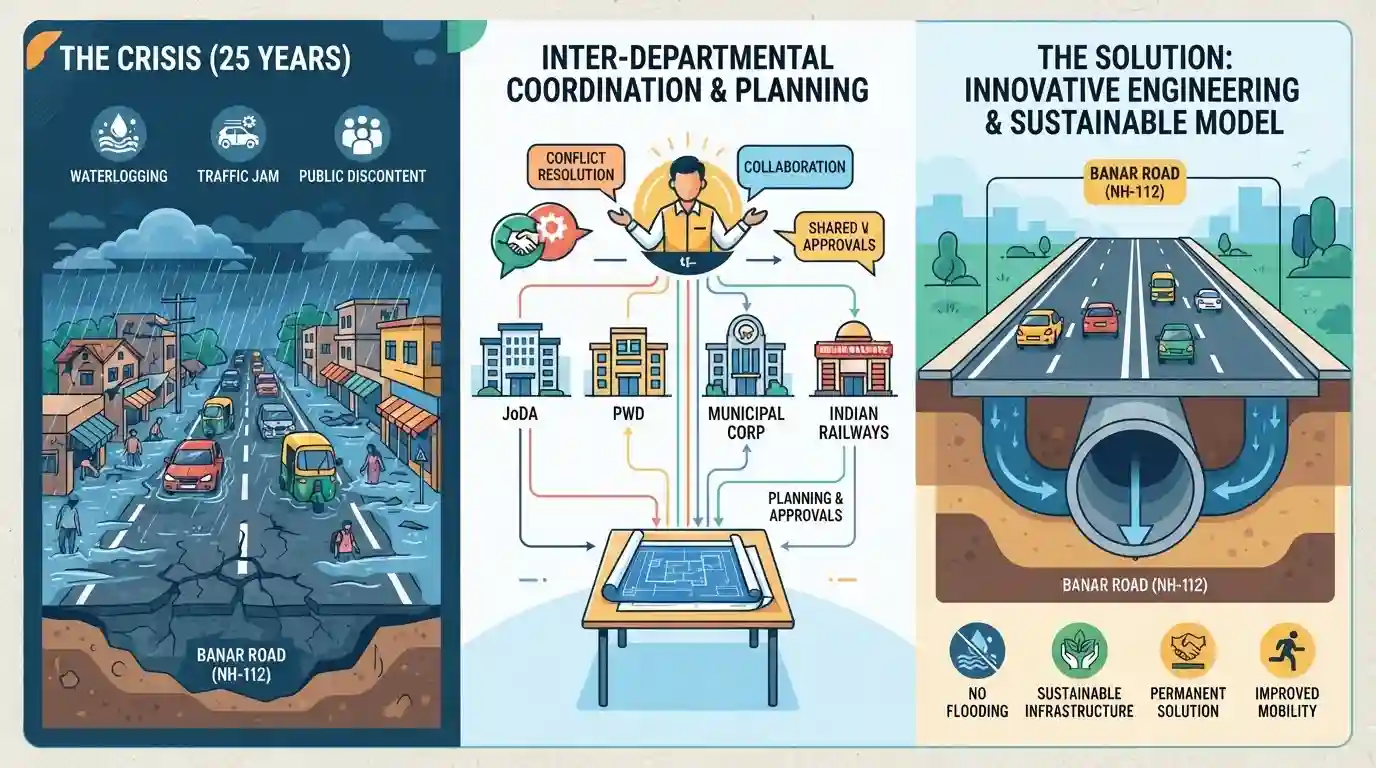
This article outlines how IAS officer Gaurav Agrawal (as Jodhpur Collector) successfully resolved a 25-year-old urban flooding and waterlogging crisis along Jodhpur's Banar Road (NH-112). By implementing an innovative engineering design—where the main drainage channel was placed directly under the road carriageway—and resolving complex inter-departmental conflicts among JoDA, PWD, Municipal Corporation, and Indian Railways, the administration created a sustainable model for urban governance and infrastructure coordination in Rajasthan.
Key Points
- Banar Road, a major national highway connecting Jodhpur with Jaipur, suffered from chronic flooding and waterlogging for over 25 years during every monsoon season due to natural drainage blockage caused by rapid urban expansion.
- Under the leadership of the then Jodhpur District Collector Gaurav Agrawal (IAS, 2014-batch), a coordinated governance and engineering initiative was undertaken in 2024 to resolve the persistent crisis.
- Innovative Engineering: To overcome the lack of physical space for utility shifting (water pipelines, power cables, sewer augmentation), the administration designed a covered 20-foot wide reinforced concrete drain constructed directly underneath the road carriageway, doubling as the road surface.
- Inter-Departmental Coordination: The project successfully negotiated ownership disputes of the old highway between the Public Works Department (PWD) and Jodhpur Development Authority (JoDA), which formally took over the road to issue the necessary No Objection Certificate (NOC).
- Overcoming Administrative Deadlocks: Alignment challenges with the Indian Railways were bypassed by rerouting the drain around railway land. Collaborative efforts between JoDA and municipal officials (including Siddharth Palanichamy) resolved long-standing financial disputes and cleared pending projects at Kharbuja Bawri and Derby area.
- Social Consensus and Public Trust: The administration mitigated local resident protests in narrow lanes by constructing temporary connectivity bridges, upgrading streetlights, providing alternative access routes, and proving the design's efficacy using temporary channels during early rains in 2025.
Important Terms
Jodhpur Development Authority (JoDA)

A statutory parastatal body responsible for the planned urban development, infrastructural expansion, and land regulation within the Jodhpur metropolitan area in Rajasthan.
UPSC context
GS Paper II (Urban Governance). Highlights the role of parastatal agencies and inter-departmental coordination in resolving urban crises.
Public Works Department (PWD)
A state government department tasked with the planning, construction, and maintenance of public physical assets, including government buildings, state highways, and major drainage systems.
UPSC context
GS Paper II & III (Governance & Infrastructure). Vital for analyzing state-level infrastructure execution and resolving bureaucratic bottlenecks.
Jodhpur Municipal Corporation
The primary Urban Local Body (ULB) governing Jodhpur, tasked with delivering essential civic amenities, managing waste and sanitation, and maintaining local public infrastructure.
UPSC context
GS Paper II (Local Self-Government). Crucial for understanding the 74th Amendment Act, devolution of powers, and urban civic administration.
Indian Railways
The national railway system operated by the Ministry of Railways. In urban infrastructure projects, it serves as a critical stakeholder for granting utility clearances and right-of-way permissions.
UPSC context
GS Paper III (Infrastructure). Demonstrates the need for robust multi-agency coordination to resolve right-of-way and financial disputes in public projects.
National Highways Authority of India (NHAI)
An autonomous statutory agency under the Ministry of Road Transport and Highways, mandated to develop, maintain, and manage the national highway network across India.
UPSC context
GS Paper III (Infrastructure). Central to evaluating statutory bodies managing road infrastructure and their role in national economic growth.
Prelims Trap
National Highways in urban areas fall exclusively under the jurisdiction of NHAI for maintenance.
As cities expand, sections of National Highways passing through urban limits are often transferred to local PWDs or urban development authorities for maintenance.
Static Concepts Connected
What are the primary causes of Urban Flooding per NDMA guidelines?
- Meteorological factors: Heavy rainfall, cyclonic storms, and thunderstorms exacerbated by micro-climatic changes in urban heat islands.
- Human/Urban factors: Concretization of catchments, encroachment on natural drainage channels, and poor solid waste management choking sewer lines.
- Administrative factors: Lack of coordination among multiple parastatal agencies leading to disjointed drainage networks.
What is the statutory role of a District Magistrate in disaster management?
- DDMA Chairperson: The DM serves as the ex-officio Chairperson of the District Disaster Management Authority (DDMA).
- Inter-agency Coordination: Acts as the focal point for harmonizing the response of local police, PWD, municipalities, and health departments.
- Resource Mobilization: Legally empowered to requisition resources, vehicles, and premises for rescue and relief operations during crises.
Cross-Topic Patterns
Urban Flooding & 74th CAA
The turf war between JoDA, PWD, and the Municipal Corporation highlights incomplete devolution under the 74th Amendment, exposing overlapping jurisdictions among parastatal bodies.
Governance Case Studies in GS IV
Resolving infrastructure deadlocks via public consensus and inter-agency bureaucratic negotiation serves as a high-value, practical example for GS IV administrative ethics case studies.

Expect a 2026 GS-IV case study or GS-III question linking urban flooding mitigation to inter-departmental silos and parastatals.
Linked PYQs · 2
Linked PYQs · 2
- 2023RPSC_PRELIMSGS1
Which of the following is not a part of the Rajasthan Urban Drinking Water, Sewage and Infrastructure Corporation Limited?
- 2025RPSC_PRELIMSGS1
What is the main objective of the “Rajasthan Urban Area Development Program (Phase-III)”?
