JMM Opts Out of Bihar Elections Citing Alliance Friction
Source:Indian Express ↗
Why It Matters
Multi-party alliances and coalition politics are defining features of India's political landscape. Frictions over seat-sharing between national and regional parties demonstrate the competing priorities of political survival and alliance unity, a frequent analytical theme in GS2 governance and polity questions.
Summary
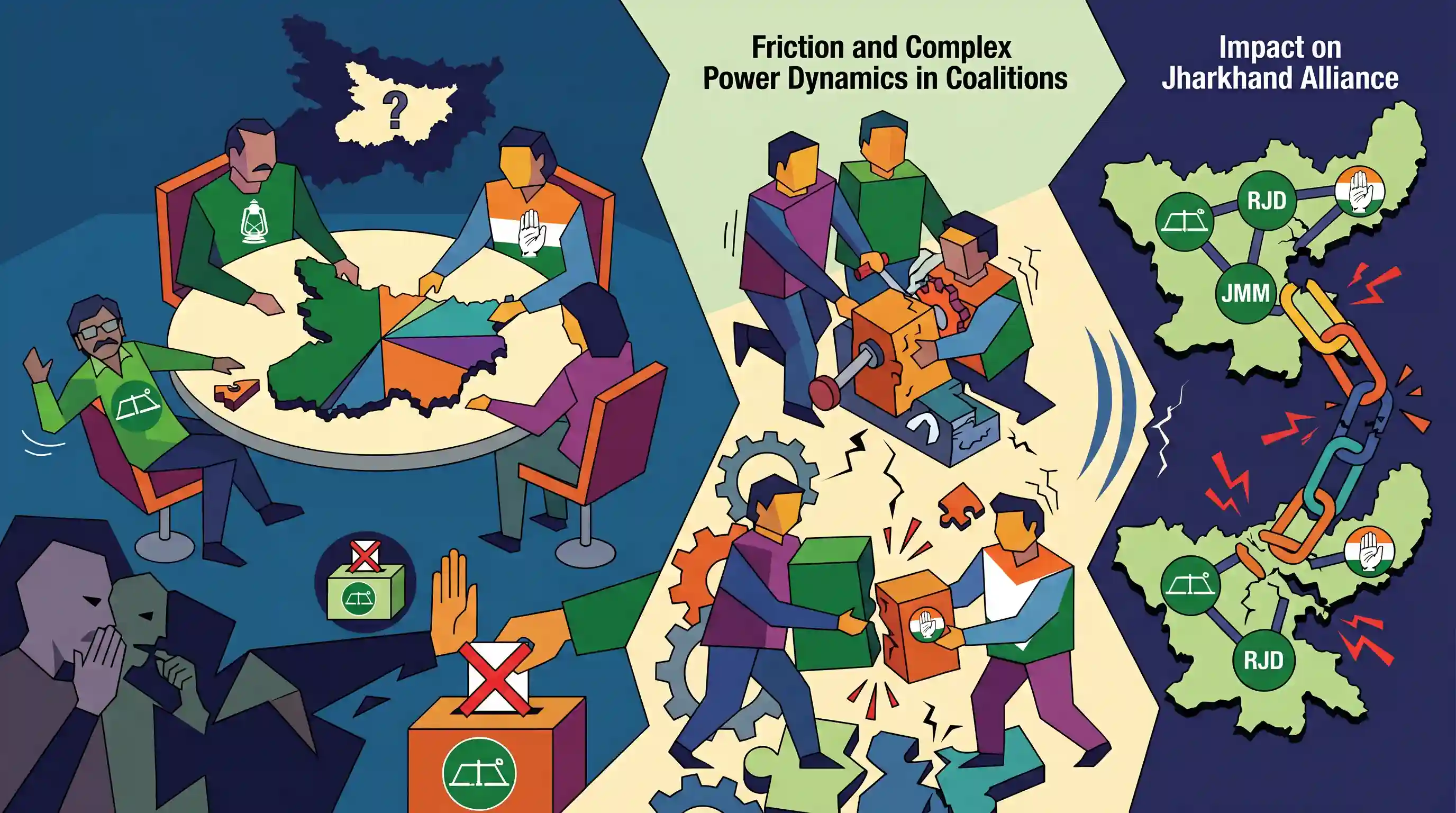
The Jharkhand Mukti Morcha (JMM) has decided against contesting the upcoming Bihar assembly elections, blaming an alleged 'political conspiracy' by its allies, the Rashtriya Janata Dal (RJD) and the Congress. The JMM claimed it was ignored during seat-sharing negotiations within the Mahagathbandhan alliance in Bihar. This development highlights the inherent friction and complex power dynamics within multi-party coalitions in India, potentially casting a shadow over the existing alliance between these parties in the neighboring state of Jharkhand.
Key Points
- The Jharkhand Mukti Morcha (JMM) has announced it will not contest the upcoming Bihar assembly elections.
- JMM leadership alleged a 'political conspiracy' by its alliance partners, RJD and Congress, accusing them of systematically ignoring JMM's demand for a fair share of seats.
- The JMM had initially identified specific seats to contest in Bihar and warned of fielding candidates independently if seat-sharing talks failed.
- This fallout in Bihar threatens to strain the broader alliance between JMM, RJD, and Congress, which currently rules the neighboring state of Jharkhand.
Important Terms
Jharkhand Mukti Morcha (JMM)

A Jharkhand-based regional party founded in 1973 by Shibu Soren and others. It spearheaded the movement for Jharkhand's statehood and focuses on Adivasi rights, tribal nationalism, and democratic socialism.
UPSC context
GS II: Regionalism and State Parties. Tests understanding of how regional movements reshape India's federal structure and state reorganization.
Rashtriya Janata Dal (RJD)
A Bihar-based regional party founded in 1997 by Lalu Prasad Yadav. It advocates for "social justice" and secularism, drawing significant support from Other Backward Classes (OBCs) and Muslims.
UPSC context
GS II: Political Parties. Relevant for studying the intersection of caste and politics and the influence of regional leaders in coalition dynamics.
Indian National Congress (INC)
India's oldest political party, founded in 1885. A national party with a "big tent" centrist ideology, it has transitioned from decades of single-party dominance to being a key coalition player.
UPSC context
GS II: Party System. Tests knowledge of national party recognition criteria and the evolution of the Indian party system.
Mahagathbandhan
Literally "Grand Alliance," a coalition of parties in Bihar (primarily RJD, INC, and Left parties) formed to consolidate anti-NDA votes through a common electoral front.
UPSC context
GS II: Coalition Governments. Examines the stability, ideological friction, and power-sharing challenges inherent in multi-party alliances in a parliamentary democracy.
Seat-sharing
A pre-electoral negotiation where alliance partners agree on which specific constituencies each will contest to prevent splitting the vote against a common political opponent.
UPSC context
GS II: Electoral Politics. Tests understanding of election management, alliance strategies, and the practical challenges of maintaining coalition harmony.
Prelims Trap
"Pre-poll alliances are recognized as a single political entity under the Anti-Defection Law (10th Schedule)."
The 10th Schedule penalizes individual defectors but does not legally bind political parties to pre-poll alliances. Switching alliance partners post-election does not invite disqualification under current anti-defection laws.
Static Concepts Connected
What are the criteria for a political party to be recognized as a State Party?
- Vote + Seat Quota: Secure at least 6% of valid votes in a State Assembly election and win a minimum of 2 seats.
- Assembly Seat Quota: Win at least 3% of the total number of seats in the Legislative Assembly or 3 seats, whichever is higher.
- Alternative Vote Quota: Secure 8% of the total valid votes polled in the state during an Assembly or Lok Sabha election (no seat requirement).
How should a Governor invite parties in a hung assembly under Sarkaria guidelines?
- First Preference: The Governor must first invite a pre-poll alliance of parties that commands a majority.
- Second Preference: If no alliance has a majority, invite the single largest party staking a claim to form the government with the support of others.
- Third Preference: If still unresolved, invite a post-poll coalition of parties joining together to form a government.
Cross-Topic Patterns
Coalition Politics & Federalism
The rise of state-level alliances directly impacts Centre-State dynamics, often forcing national parties to cede policy autonomy to regional partners and reinforcing cooperative federalism.
10th Schedule & Post-Poll Alliances
Frequent alliance breakdowns highlight a statutory gap where entire parties can switch post-poll partners without triggering the 10th Schedule, prompting debates around the Law Commission's 170th report.

Expect a multi-statement Prelims question testing the Sarkaria Commission's guidelines on pre-poll alliances and Governor's discretion.
Linked PYQs · 2
Linked PYQs · 2
- 2022MainsGS2
“While the national political parties in India favour centralisation, the regional parties are in favour of State autonomy.” Comment.
- 2017PrelimsGS1
Consider the following statements: 1. The Election Commission of India is a five-member body. 2. Union Ministry of Home Affairs decides the election schedule for the conduct of both general elections and bye-elections. 3. Election Commission resolves the disputes relating to splits/mergers of recognised political parties. Which of the statements given above is/are correct?
