JK Budget Session Functioning of Union Territory Legislature
Source:Indian Express ↗
Why It Matters
The resumption of the budget session in the J&K Assembly is an important practical example of the functioning of a Union Territory with a legislature. It underscores the provisions of the J&K Reorganisation Act, 2019, making it highly relevant for Polity and Governance topics in GS Paper 2.
Summary
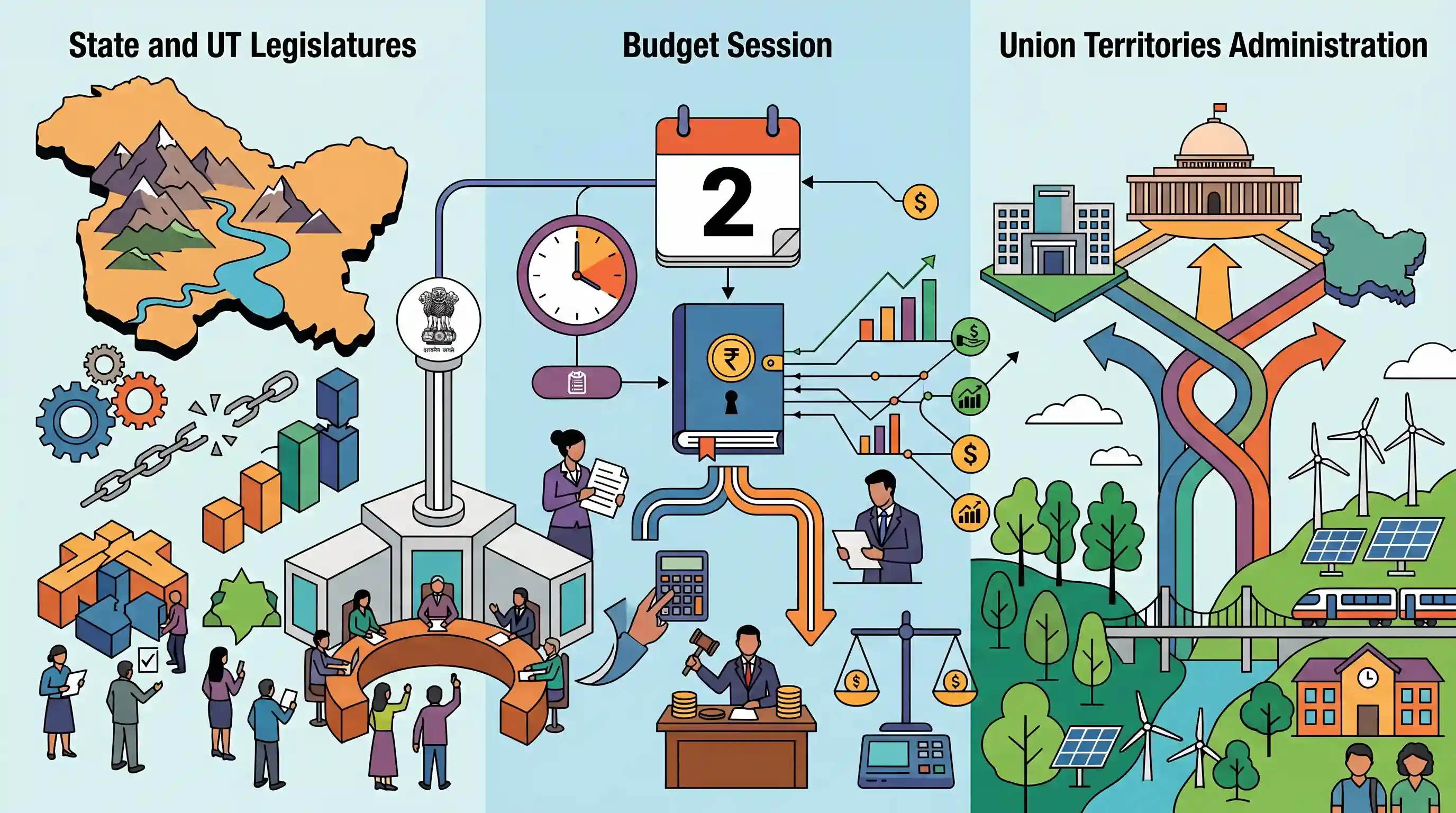
The Union Territory of Jammu and Kashmir is set to commence its Budget session on February 2. The session will be conducted in two parts, marking a significant milestone in the legislative and financial administration of the newly elected UT assembly. This development reflects the ongoing operationalization of democratic and legislative processes in J&K following the J&K Reorganisation Act of 2019.
Key Points
- The Budget session for the Union Territory of Jammu & Kashmir is scheduled to begin on February 2.
- The session will be held in two parts, adopting a format that allows legislative committees to scrutinise the budgetary demands for grants in the interim.
- This marks a crucial step in the resumption of the local budget-making process and legislative functioning for J&K as a Union Territory with an elected assembly.
Important Terms
Jammu and Kashmir Reorganisation Act, 2019

A landmark parliamentary act that bifurcated the former State of Jammu and Kashmir into the Union Territories of Jammu & Kashmir (with legislature) and Ladakh (without legislature) from October 31, 2019.
UPSC context
GS Paper II (Polity & Governance). Tests knowledge of federalism, constitutional amendments, and administrative restructuring of regions.
Legislative Assembly of Jammu and Kashmir
The unicameral legislative body of the UT of J&K that can make laws on State List subjects except 'Public Order' and 'Police', and on the Concurrent List.
UPSC context
GS Paper II. Focuses on legislative powers of UTs and the specific constraints on J&K’s assembly compared to states.
Article 239A of the Indian Constitution
The constitutional provision, originally for Puducherry, applied to J&K to enable the creation of a local legislature and Council of Ministers to advise the Lieutenant Governor.
UPSC context
GS Paper II. Relevant for understanding the legal basis of UT governance and differences between Delhi, Puducherry, and J&K.
Lieutenant Governor (LG) of Jammu and Kashmir
The executive head of the UT of J&K, appointed by the President, with significant discretionary powers over police, public order, and the appointment of the Council of Ministers.
UPSC context
GS Paper II. Essential for analyzing the balance of power between the Centre's representative and the elected local government.
Annual Financial Statement
The constitutional document (Budget) detailing the estimated receipts and expenditure of the UT for a financial year, which must be presented before the Legislative Assembly.
UPSC context
GS Paper III (Economy) & GS Paper II (Financial Administration). Tests procedural knowledge of budget passage in a UT setting.
Delimitation Commission
A body tasked with redrawing boundaries of assembly and parliamentary constituencies; for J&K, it increased the number of seats to 90 following the 2019 reorganisation.
UPSC context
GS Paper II. Critical for topics related to elections, representation, and the democratic process in newly formed or restructured areas.
Prelims Trap
The J&K Legislative Assembly lacks the power to legislate on Police, Public Order, and Land, similar to the Delhi Assembly.
Unlike Delhi (Article 239AA), which excludes Police, Public Order, and Land, the J&K Reorganisation Act only excludes Police and Public Order. The J&K Assembly retains power over Land.
Static Concepts Connected
How does the J&K Legislature's constitutional basis differ from Delhi's?
- Article 239A (J&K): J&K operates similarly to Puducherry under Art 239A. Parliament enacted the Reorganisation Act 2019 to define its legislative powers, excluding only Police and Public Order.
- Article 239AA (Delhi): Delhi has special constitutional status directly via Art 239AA. Its legislative assembly is explicitly barred from legislating on Police, Public Order, and Land.
What is the procedural utility of a two-part Budget session?
- Committee Scrutiny: The recess period allows Departmentally Related Standing Committees (DRSCs) to technically and closely examine the Demands for Grants for various ministries.
- The Guillotine: Due to time limits, any undiscussed Demands for Grants are grouped together on the final day and put directly to a vote without debate.
- Vote on Account: Since the full budget isn't passed before the financial year begins, a Vote on Account funds operations during the interim recess period.
Cross-Topic Patterns
Asymmetric Federalism & UT Legislatures
The functioning of J&K's legislature under Article 239A is frequently contrasted with the special provisions for Delhi and full states, illustrating India's model of asymmetric federalism.
Parliamentary Financial Control & DRSCs
The two-part budget session and the Guillotine procedure link the UT’s local legislative processes with the broader UPSC theme of executive financial accountability to the legislature.

A comparative analysis of legislative powers of UTs (J&K vs Delhi vs Puducherry) over State List subjects is highly probable in 2026.
Linked PYQs · 2
Linked PYQs · 2
- 2025MainsGS2
Discuss the nature of Jammu and Kashmir Legislative Assembly after the Jammu and Kashmir Reorganization Act, 2019. Briefly describe the powers and functions of the Assembly of the Union Territory of Jammu and Kashmir.
- 2024PrelimsGS1
With reference to Union Budget, consider the following statements : 1. The Union Finance Minister on behalf of the Prime Minister lays the Annual Financial Statement before both the Houses of Parliament. 2. At the Union level, no demand for a grant can be made except on the recommendation of the President of India. Which of the statements given above is/are correct?
