Domestic Political Consensus on Pahalgam Terror Attack
Source:The Hindu ↗
Why It Matters
The article illustrates the multidimensional impact of terrorism in J&K—spanning domestic political unity against violence, the socio-cultural resilience of 'Kashmiriyat', and the immediate bilateral diplomatic and economic ruptures between India and Pakistan.
Summary
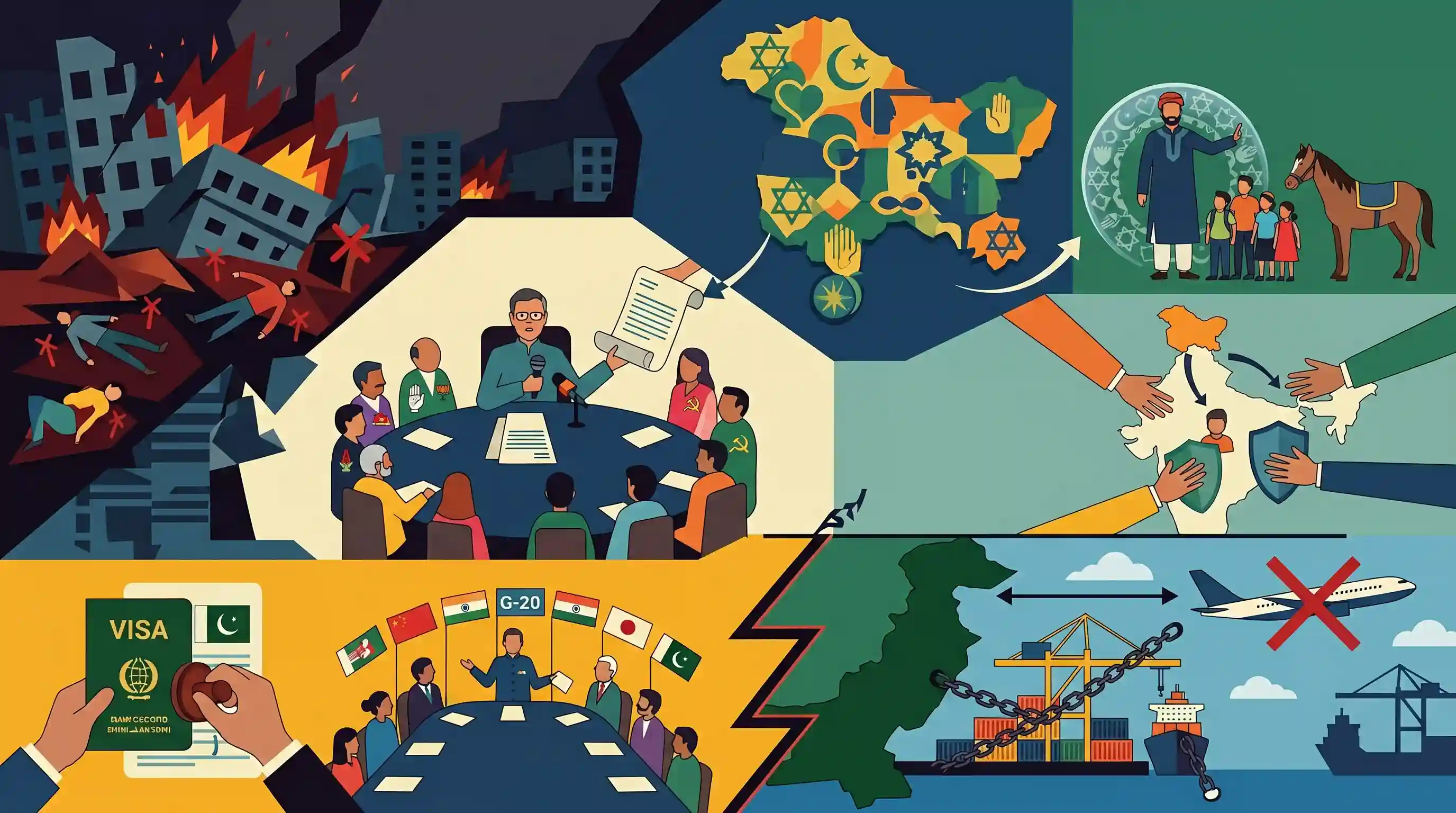
In response to the devastating Pahalgam terror attack that killed 26 civilians, an all-party meeting chaired by J&K Chief Minister Omar Abdullah passed a joint resolution condemning the violence as an attack on 'Kashmiriyat' and the pluralistic 'Idea of India'. The political spectrum united to honor the sacrifice of local pony operator Syed Adil Hussain Shah, who died saving tourists, while also urging states nationwide to protect Kashmiris working or studying away from home. Concurrently, the attack has led to a sharp diplomatic escalation, resulting in India revoking visas for Pakistani nationals, briefing G-20 envoys, and Pakistan suspending bilateral trade and closing its airspace.
Key Points
- An all-party meeting led by J&K CM Omar Abdullah unanimously condemned the Pahalgam terror attack, terming it an assault on Kashmiriyat and the 'Idea of India'.
- Political leaders highlighted the sacrifice of local pony operator Syed Adil Hussain Shah as the true embodiment of Kashmiri values in contrast to terrorism.
- The attack has triggered severe diplomatic fallout, with India revoking visas for Pakistani nationals and briefing G-20 envoys, while Pakistan snapped trade ties and closed its airspace to India.
- The resolution appealed to state and UT governments across India to ensure the safety of Kashmiri students and professionals residing outside J&K to prevent reprisal attacks.
Important Terms
Kashmiriyat

A centuries-old socio-cultural ethos of communal harmony and religious syncretism in the Kashmir Valley, emphasizing the shared heritage and peaceful coexistence between Muslims and Kashmiri Pandits.
UPSC context
GS Paper I (Society) and GS IV (Ethics); tests understanding of regional pluralism and communal harmony.
Idea of India
A constitutional and philosophical vision of India as a secular, democratic, and inclusive republic where citizenship is defined by belonging rather than religion, caste, or ethnicity.
UPSC context
GS Paper II (Polity) and GS I (Social Issues); tests awareness of foundational national values and secularism.
G-20
A major international forum for economic cooperation comprising 19 countries and the EU; in the J&K context, it serves as a platform for India to demonstrate regional normalcy.
UPSC context
GS Paper II (International Relations); tests knowledge of multilateral diplomacy and India’s global standing on the Kashmir issue.
Internal Security
The maintenance of peace and law within national borders against threats like cross-border terrorism, radicalization, and insurgency, particularly in sensitive regions like Jammu and Kashmir.
UPSC context
GS Paper III (Security); core topic focusing on terrorism, non-state actors, and border management.
National Conference (NC)
The oldest regional political party in Jammu and Kashmir, founded by Sheikh Abdullah; it historically advocated for state autonomy and currently leads the regional government.
UPSC context
GS Paper II (Polity); relevant for understanding regional political dynamics and J&K’s constitutional history.
Peoples Democratic Party (PDP)
A regional political party in J&K founded by Mufti Mohammed Sayeed, known for its ‘healing touch’ policy and advocacy for ‘self-rule’ and dialogue with stakeholders.
UPSC context
GS Paper II (Polity/Regional Parties); tests understanding of different political approaches to conflict resolution in Kashmir.
India-Pakistan Relations
The complex diplomatic, economic, and military interactions between the two South Asian neighbors, often dominated by the Kashmir dispute and cross-border security concerns.
UPSC context
GS Paper II (International Relations); key topic regarding neighborhood policy and regional stability.
Prelims Trap
"Closing sovereign airspace to civilian flights of a specific country violates the rules of the Chicago Convention."
Article 9 of the Chicago Convention explicitly permits states to restrict or prohibit flying over their territory in exceptional circumstances or for public safety and national security reasons.
Static Concepts Connected
How does the Chicago Convention govern airspace sovereignty during conflicts?
- Absolute Sovereignty: Article 1 grants every state complete and exclusive sovereignty over the airspace above its land territory and adjacent territorial waters.
- Security Exceptions: Article 9 allows states to restrict or prohibit the aircraft of other states from flying over their territory for reasons of military necessity or public safety.
- Freedoms of the Air: While the First Freedom grants overflight rights, sovereign states have the authority to suspend these transit rights during severe diplomatic standoffs or security crises.
What is the 'Hearts and Minds' (WHAM) strategy in counter-insurgency?
- Core Objective: Aimed at winning local population support to isolate insurgents, effectively cutting off their safe havens, intelligence networks, and logistical supply chains.
- Civic Action: Implemented through military-led welfare initiatives like the Indian Army's 'Operation Sadbhavana' in J&K, focusing on education, health, and community infrastructure.
- Ideological Counter: Leveraging syncretic cultural identities, such as 'Kashmiriyat', to ideologically counter extremist radicalization and foster emotional integration with the national mainstream.
Cross-Topic Patterns
Airspace weaponization + Economic Geography
Mutual airspace closures force civilian flights to reroute significantly, exponentially increasing fuel burn, operational costs, and carbon emissions for international aviation routes connecting South Asia to the West.
Security exceptions in Trade (WTO)
Snapping trade ties over terror incidents invokes GATT Article XXI (Security Exception), allowing a country to breach its WTO obligations to protect its essential security interests.

Expect a 2026 prelims question testing the Chicago Convention's provisions on airspace sovereignty alongside WTO's national security exceptions.
Linked PYQs · 3
Linked PYQs · 3
- 2023MainsGS3
Winning of 'Hearts and Minds' in terrorism-affected areas is an essential step in restoring the trust of the population. Discuss the measures adopted by the Government in this respect as part of the conflict resolution in Jammu and Kashmir.
- 2015MainsGS2
Terrorist activities and mutual distrust have clouded India-Pakistan relations. To what extent the use of soft power like sports and cultural exchanges could help generate goodwill between the two countries? Discuss with suitable examples.
- 2022MainsGS1
Are tolerance, assimilation and pluralism the key elements in the making of an Indian form of secularism? Justify your answer.
