J&K Militancy Rehabilitation Scheme Leaves Out Security Victims
Source:The Hindu ↗
Why It Matters
Highlights the complex challenges of conflict resolution and winning 'hearts and minds' in J&K, showing how asymmetric rehabilitation policies can exacerbate grievances regarding state accountability and human rights violations by security forces.
Summary
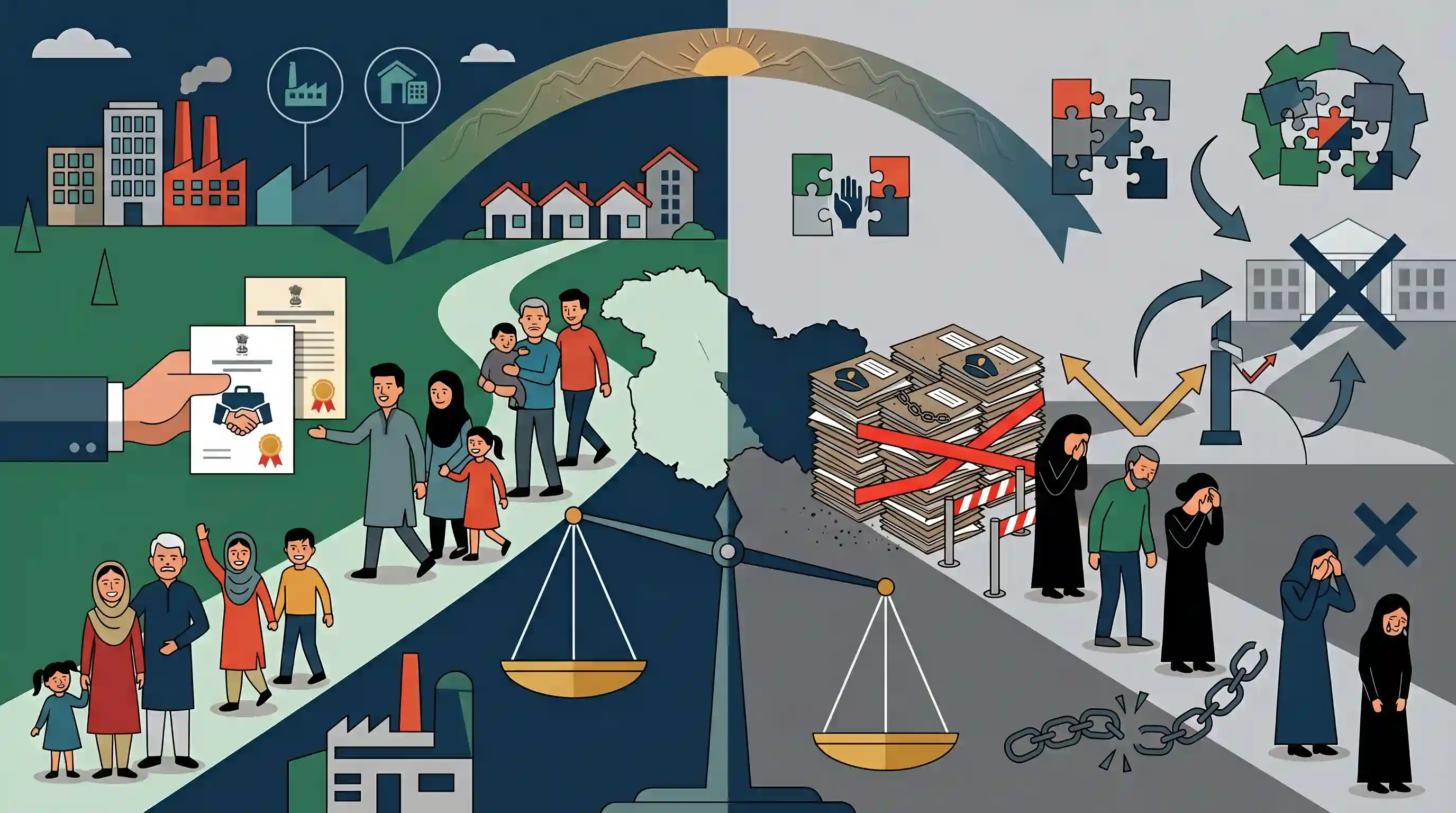
Jammu & Kashmir Lieutenant Governor Manoj Sinha has recently promised government jobs under the SRO-43 scheme to "militancy-affected families". However, this initiative has been heavily criticized by some residents for enforcing an "asymmetry policy", as it completely excludes the families of individuals who were killed in incidents involving security forces. Victim families—such as the Farooqis, whose relatives were killed by the Border Security Force (BSF) in 1992—argue that their police FIRs have gathered dust for decades without active investigation. Furthermore, appeals to statutory bodies like the National Human Rights Commission (NHRC) have not resulted in any justice, comparable rehabilitation, or administrative accountability. This discrepancy highlights the enduring complexities of conflict resolution in the region and raises significant questions about equitable state rehabilitation policies, human rights violations, and the necessity of establishing comprehensive accountability mechanisms for security forces in insurgency-affected areas.
Key Points
- J&K L-G Manoj Sinha announced a scheme providing government jobs under SRO-43 to families affected by militancy.
- The scheme explicitly covers only victims of militant violence, omitting those whose kin were killed by security forces.
- Families of victims of security force violence argue this is an "asymmetry policy", noting their cases remain in legal limbo with no accountability, compensation, or job offers.
- The issue underscores unresolved human rights concerns in J&K, with past appeals to the NHRC yielding no results for affected families.
Important Terms
SRO-43

A 1994 Jammu & Kashmir regulation providing compassionate government appointments or compensation to families of government employees or civilians killed in militancy-related incidents. Now replaced by the 2022 Rehabilitation Scheme.
UPSC context
GS Paper II (Governance/Social Justice); tests regional rehabilitation policies and administrative equity in conflict zones.
Lieutenant Governor (L-G)
The constitutional administrator of a Union Territory; in Jammu & Kashmir, the L-G holds expansive executive powers over 'Police', 'Public Order', and 'Services' under the 2019 Reorganisation Act.
UPSC context
GS Paper II (Polity/Federalism); essential for understanding Union Territory administration and the 2019 Reorganisation framework.
National Human Rights Commission (NHRC)
An independent statutory body established under the Protection of Human Rights Act, 1993, to investigate violations and recommend remedial measures to the government.
UPSC context
GS Paper II (Statutory Bodies); tests the watchdog's role, limitations, and the non-binding nature of its recommendations.
Border Security Force (BSF)
A Central Armed Police Force (CAPF) under the Ministry of Home Affairs, primarily tasked with guarding India's borders with Pakistan and Bangladesh and performing counter-insurgency duties.
UPSC context
GS Paper III (Internal Security); involves the mandate and deployment of security forces in insurgency-hit regions.
Jammu & Kashmir Reorganisation Act, 2019
The landmark 2019 legislation that bifurcated the state of Jammu and Kashmir into two Union Territories—J&K (with legislature) and Ladakh (without legislature)—and extended all Central laws.
UPSC context
GS Paper II (Polity); foundational for questions regarding J&K's legal status, Article 370 repeal, and administrative restructuring.
Internal Security
The maintenance of peace and law within a country's borders, specifically addressing threats like militancy, insurgency, and ethnic conflict that challenge state sovereignty.
UPSC context
GS Paper III (Security); the overarching theme for J&K conflict resolution, border management, and counter-terrorism policies.
Prelims Trap
The NHRC can independently investigate human rights violations committed by the armed forces.
Under Section 19 of the Protection of Human Rights Act, 1993, the NHRC cannot independently investigate the armed forces; it can only seek a report from the Centre.
Static Concepts Connected
What are the NHRC's powers regarding complaints against the armed forces?
- Report seeking: NHRC can only call for a report from the Central Government regarding complaints of rights violations by the armed forces.
- Recommendations: After receiving the government's report, the NHRC can either drop the matter or make recommendations to the government.
- No independent probe: It lacks the statutory power to independently investigate incidents or directly summon armed forces personnel for questioning.
What legal immunity does the Armed Forces (Special Powers) Act (AFSPA) provide?
- Prior sanction: AFSPA prohibits prosecution, suit, or legal proceedings against personnel without the Central Government's prior sanction.
- Operational powers: Grants authority to use force, arrest without a warrant, and search premises on mere suspicion in designated 'disturbed areas'.
- Good faith clause: Personnel are legally protected for any actions taken or purported to be taken 'in good faith' under the Act.
Cross-Topic Patterns
AFSPA impunity + NHRC limitations
A classic Polity-Internal Security overlap where statutory constraints (PHRA Sec 19 and AFSPA Sec 7) collectively bar civilian redressal in conflict zones.
Asymmetric welfare + WHAM doctrine
Selective state compensation schemes undermine the 'Winning Hearts and Minds' (WHAM) counter-insurgency doctrine by fueling alienation, a frequent theme in Mains GS3.

Expect a 2026 Prelims question testing the exact limits of NHRC's jurisdiction over armed forces alongside AFSPA prior-sanction rules.
Linked PYQs · 3
Linked PYQs · 3
- 2023MainsGS3
Winning of 'Hearts and Minds' in terrorism-affected areas is an essential step in restoring the trust of the population. Discuss the measures adopted by the Government in this respect as part of the conflict resolution in Jammu and Kashmir.
- 2015MainsGS3
Human rights activists constantly highlight the view that the Armed Forces (Special Powers) Act, 1958 (AFSPA) is a draconian act leading to cases of human rights abuses by the security forces. What sections of AFSPA are opposed by the activists? Critically evaluate the requirement with reference to the view held by the Apex Court.
- 2014MainsGS2
National Human Rights Commission (NHRC) in India can be most effective when its tasks are adequately supported by other mechanisms that ensure the accountability of a government. In light of the above observation assess the role of NHRC as an effective complement to the judiciary and other institutions in promoting and protecting human rights standards.
