JK LG Invokes Article 311 to Dismiss Employees for Terror Links
Source:The Hindu ↗
Why It Matters
The use of Article 311(2)(c) to dismiss civil servants without inquiry highlights the tension between national security imperatives and constitutional safeguards for government employees. It is highly relevant for GS-2 (Constitutional provisions, civil services) and GS-3 (Internal security, terrorism, and conflict resolution in border states).
Summary
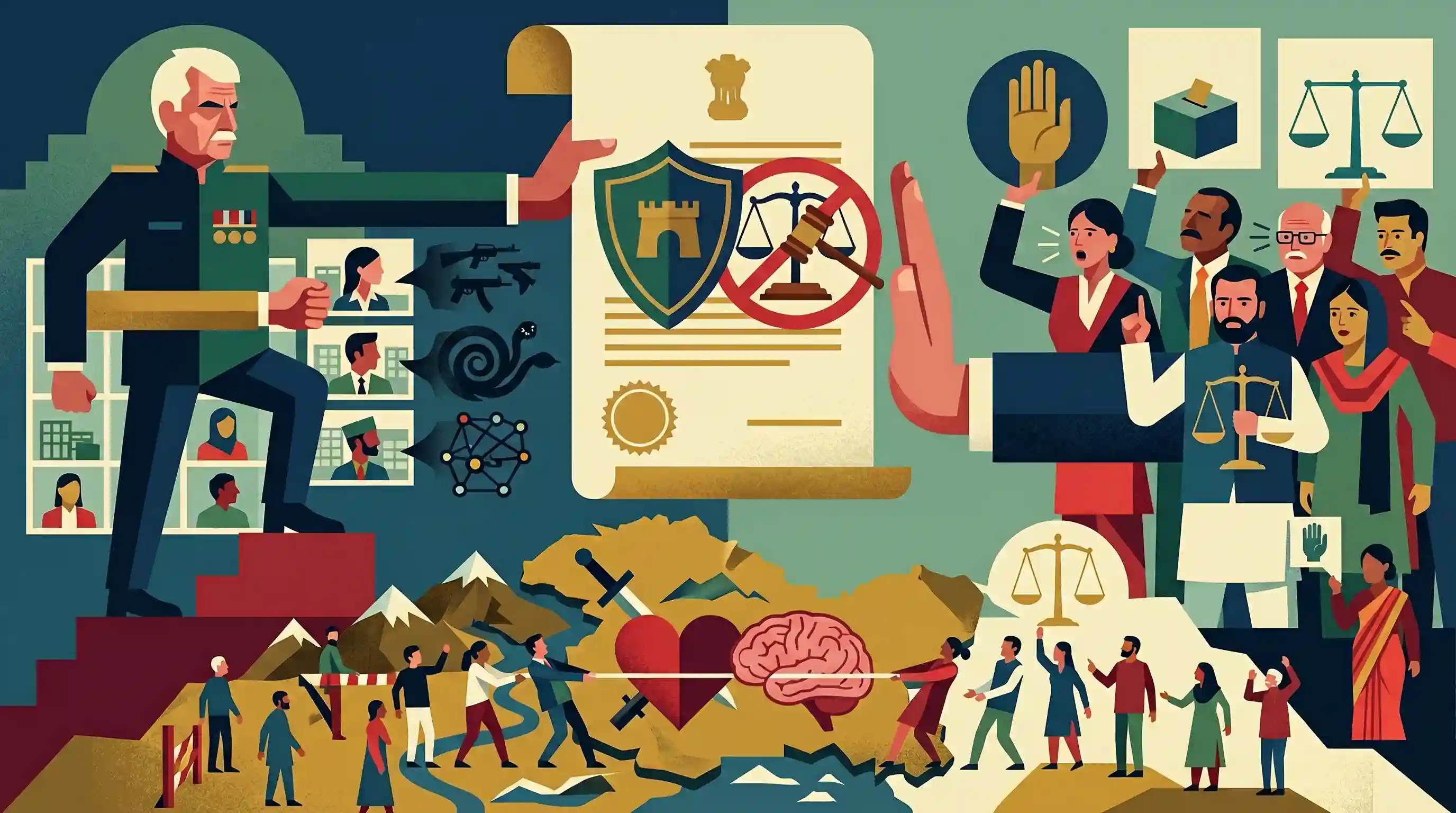
The Jammu and Kashmir administration, led by Lieutenant Governor Manoj Sinha, dismissed three government employees over alleged associations with terror organizations Lashkar-e-Taiba and Hizbul Mujahideen. The dismissals were executed invoking Article 311(2)(c) of the Constitution, which permits the termination of civil servants without holding a formal departmental inquiry if it is deemed necessary for the security of the State. The employees were accused of facilitating terror logistics and radicalization. However, local political leaders have condemned the move, stating that denying a fair trial goes against democratic principles and counteracts the goal of winning the 'hearts and minds' of the local populace in conflict resolution.
Key Points
- J&K Lieutenant Governor Manoj Sinha sacked three government employees, including two teachers, for alleged links to terror outfits LeT and Hizbul Mujahideen.
- The terminations were carried out under Article 311(2)(c) of the Constitution, which allows the Governor to dismiss employees without a departmental inquiry in the interest of state security.
- The individuals were accused of organizing terror logistics, terror financing, and radicalizing youth.
- Regional political leaders criticized the summary dismissals, arguing they violate the right to a fair trial and undermine efforts at political reconciliation in J&K.
Important Terms
Article 311 of the Constitution

Constitutional provision providing safeguards to civil servants against arbitrary dismissal or rank reduction. It requires a formal inquiry and a reasonable opportunity for the employee to be heard before termination.
UPSC context
GS Paper 2: Governance and Polity. Tests understanding of civil service safeguards and executive accountability.
Article 311(2)(c)
A specific proviso allowing the President or Governor/L-G to dismiss a civil servant without an inquiry if satisfied that such an inquiry is inexpedient for the security of the State.
UPSC context
GS Paper 2 & 3: Constitutional exceptions and Internal Security. Focuses on the trade-off between natural justice and state security.
Doctrine of Pleasure
A constitutional principle (Article 310) stating civil servants serve at the will of the executive head, though in India, it is limited by procedural safeguards under Article 311.
UPSC context
GS Paper 2: Indian Constitution. Tests knowledge of the tenure of civil servants and limitations on executive power.
Lashkar-e-Taiba (LeT)
A Pakistan-based, UN-designated terrorist organization primarily active in Jammu and Kashmir. It is listed under India's Unlawful Activities (Prevention) Act (UAPA) for various cross-border terror acts.
UPSC context
GS Paper 3: Internal Security. Relates to non-state actors and challenges to India’s sovereignty.
Hizbul Mujahideen (HM)
An Islamist militant group formed in 1989 that advocates for the integration of Jammu and Kashmir with Pakistan. It is designated as a terrorist organization by India.
UPSC context
GS Paper 3: Internal Security. Concerns the history of insurgency and militancy in the Kashmir region.
Lieutenant Governor (L-G)
The constitutional head of a Union Territory. In Jammu and Kashmir, the L-G holds significant executive authority, including the power to dismiss employees on security grounds.
UPSC context
GS Paper 2: Executive structure. Tests knowledge of UT administration and the center-state relations in sensitive regions.
Prelims Trap
Civil servants cannot be dismissed without a departmental inquiry under any circumstances.
Article 311(2)(c) provides an explicit exception empowering the President or Governor to dismiss a civil servant without an inquiry if state security is threatened.
Static Concepts Connected
What is the 'Doctrine of Pleasure' and how does Article 311 restrict it?
- Doctrine of Pleasure: Under Article 310, civil servants hold office during the pleasure of the President or Governor.
- Appointing Authority: Article 311(1) mandates they cannot be dismissed by an authority subordinate to the one that appointed them.
- Right to Inquiry: Article 311(2) requires a formal inquiry and a reasonable opportunity to be heard before dismissal.
- Constitutional Exceptions: Exceptions exist for criminal conviction, when an inquiry is impractical, or when state security is at risk (Art 311(2)(c)).
How does J&K's governance model differ from full States regarding security?
- Excluded Subjects: Under the J&K Reorganisation Act 2019, 'Public Order' and 'Police' are excluded from the legislative assembly's jurisdiction.
- L-G Control: The Lieutenant Governor exercises direct executive control over state security and administrative matters, acting independently of the Council of Ministers.
Cross-Topic Patterns
Internal Security + Constitutional Law
The use of constitutional exceptions (Art 311) to neutralize radicalization within state machinery creates a direct bridge between GS2 (Constitutional Law) and GS3 (Internal Security).
UT Administration + L-G Discretion
The L-G's unilateral action highlights the structural realities of the J&K Reorganisation Act 2019, where 'Police' and 'Public Order' bypass local elected leaders.

Article 311(2) exceptions and the J&K L-G's discretionary powers over civil services are highly likely to appear as paired Prelims statements.
Linked PYQs · 4
Linked PYQs · 4
- 2025MainsGS3
Terrorism is a global scourge. How has it manifested in India? Elaborate with contemporary examples. What are the counter measures adopted by the State? Explain.
- 2023MainsGS3
Winning of 'Hearts and Minds' in terrorism-affected areas is an essential step in restoring the trust of the population. Discuss the measures adopted by the Government in this respect as part of the conflict resolution in Jammu and Kashmir.
- 2024MainsGS2
The Doctrine of Democratic Governance makes it necessary that the public perception of the integrity and commitment of civil servants becomes absolutely positive. Discuss.
- 2020MainsGS2
Institutional quality is a crucial driver of economic performance". In this context suggest reforms in Civil Service for strengthening democracy.
