Jammu and Kashmir Crackdown on Drug Traffickers
Source:The Hindu ↗
Why It Matters
The article provides a real-world case study on the complexities of tackling narco-terrorism in border states, balancing stringent law enforcement with compassionate rehabilitation. It also perfectly illustrates the structural and political frictions inherent in the administration of Union Territories with a legislature, specifically the power dynamics between the Lieutenant Governor and elected ministers.
Summary
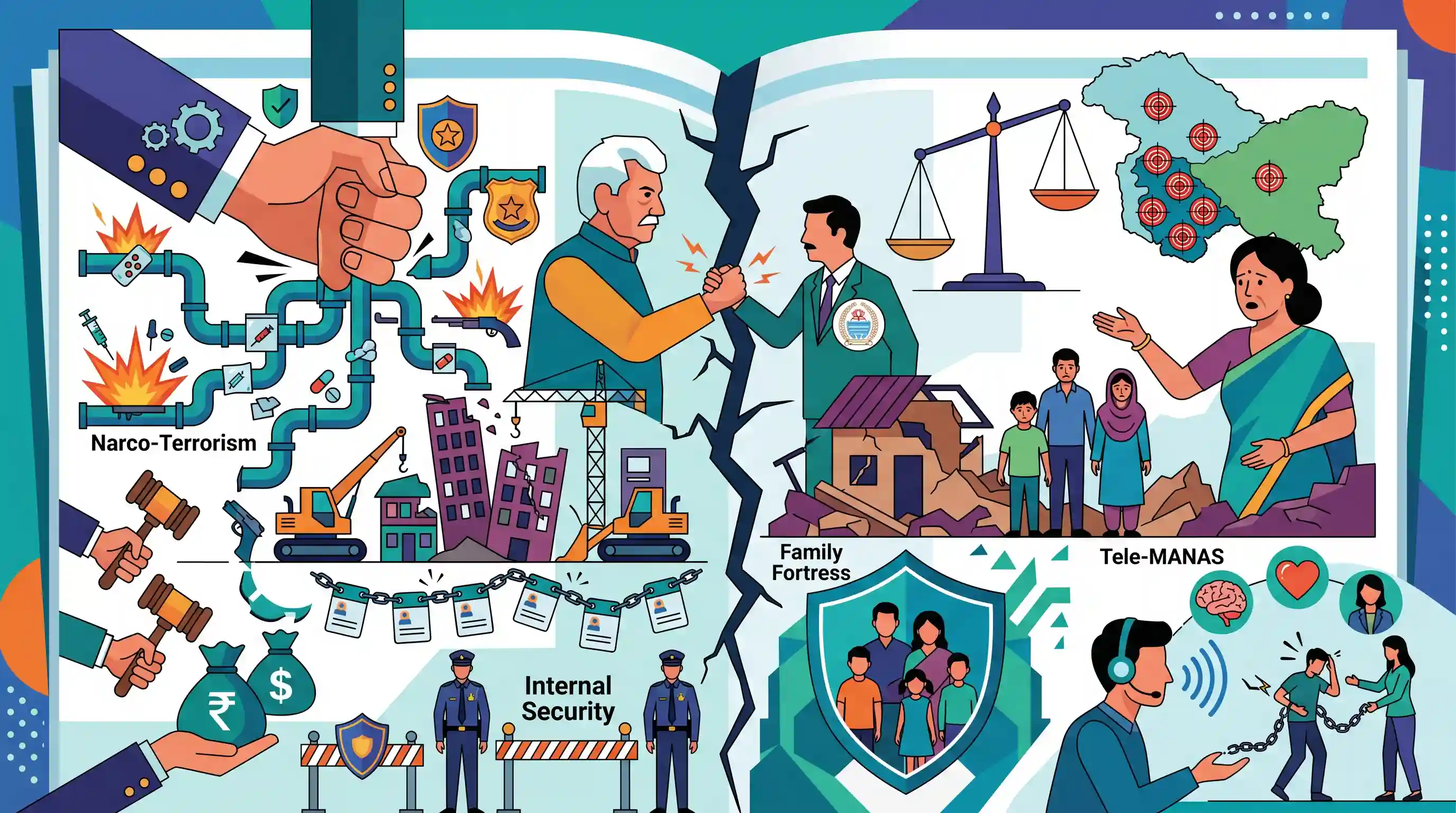
Jammu and Kashmir Lieutenant Governor Manoj Sinha has hardened his stance against drug peddlers, initiating a massive crackdown that includes seizing assets, demolishing illegal properties, and suspending licenses linked to narco-smugglers. The aggressive campaign, aimed at dismantling the narco-terrorism nexus, has drawn criticism from J&K Minister Sakina Itoo, who argues that property demolitions unfairly penalize families and are disproportionately targeted at the Kashmir valley. While enforcing strict punitive measures against traffickers, the administration is simultaneously promoting the 'Family Fortress Initiative' and utilizing Tele-MANAS to rehabilitate drug addicts with compassion. The developments highlight both the severe internal security threat posed by drug cartels in border regions and the ongoing policy friction between the appointed L-G and the elected government in the Union Territory.
Key Points
- J&K L-G Manoj Sinha has intensified the crackdown on drug traffickers, ordering the seizure and demolition of properties and businesses funded by illicit drug money.
- The anti-drug campaign has resulted in the arrest of nearly 700 smugglers, suspension of 150 pharmacy licenses, and the installation of 3,000 CCTV cameras across drug stores in the Union Territory.
- J&K Minister Sakina Itoo opposed the punitive property demolitions, arguing they disproportionately impact youth and families, and claimed such actions are concentrated more in the Kashmir valley than in Jammu.
- Differentiating between peddlers and users, the L-G emphasized compassionate rehabilitation for addicts utilizing the Tele-MANAS counseling network and the community-driven 'Family Fortress Initiative'.
- The situation underscores the dual challenges of combating narco-terrorism as an internal security threat and managing the administrative friction between the L-G and elected representatives in J&K.
Important Terms
Narco-Terrorism

A security threat where drug trafficking proceeds fund terrorist activities. In J&K, it is viewed as a 'two-headed snake' where narcotics provide the 'oxygen' (financing) for militancy and insurgency.
UPSC context
GS Paper III (Internal Security). Tests understanding of the nexus between organized crime, illicit drug trade, and national security threats.
Family Fortress Initiative
A community-based prevention strategy in Jammu and Kashmir that uses family bonds, schools, and religious institutions to conduct weekly dialogues and audits against drug addiction.
UPSC context
GS Paper II (Social Justice/Health). Relevant for community-led interventions in public health and drug abuse prevention.
NDPS Act (1985)
India’s primary drug control law. Sections 68E and 68F are frequently invoked to seize, freeze, or demolish assets and properties acquired through the proceeds of illegal narcotics trade.
UPSC context
GS Paper II (Statutory Bodies/Laws). Tests knowledge of legal frameworks governing internal security and social issues.
Tele-MANAS
A 24/7 national tele-mental health helpline (14416). In J&K, it serves as a digital first-aid and counseling platform to rehabilitate drug addicts with dignity and compassion.
UPSC context
GS Paper II (Governance/Health). Tests awareness of government initiatives utilizing technology for public welfare and mental health.
Nasha Mukt J&K Abhiyan
A comprehensive 100-day administrative campaign in J&K focused on dismantling drug networks through massive public outreach, strict enforcement, and the identification of regional drug hotspots.
UPSC context
GS Paper II (Social Justice). Relevant for state-led social welfare programs and grassroots-level implementation of national campaigns.
Prelims Trap
"The elected Legislative Assembly of Jammu and Kashmir exercises legislative jurisdiction over Police and Public Order."
Under the J&K Reorganisation Act, 2019, 'Police' and 'Public Order' are specifically excluded from the Assembly's domain and rest solely with the L-G.
Static Concepts Connected
What is the division of legislative powers in the UT of J&K?
- Legislative limits: The elected Assembly can legislate on matters in the State and Concurrent Lists, strictly excluding 'Public Order' and 'Police'.
- L-G's discretion: The Lieutenant Governor acts in his discretion regarding these excluded subjects, effectively keeping internal security under the Union Government's control.
How does the NDPS Act deal with the proceeds of drug trafficking?
- Property forfeiture: Chapter V-A empowers authorities to trace, freeze, and forfeit illegally acquired properties derived from illicit drug trafficking, crippling the economic infrastructure of cartels.
- Burden of proof: The law often shifts the burden of proof to the accused to demonstrate that their assets were acquired through legitimate sources, not illicit drug money.
Cross-Topic Patterns
Border Security + Golden Crescent
J&K's proximity to the Golden Crescent makes it highly vulnerable to cross-border drug syndicates, linking local NDPS policing directly to the broader internal security threat of terrorism financing.
Tele-MANAS + Social Justice
Originally launched to address post-COVID mental health, Tele-MANAS is increasingly being repurposed as a frontline clinical triaging and rehabilitation tool for substance abuse victims in high-conflict zones.

Expect a 2026 Prelims question comparing L-G discretionary powers over 'Public Order' in Delhi vs J&K under their respective UT frameworks.
Linked PYQs · 4
Linked PYQs · 4
- 2024MainsGS3
Explain how narco-terrorism has emerged as a serious threat across the country. Suggest suitable measures to counter narco-terrorism.
- 2023MainsGS3
The use of unmanned aerial vehicles (UAVs) by our adversaries across the borders to ferry arms/ammunitions, drugs, etc., is a serious threat to the internal security. Comment on the measures being taken to tackle this threat.
- 2016MainsGS2
Discuss the essentials of the 69th Constitutional Amendment Act and anomalies, if any, that have led to recent reported conflicts between the elected representatives and the institution of the Lieutenant Governor in the administration of Delhi. Do you think that this will give rise to a new trend in the functioning of the Indian federal politics?
- 2018MainsGS2
Whether the Supreme Court Judgement (July 2018) can settle the political tussle between the Lt. Governor and elected government of Delhi? Examine.
