Jammu and Kashmir legislative scrutiny of Food Safety Act gaps
Source:Indian Express ↗
Why It Matters
This issue combines two significant UPSC themes: the functioning and powers of the J&K UT Legislative Assembly as well as the governance and regulatory challenges surrounding the Food Safety and Standards Act, directly impacting public health.
Summary
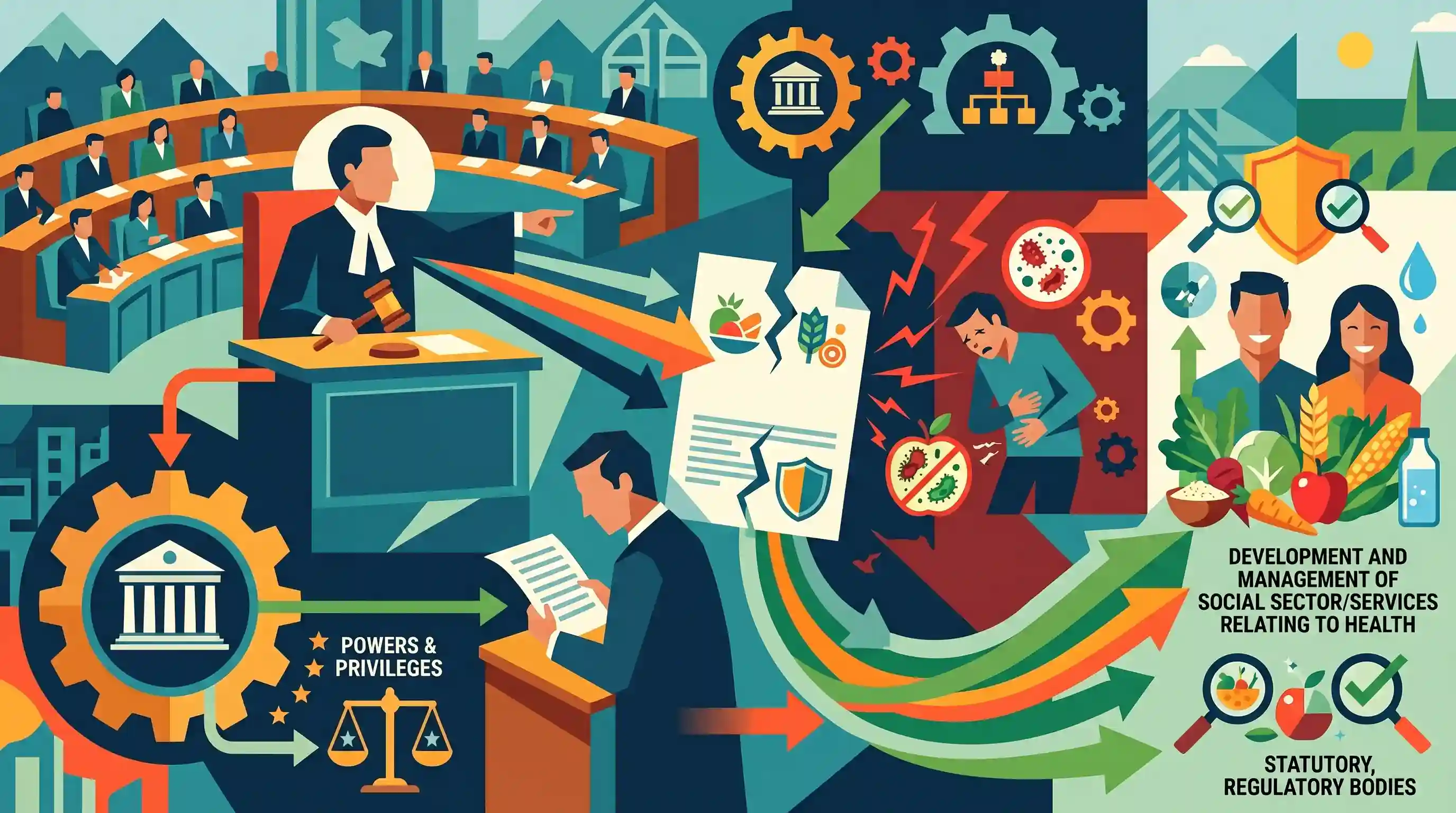
During a session in the J&K Legislative Assembly, the Speaker demanded structural changes to the Food Safety Act following an admission by the concerned Minister regarding its deficiencies. This development brings to the forefront both the functional dynamics of the newly constituted J&K Legislative Assembly (post-Reorganization Act) and the pressing need to address legislative gaps in the Food Safety and Standards Act to ensure better public health outcomes.
Key Points
- The Speaker of the J&K Legislative Assembly demanded amendments to the Food Safety Act to ensure it meets contemporary public health requirements.
- A J&K government Minister acknowledged that there are significant deficiencies and loopholes in the current Food Safety Act that hamper its effective enforcement.
- The event underscores the proactive role of the newly formed J&K legislature in debating and scrutinizing public health statutes applicable in the Union Territory.
Important Terms
Food Safety and Standards Act, 2006

A 2006 law consolidating Indian food regulations to establish science-based standards. It regulates the manufacture, storage, distribution, and sale of food to ensure public health and safety.
UPSC context
GS Paper II & III: Health and statutory bodies. Tests knowledge of regulatory frameworks and legislative gaps in public safety.
Jammu & Kashmir Legislative Assembly
The legislative body for the UT of J&K, reconstituted under the 2019 Reorganisation Act. It has powers to legislate on State and Concurrent List subjects, excluding 'Public Order' and 'Police'.
UPSC context
GS Paper II: State Legislature and Federalism. Tests understanding of UT governance models (Article 239A) and specific regional powers.
Food Safety and Standards Authority of India (FSSAI)
A statutory body under the Ministry of Health & Family Welfare, established by the FSS Act, 2006. It monitors food quality and grants licenses to food business operators across India.
UPSC context
GS Paper II: Statutory bodies. Relevant for questions on institutional efficacy in managing social sector health services.
Jammu & Kashmir Reorganisation Act, 2019
Parliamentary legislation that bifurcated the state of Jammu and Kashmir into two Union Territories—J&K (with a legislature) and Ladakh (without a legislature)—and revoked its special status.
UPSC context
GS Paper II: Indian Constitution and Federal Structure. Crucial for understanding J&K’s administrative transition and legislative limitations.
Food Adulteration
The intentional lowering of food quality through the addition of inferior substances or removal of vital nutrients, leading to health risks. It is a punishable offense under the FSS Act.
UPSC context
GS Paper III: Food Processing and Social Sector/Health. Tests awareness of public health challenges and the necessity of stronger punitive legislation.
Prelims Trap
"J&K, being a Union Territory, lacks the power to amend central laws on the Concurrent List like the Food Safety Act."
J&K has an Article 239A legislature. It can legislate on Concurrent List subjects, but conflicting State/UT amendments to Central laws require Presidential assent to prevail.
Static Concepts Connected
What are the legislative powers of the J&K Legislative Assembly?
- Jurisdiction: Can legislate on all State List subjects except 'Police' and 'Public Order', and all Concurrent List subjects.
- Constitutional Basis: Created under Article 239A (similar to Puducherry), governed by the J&K Reorganisation Act, 2019.
- LG's Assent: Bills passed by the Assembly require the assent of the Lieutenant Governor, who may reserve them for the President.
What is the statutory framework governing food safety in India?
- FSSA 2006: The Food Safety and Standards Act, 2006 is a central law that consolidated older laws like the Prevention of Food Adulteration Act, 1954.
- FSSAI: An autonomous statutory body established under FSSA 2006 to regulate food manufacturing, storage, and distribution.
- Nodal Ministry: FSSAI functions under the administrative control of the Union Ministry of Health and Family Welfare.
Cross-Topic Patterns
Asymmetric Federalism & UT Legislatures
The J&K Assembly's intent to amend a Concurrent List law highlights functional differences in legislative powers between UTs with assemblies (J&K, Puducherry) and states.
Health vs Adulteration in 7th Schedule
Public health is a State subject (Entry 6), but food adulteration is Concurrent (Entry 18), often leading to overlapping federal enforcement zones and Centre-State friction.

Expect a 2026 prelims question contrasting the exact legislative boundaries of J&K, Delhi, and Puducherry assemblies on Concurrent subjects.
Linked PYQs · 2
Linked PYQs · 2
- 2025MainsGS2
Discuss the nature of Jammu and Kashmir Legislative Assembly after the Jammu and Kashmir Reorganization Act, 2019. Briefly describe the powers and functions of the Assembly of the Union Territory of Jammu and Kashmir.
- 2018PrelimsGS1
Consider the following statements: 1. The Food Safety and Standards Act, 2006 replaced the Prevention of Food Adulteration Act, 1954. 2. The Food Safety and Standards Authority of India (FSSAI) is under the charge of Director General of Health Services in the Union Ministry of Health and Family Welfare. Which of the statements given above is/are correct?
