Jammu and Kashmir Assembly Statehood Restoration Resolution
Source:Indian Express ↗
কেন এটি গুরুত্বপূর্ণ
It deals with core constitutional and federal issues concerning Union Territories, statehood restoration, and legislative autonomy in Jammu and Kashmir.
সারসংক্ষেপ
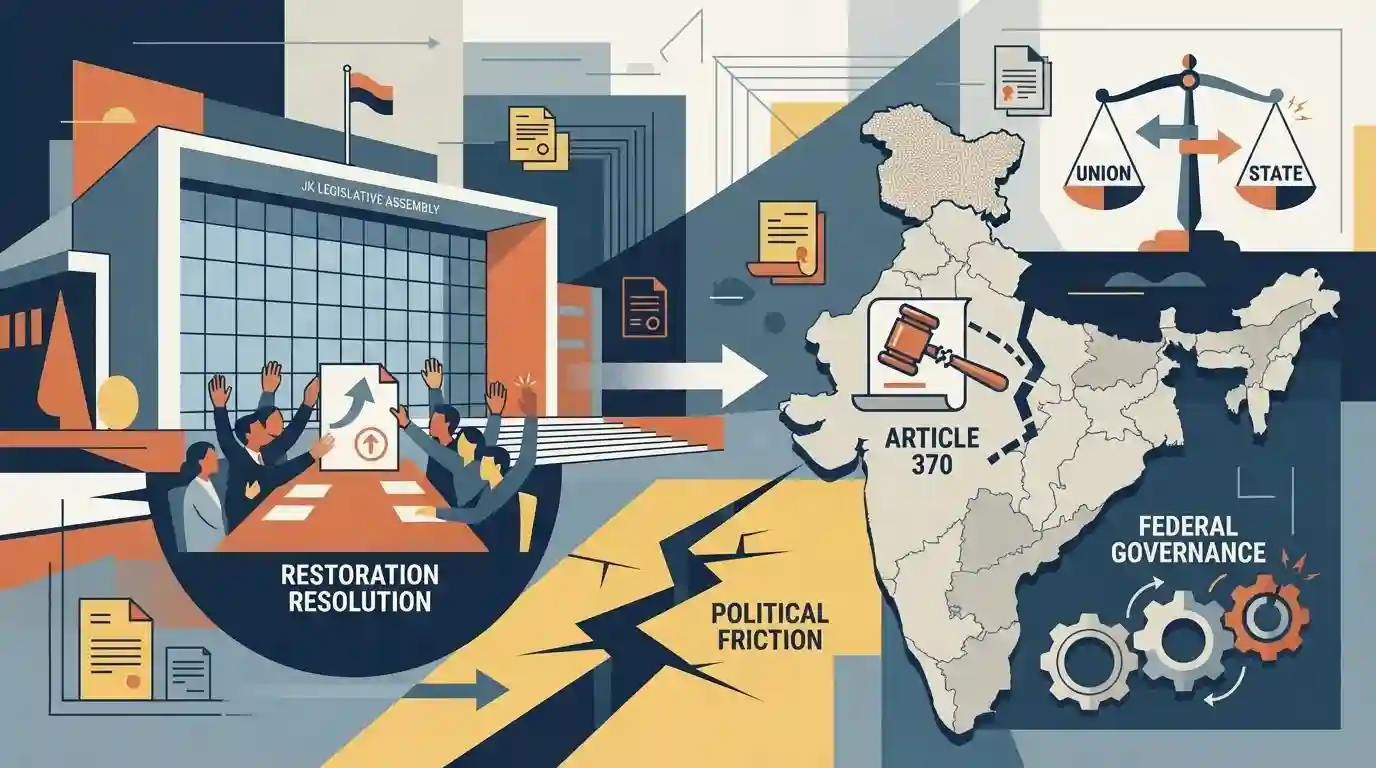
The Jammu and Kashmir Legislative Assembly passed a resolution demanding the full restoration of statehood, triggering political friction regarding constitutional provisions such as Article 370 and federal governance.
মূল বিষয়
- The Jammu and Kashmir Assembly passed a resolution seeking the full restoration of statehood.
- The resolution also touched upon the context of Article 370, leading to intense political debate and opposition from the BJP.
- The issue highlights federal dynamics, legislative powers of Union Territories, and constitutional changes in Jammu and Kashmir.
গুরুত্বপূর্ণ শব্দ
Article 370

A temporary provision in the Indian Constitution that granted special autonomous status to Jammu and Kashmir, rendered inoperative in August 2019.
UPSC context
Important for GS Paper II (Indian Constitution—Significant Provisions, Federal Structure, and Judicial Review).
Jammu and Kashmir Reorganization Act
The central legislation enacted in 2019 that bifurcated the erstwhile state of Jammu and Kashmir into two Union Territories: Jammu and Kashmir, and Ladakh.
UPSC context
Relevant for GS Paper II (Functions and Responsibilities of the Union and States, Federalism, and Reorganization of States).
Jammu and Kashmir Legislative Assembly
The unicameral legislature of the Union Territory of Jammu and Kashmir, empowered to enact laws on state and concurrent lists.
UPSC context
Tested under GS Paper II (State Legislature, Centre-State relations, and Union Territory governance models).
প্রিলিমস ফাঁদ
The J&K Assembly resolution legally compels the Union Parliament to immediately restore statehood and reverse the Reorganization Act.
Aspirants often assume a state legislative assembly resolution on statehood or central statutes has binding legal effect on Parliament, whereas it is only recommendatory and political.
সংযুক্ত স্থির ধারণা
What are the constitutional provisions governing the creation, alteration, and statehood of states in India?
- Article 3 Power: Parliamentary Power under Article 3 allows Parliament to form new states, alter areas, boundaries, or names by a simple majority.
- Prior Recommendation: Presidential Recommendation is mandatory before a bill affecting state boundaries or name is introduced in either House of Parliament.
- UT vs State: Union Territories vs States distinction remains crucial; Parliament possesses plenary legislative powers over UTs under Part VIII of the Constitution.
আন্তঃবিষয় প্যাটার্ন
Legislative Resolutions vs. Parliamentary Reorganization Powers
Resolutions by state legislatures challenging central reorganizations test the boundaries of executive discretion under Article 3 and parliamentary supremacy in federal structures.
Special Status Provisions and Judicial Review
The revocation and subsequent legal challenges regarding Article 370 remain a benchmark for the scope of presidential orders and judicial review under Article 356/3.

Expect statement-based questions on the limits of state assembly resolutions regarding central acts and Union Territory statehood restoration.
সংযুক্ত PYQ · 2
সংযুক্ত PYQ · 2
- 2025MainsGS2
Discuss the nature of Jammu and Kashmir Legislative Assembly after the Jammu and Kashmir Reorganization Act, 2019. Briefly describe the powers and functions of the Assembly of the Union Territory of Jammu and Kashmir.
- 2016MainsGS2
To what extent is Article 370 of the Indian Constitution, bearing marginal note "Temporary provision with respect to the State of Jammu and Kashmir", temporary? Discuss the future prospects of this provision in the context of Indian polity.
