BRICS Space Economy Proposal and Space Technology Cooperation
Source:The Hindu ↗
Why It Matters
Highlights India's leadership in space diplomacy and its efforts to institutionalize space cooperation among the expanding BRICS grouping. It connects GS2 multilateral diplomacy with GS3 space technology applications and sustainability.
Summary
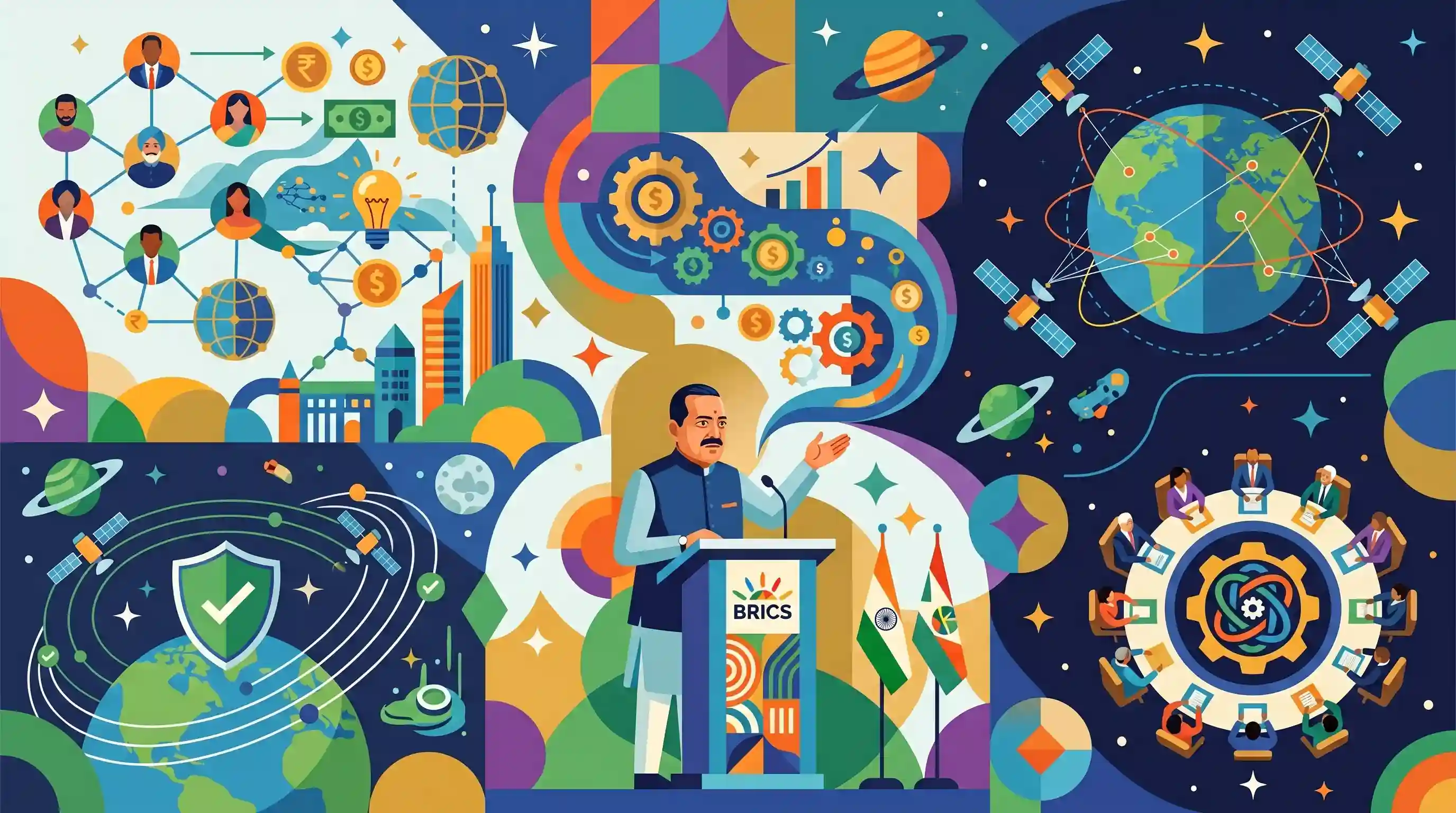
At the BRICS Heads of Space Agencies meeting held under India's 2026 Chairship, Union Minister Jitendra Singh proposed the creation of a 'BRICS Space Economy'. The initiative aims to enhance multilateral collaboration in innovation, investment, and sustainable development. Key focus areas included space sustainability (debris-free missions), expanding the BRICS Remote Sensing Satellite Constellation to include new members, and operationalizing the BRICS Space Council.
Key Points
- India is hosting the BRICS Heads of Space Agencies (HOSA) meeting as part of its BRICS Chairship for 2026.
- Union Minister Jitendra Singh pitched a 'BRICS Space Economy' to boost start-ups, innovation, entrepreneurship, and resilient supply chains for space components.
- The expansion of the BRICS Remote Sensing Satellite Constellation (RSSC) to include new members (Egypt, Ethiopia, Iran, UAE) was a key agenda item.
- The meeting emphasized space sustainability, specifically focusing on debris-free space missions.
- Discussions also advanced on operationalizing the proposed BRICS Space Council to further institutionalize space cooperation among member states.
Important Terms
BRICS Space Economy

A collaborative framework proposed by India to integrate BRICS nations' space scientific expertise, industrial capacity, and investment, aiming for co-development and co-innovation to drive global economic growth.
UPSC context
Relevant for GS Paper III (Science and Technology/Economy) and GS Paper II (International Relations); tests understanding of space diplomacy and commercialization.
BRICS Remote Sensing Satellite Constellation (RSSC)
A data-sharing mechanism using a 'virtual constellation' of existing satellites from member nations to support disaster management, climate monitoring, and socio-economic development.
UPSC context
GS Paper III (Space Technology); significant for disaster management and multilateral technological cooperation.
BRICS Space Council
A proposed advisory body designed to institutionalize BRICS space governance, coordinate joint exploration programs, and facilitate policy alignment across the expanded 11-member bloc.
UPSC context
GS Paper II (International Relations); represents the institutionalization of non-Western multilateral groups in strategic sectors.
Space Sustainability
The practice of conducting space activities to ensure long-term orbital safety, specifically through 'debris-free missions' and domestic governance frameworks for sustainable space operations.
UPSC context
GS Paper III (Environment/Science & Tech); critical for discussions on orbital crowding and India's 'Debris-Free Missions' by 2030 goal.
BRICS+
An expanded intergovernmental organization of 11 emerging economies (including newer members like Egypt, Ethiopia, and UAE) focusing on scientific, economic, and strategic autonomy outside Western-led frameworks.
UPSC context
GS Paper II (International Relations); fundamental for understanding global geopolitics, South-South cooperation, and emerging multilateralism.
Prelims Trap
The BRICS Remote Sensing Satellite Constellation (RSSC) was launched as a new initiative under India's 2026 Chairship.
The RSSC agreement was actually signed in 2021. The 2026 meeting focuses on expanding this existing data-sharing network to the newest BRICS members.
Static Concepts Connected
What is Kessler Syndrome and how is India mitigating space debris?
- Kessler Syndrome: A theoretical scenario where LEO object density is high enough that a single collision generates a cascade of debris, rendering orbits unusable.
- Global Guidelines: UN COPUOS guidelines recommend post-mission disposal, such as de-orbiting satellites within 25 years of end-of-life.
- India's Response: ISRO launched Project NETRA for space object tracking and the IS4OM facility for safe and sustainable space operations.
What is the current composition of the expanded BRICS grouping?
- Original Core: Brazil, Russia, India, China, and South Africa (who joined in 2010).
- 2024 Expansion: Egypt, Ethiopia, Iran, and the UAE officially became full members on January 1, 2024.
- Notable Exceptions: Argentina was invited but formally declined to join under its new government; Saudi Arabia's formal accession status remains nuanced.
Cross-Topic Patterns
IN-SPACe + Multilateral Space Diplomacy
Promoting a 'BRICS Space Economy' aligns directly with India's domestic space privatization push (IN-SPACe), aiming to integrate Indian space start-ups into broader multilateral supply chains.
Global South & Space Data Sovereignty
The BRICS RSSC gives the Global South independent access to critical Earth observation data for climate and disaster management, reducing reliance on Western satellite networks like Copernicus or Landsat.

BRICS expansion + Space Tech is a prime 2026 target. Expect a multi-statement question linking the BRICS RSSC and Kessler Syndrome.
Linked PYQs · 3
Linked PYQs · 3
- 2012MainsGS2
Compare the significance of IBSA and BRICS in the context of India's multilateral diplomacy.
- 2016MainsGS3
Discuss India's achievements in the field of Space Science and Technology. How the application of this technology has helped India in its socio-economic development?
- 2015PrelimsGS1
In which of the following activities are Indian Remote Sensing (IRS) satellites used? 1. Assessment of crop productivity 2. Locating groundwater resources 3. Mineral exploration 4. Telecommunications 5. Traffic studies Select the correct answer using the code given below.
