CSIR NBRI Inaugurates Eco Educational Hub in Lucknow
Source:dd-india ↗
Why It Matters
The development of an eco-educational hub in Lucknow creates a prominent focal point for UP-specific environment and heritage questions. Its unique integration of living botanical specimens with historical events (such as the Dandi March and Champaran Satyagraha) bridges Environment (GS3) and Modern History (GS1). Knowing the specific UP locations like Banthra, Fatehpur, and Prayagraj in this context is highly relevant for State PCS preliminary exams.
Summary
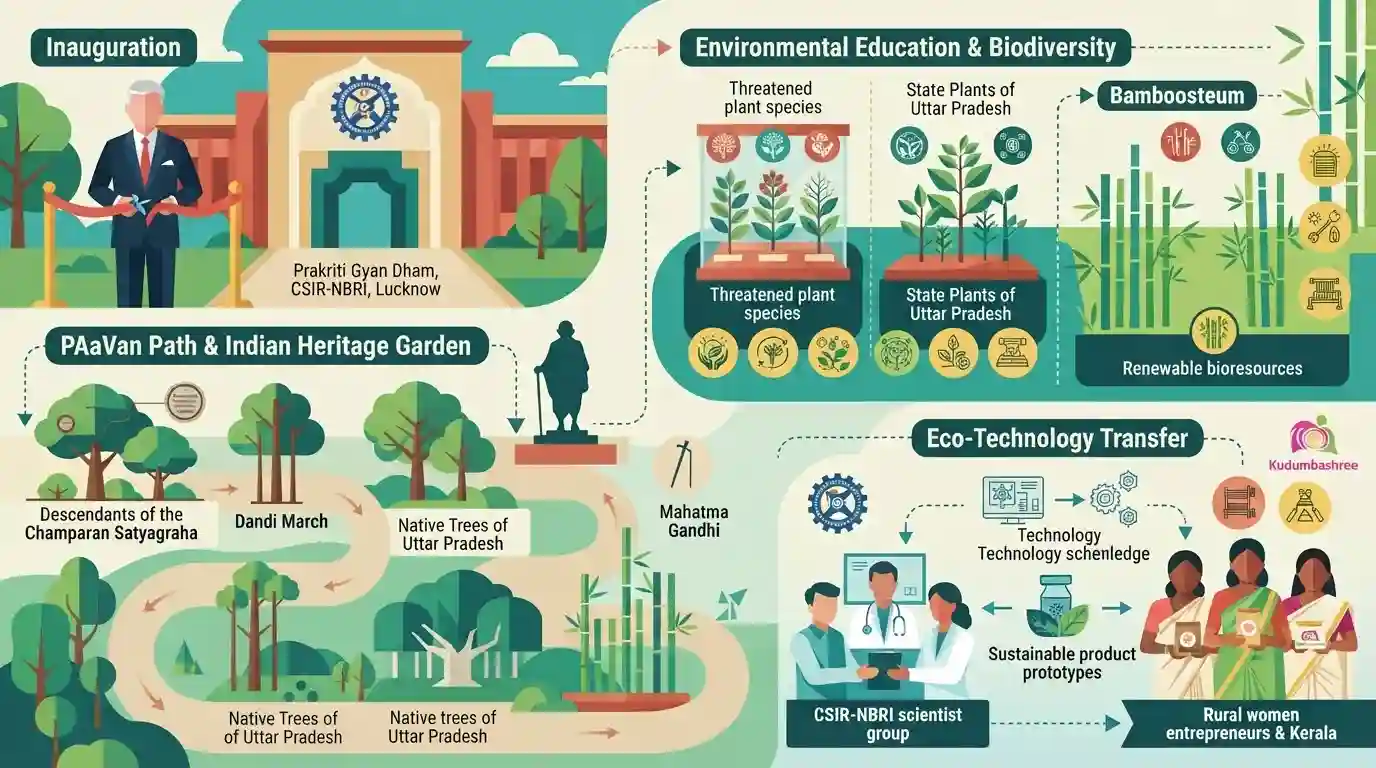
CSIR-National Botanical Research Institute (CSIR-NBRI) has launched the 'Prakriti Gyan Dham' eco-educational hub in Lucknow, Uttar Pradesh. Inaugurated by Union Minister Dr. Jitendra Singh, the facility integrates biodiversity conservation with Indian history and culture. Key highlights include the 'PAaVan Path' and 'Indian Heritage Garden,' which host historically significant trees from Uttar Pradesh, as well as descendants of trees linked to Mahatma Gandhi's Champaran Satyagraha and Dandi March. The initiative also emphasizes environmental education, showcasing threatened species and state plants, alongside a Bamboosteum to promote renewable bioresources. Additionally, CSIR-NBRI transferred eco-technologies to Kerala's Kudumbashree to foster rural women's entrepreneurship.
Key Points
- Union Minister Dr. Jitendra Singh inaugurated 'Prakriti Gyan Dham', an eco-educational hub developed by CSIR-NBRI at Maharishi Parashar Bioresource Centre in Banthra, Lucknow.
- The hub features 'PAaVan Path', including an 'Indian Heritage Garden' that houses culturally and historically significant trees like the Bawan Imli of Fatehpur, Mother Dussehri of Lucknow, and Patalpuri Banyan of Prayagraj.
- Living descendants of trees associated with Mahatma Gandhi, including a mango tree from Bhitiharwa (Champaran) and trees linked to the Dandi March, are conserved here.
- The park includes a 'Bamboosteum' with 43 bamboo species, promoting it as a renewable bioresource, and enclaves for threatened Indian plants ('Vibhav') and state plants ('Bhairav').
- CSIR-NBRI executed technology transfers to empower women through Kerala's Kudumbashree network and licensed Low-Cost Photobioreactor technology to a private firm.
Important Terms
Prakriti Gyan Dham

India's first dedicated Eco-Educational Hub in Lucknow, developed by CSIR-NBRI. Functioning as a "living laboratory," it integrates biodiversity conservation, botanical heritage, and experiential environmental learning.
UPSC context
Important for GS-3 (Environment & Biodiversity) as a novel model for public conservation awareness and eco-tourism.
PAaVan Path
Stands for 'Plants and Associated Vegetations for Appreciating Nature.' It is a heritage interpretive trail at Prakriti Gyan Dham, showcasing curated plant collections from India's diverse ecological regions.
UPSC context
Relevant for GS-3 (Environment), highlighting interactive and culturally grounded approaches to ecological education and biodiversity conservation.
CSIR-National Botanical Research Institute (CSIR-NBRI)
A premier Lucknow-based plant research laboratory under CSIR. It focuses on botanical science, biodiversity conservation, and transferring eco-technologies to industry and society.
UPSC context
Significant for GS-3 (Science & Technology; Environment) as a key institution translating plant research into socio-economic applications.
Kudumbashree
Kerala's flagship poverty eradication and women's empowerment mission. It recently received plant-based eco-technologies from CSIR-NBRI to promote women-led rural entrepreneurship and livelihood generation.
UPSC context
Highly relevant for GS-2 (SHGs, Poverty Alleviation) and GS-3 (Inclusive Growth), illustrating science-driven rural women's empowerment.
Council of Scientific & Industrial Research (CSIR)
India's largest state-funded research and development organization operating under the Ministry of Science and Technology. It drives advancements across diverse scientific fields, including eco-technologies and industrial research.
UPSC context
Fundamental for GS-3 (Science & Technology) regarding India's institutional R&D framework and technology commercialization initiatives.
Prelims Trap
Prakriti Gyan Dham is a newly established in-situ conservation reserve in Uttar Pradesh.
Prakriti Gyan Dham is a botanical garden, which is an ex-situ (off-site) conservation method. It is not an in-situ natural habitat like a National Park.
Static Concepts Connected
What are the primary ex-situ conservation methods for biodiversity?
- Botanical Gardens: Cultivating rare and threatened plant species outside their natural habitats for preservation, research, and public education.
- Gene/Seed Banks: Preserving seeds, pollen, and tissue cultures (often via cryopreservation) to maintain genetic viability for future ecosystem restoration.
- Captive Breeding: Breeding and maintaining endangered animal species in controlled environments to prevent extinction.
What is the historical significance of the Bawan Imli tree?
- 1857 Revolt: A tamarind tree located in Fatehpur, Uttar Pradesh, recognized as a crucial site of the 1857 Uprising.
- Martyr's Memorial: The British hanged 52 freedom fighters from its branches, making it a powerful martyr's memorial and symbol of local resistance.
Cross-Topic Patterns
Ex-situ conservation + Freedom Struggle
Linking natural heritage to historical events (Bawan Imli, Champaran) merges environmental conservation with Modern Indian History, creating a unique narrative for UPSC questions.
Lab-to-Land + SHG Empowerment
CSIR-NBRI transferring eco-technologies to Kerala’s Kudumbashree illustrates how top-tier scientific research is being practically leveraged for grassroots rural women's entrepreneurship.

Expect a 2026 prelims statement pairing ex-situ conservation sites with specific freedom struggle landmarks like Bawan Imli or Champaran.
Linked PYQs · 5
Linked PYQs · 5
- 2008UPPSC_PRELIMSGS1
Identify a non-CSIR Institute situated at Lucknow in U.P.:
- 2020UPPSC_PRELIMSGS1
In which of the following places the Bio-technology Park is located in Uttar Pradesh ?
- 2018UPPSC_PRELIMSGS1
Which of the following is NOT an example of in-situ conservation strategy?
- 2017UPPSC_PRELIMSGS1
Arrange the following events in correct chronological sequence using the code given below: i. Satyagrah against the Rowlatt Act ii. Champaran Satyagraha iii. Kheda Peasant struggle iv. Ahmedabad Mill Strike
- 2019UPPSC_PRELIMSGS1
Arrange the following events in a chronological order and select the correct answer from the codes given below: I. Appointment of Simon Commission II. Jallianwala Bagh Massacre III. Mahatma Gandhi's Dandi March IV. Death of Ferozshah Mehta
