Jharkhand Launches Artificial Intelligence Policy for Governance
Source:Indian Express ↗
Why It Matters
This development illustrates the increasing decentralized adoption of advanced technologies like AI by Indian state governments to transform public administration and service delivery. It serves as a practical, contemporary case study for mains answers regarding e-governance models (interactive and analytical), real-time monitoring of development schemes, and the application of cutting-edge S&T in social sectors and natural resource management.
Summary
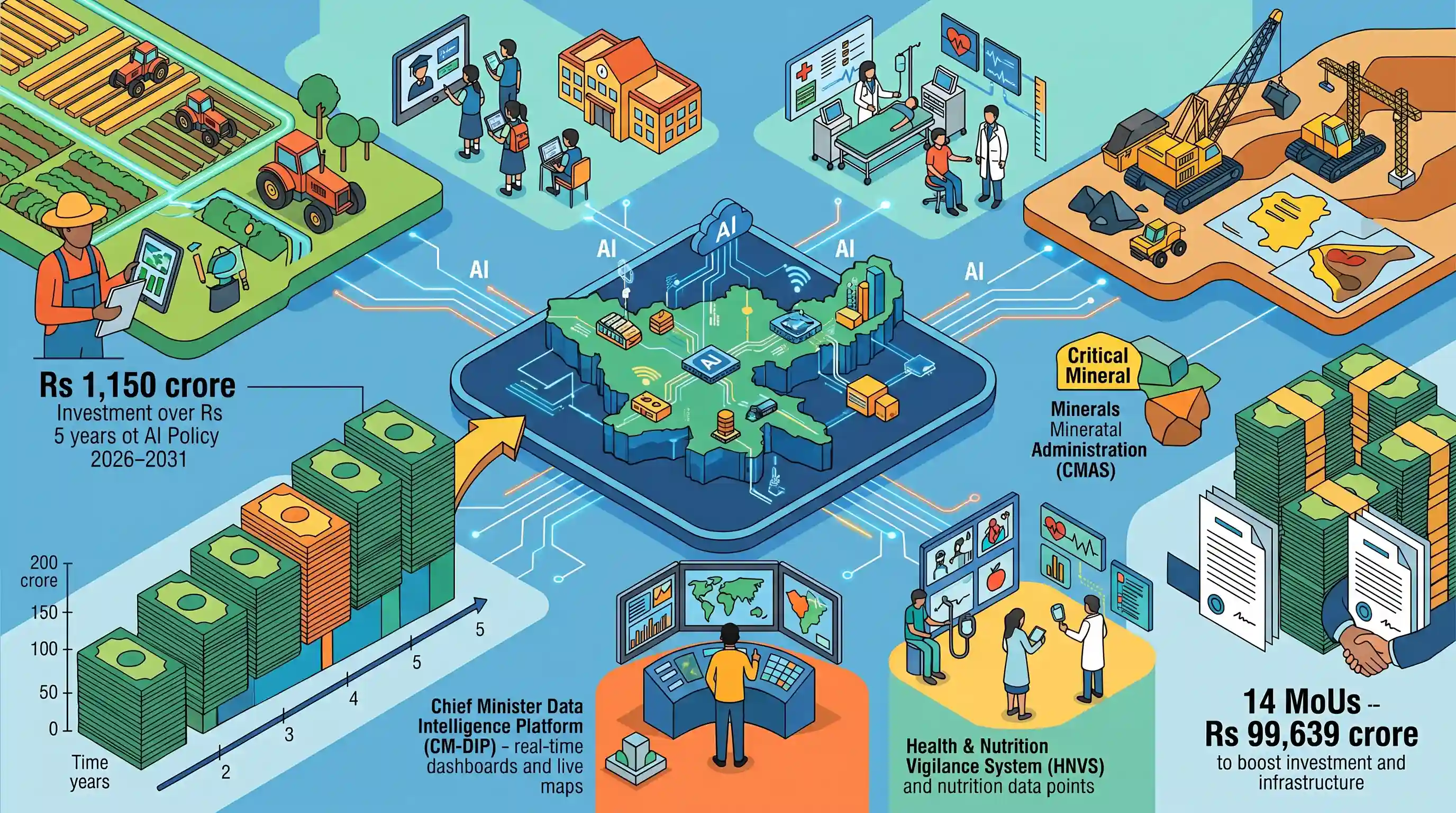
The Jharkhand government has proposed the 'Jharkhand Artificial Intelligence (AI) Policy 2026–2031' at the National Stakeholders’ Consultation 2026. This comprehensive roadmap involves a proposed investment of Rs 1,150 crore over five years to establish AI-enabled infrastructure and accelerate tech adoption across key public sectors, including agriculture, education, healthcare, and mining. Crucial tools under this policy include the Chief Minister Data Intelligence Platform (CM-DIP) for real-time governance monitoring, the Health & Nutrition Vigilance System (HNVS), and the Critical Minerals Administration System (CMAS) designed to optimize resource governance and healthcare monitoring. Additionally, Jharkhand signed 14 MoUs worth Rs 99,639 crore to boost investment and infrastructure.
Key Points
- The Jharkhand government proposed the 'Jharkhand Artificial Intelligence (AI) Policy 2026–2031' during the National Stakeholders' Consultation 2026 in New Delhi.
- The policy outlines a proposed investment of Rs 1,150 crore over five years to build robust digital infrastructure, foster innovation, and accelerate the adoption of AI across government departments.
- Key targeted sectors for AI integration include healthcare, agriculture, education, mining, environmental management, and disaster response.
- The state introduced the Chief Minister Data Intelligence Platform (CM-DIP), an AI-enabled system to monitor welfare and development programs in real-time.
- Specialized analytical systems such as the Health & Nutrition Vigilance System (HNVS) and the Critical Minerals Administration System (CMAS) were designed to leverage data analytics to improve healthcare delivery and mineral resources administration.
- As part of its larger investment push, Jharkhand signed 14 MoUs worth Rs 99,639 crore, aiming to attract more than Rs 10,000 crore in investments by 2050 through modernized resource administration.
Important Terms
Jharkhand Artificial Intelligence (AI) Policy 2026–2031

A proposed five-year state framework to integrate AI across sectors like healthcare, mining, and agriculture while ensuring data privacy, ethical deployment, and cybersecurity.
UPSC context
GS Paper II (E-governance) & GS Paper III (S&T); tests candidate awareness of state-level AI policies.
Chief Minister Data Intelligence Platform (CM-DIP)
An AI-enabled system proposed by Jharkhand for real-time monitoring of government welfare programs, infrastructure projects, and departmental performance to boost transparency.
UPSC context
GS Paper II (E-governance); tests knowledge of technology-driven decision support and transparency systems in governance.
Health & Nutrition Vigilance System (HNVS)
An AI-driven analytics system proposed by Jharkhand to strengthen healthcare delivery, track health infrastructure, and optimize nutrition welfare programs across the state.
UPSC context
GS Paper II (Social Welfare & Health); tests technology-driven solutions for welfare delivery and social-sector management.
Critical Minerals Administration System (CMAS)
An AI-based data management tool proposed by Jharkhand to modernize mineral administration, track resources, and enhance governance in the state's vital mining sector.
UPSC context
GS Paper III (Resource Management); tests application of digital tools in resource governance and mineral extraction.
Prelims Trap
The Critical Minerals Administration System (CMAS) is a centralized, nationwide platform managed by the Union Ministry of Mines.
CMAS is a localized initiative under Jharkhand's state-specific AI Policy, not a central government portal. Aspirants often confuse subnational schemes with national ones.
Static Concepts Connected
What are the four main interaction models of E-Governance?
- G2G (Govt-to-Govt): Sharing data and integration between central, state, and local government entities.
- G2C (Govt-to-Citizen): Seamless delivery of public services, certificates, and welfare directly to citizens.
- G2B (Govt-to-Business): Streamlining licensing, compliance, and procurement to improve the ease of doing business.
- G2E (Govt-to-Employee): Internal human resource management, training, and performance tracking of public servants.
What are the core focus sectors of India's National Strategy for AI?
- Healthcare: Increasing access and affordability, especially in remote areas through AI-assisted diagnostics.
- Agriculture: Optimizing crop yields, precision farming, and real-time commodity price discovery.
- Education: Enhancing learning outcomes through personalized learning tools and automated grading systems.
- Smart Cities & Mobility: Developing smart cities and smart, integrated transport networks to reduce congestion.
Cross-Topic Patterns
AI + Critical Mineral Security
Integrating AI systems like CMAS with mineral administration addresses GS3 challenges of illegal mining, supply-chain leakages, and national resource mapping in LWE-affected zones.
Subnational tech policies & federalism
State-led AI policies showcase decentralized policy experimentation, though they risk widening digital and economic disparities between tech-forward and resource-dependent states.

Mains 2026 may ask to evaluate subnational AI frameworks in addressing regional disparities, resource leakages, and tribal welfare delivery.
Linked PYQs · 4
Linked PYQs · 4
- 2024MainsGS2
e-governance is not just about the routine application of digital technology in service delivery process. It is as much about multifarious interactions for ensuring transparency and accountability. In this context evaluate the role of the 'Interactive Service Model' of e-governance.
- 2023MainsGS2
e-governance, as a critical tool of governance, has ushered in effectiveness, transparency and accountability in governments. What inadequacies hamper the enhancement of these features ?
- 2023MainsGS3
Introduce the concept of Artificial Intelligence (AI). How does Al help clinical diagnosis? Do you perceive any threat to privacy of the individual in the use of Al in healthcare?
- 2020PrelimsGS1
With the present state of development, Artificial Intelligence can effectively do which of the following? 1. Bring down electricity consumption in industrial units 2. Create meaningful short stories and songs 3. Disease diagnosis 4. Text-to-Speech Conversion 5. Wireless transmission of electrical energy Select the correct answer using the code given below:
