Demand for Judicial Probe into JPSC and JSSC Recruitment Scandals
Source:The Hindu ↗
Why It Matters
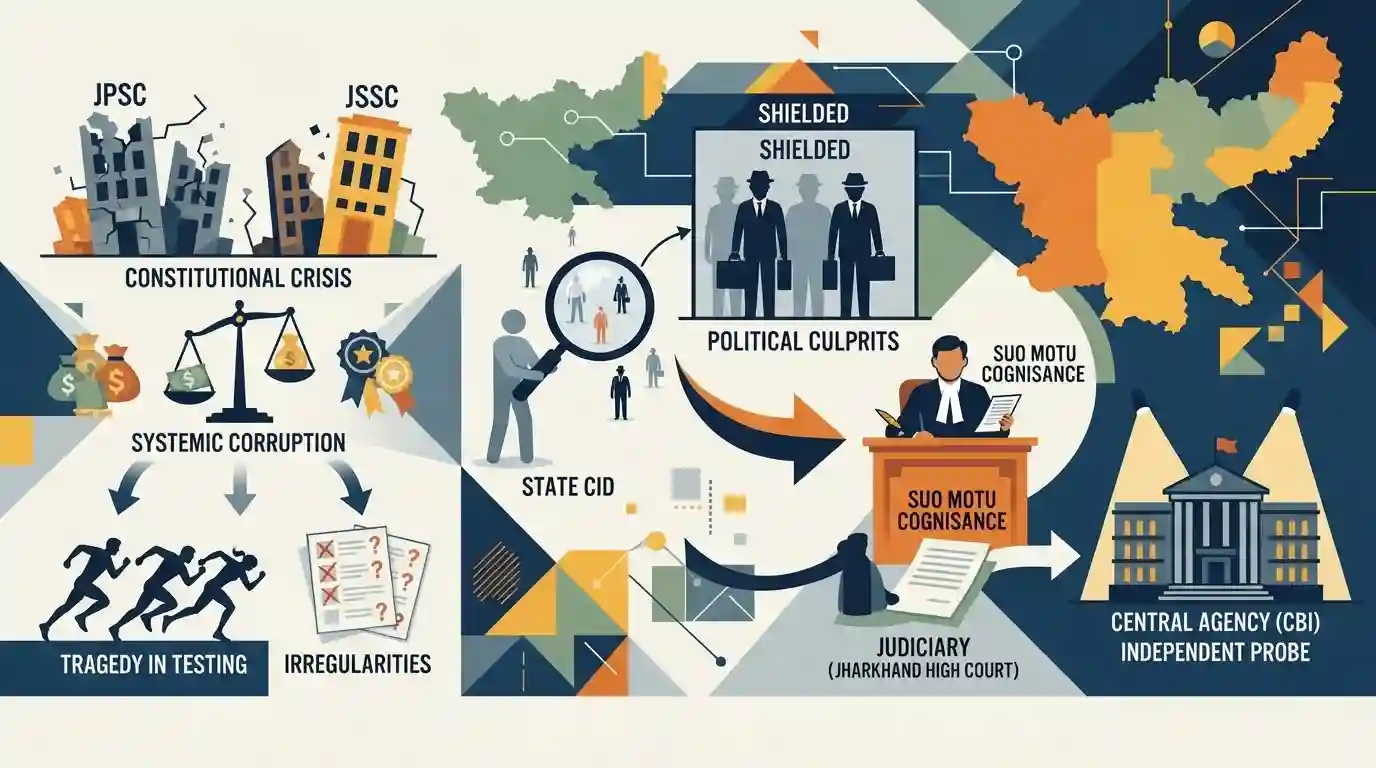
The article underscores recurring concerns regarding systemic corruption and lack of transparency in State Public Service Commissions (Constitutional Bodies), which severely undermines public trust and youth employment. It also touches upon federal friction concerning CBI versus State CID jurisdiction and highlights the vital role of the judiciary (via suo motu cognisance) in upholding accountability and the rule of law.
Summary
Former Jharkhand Chief Minister Champai Soren has appealed to the Jharkhand High Court to take suo motu cognisance of alleged widespread irregularities in recruitment exams conducted by the JPSC and JSSC. Criticising the state CID's ongoing investigation for allegedly targeting minor suspects while shielding major political culprits, he demanded an independent CBI probe to ensure transparency. The allegations involve systemic corruption, the 'auctioning' of government jobs, nepotism in interview panels, and the tragic deaths of candidates during physical endurance tests. The controversy raises serious questions about the integrity of state recruiting bodies and highlights the role of the judiciary and central investigative agencies in ensuring accountability.
Key Points
- Former Jharkhand CM Champai Soren urged the Jharkhand High Court to take suo motu cognisance of alleged irregularities in recruitment exams conducted by the JPSC and JSSC.
- Soren criticized the state Criminal Investigation Department (CID) for allegedly shielding influential figures and demanded a CBI probe to uncover the truth.
- Allegations include the 'auctioning' of government jobs, paper leaks in the JSSC CGL exam, and blatant nepotism involving relatives of political figures serving on interview panels.
- The issue is compounded by the recent deaths of multiple candidates during physical tests for excise constable recruitment.
- The case brings forth critical issues regarding the transparency of State Public Service Commissions, trust deficits in state investigative agencies, and the scope of judicial intervention.
Important Terms
Jharkhand Public Service Commission

A constitutional body established under Article 315 of the Constitution of India, responsible for conducting recruitment examinations and advising the Jharkhand state government on civil service appointments and disciplinary matters.
UPSC context
GS Paper II (Constitutional Bodies/Governance); tests structure, functioning, and independence of State Public Service Commissions.
Jharkhand High Court
The highest judicial organ in Jharkhand, established on November 15, 2000, under the Bihar Reorganisation Act, 2000, responsible for administering justice, protecting fundamental rights, and exercising judicial review.
UPSC context
GS Paper II (Judiciary); tests jurisdiction, powers, and role of High Courts in ensuring accountability.
Central Bureau of Investigation
India's premier federal investigative agency, functioning under the Ministry of Personnel. It derives its powers from the Delhi Special Police Establishment Act, 1946, to probe corruption, economic offenses, and serious crimes.
UPSC context
GS Paper II (Statutory/Regulatory Bodies/Federalism); tests federal investigative jurisdictions and the issue of state consent.
Suo Motu Cognisance
A legal power enabling Indian courts to initiate legal proceedings on their own initiative without a formal petition, usually based on media reports or public grievances.
UPSC context
GS Paper II (Judiciary/Polity); tests the concepts of judicial activism, judicial review, and public interest litigation.
Jharkhand Staff Selection Commission
A statutory body constituted under the JSSC Act, 2008, responsible for conducting competitive exams to recruit candidates for Group C (technical and non-technical) posts under the Jharkhand government.
UPSC context
GS Paper II (Governance/Statutory Bodies); tests structural framework, autonomy, and functioning of state recruitment bodies.
State Criminal Investigation Department
A specialized investigative wing of a state police force in India, tasked with probing complex, politically sensitive, or inter-district crimes referred by the state government or High Courts.
UPSC context
GS Paper II (Governance/Internal Security); tests state-level crime investigation mechanisms and police reforms.
Prelims Trap
The Governor of a State has the constitutional power to suspend or remove a State Public Service Commission member on grounds of misbehaviour.
While SPSC members are appointed by the Governor, only the President can remove them after a mandatory, binding Supreme Court inquiry under Article 317.
Static Concepts Connected
What constitutional safeguards secure the independence of State Public Service Commissions?
- Presidential Removal: Members are appointed by the Governor but can only be removed or suspended by the President of India (Article 317).
- Charged Expenditure: Salaries and administrative expenses are charged on the Consolidated Fund of the State, making them non-votable (Article 322).
- Employment Bar: Members are ineligible for reappointment to the same post, reducing potential executive influence through future inducements.
How does judicial review bypass the requirement of state consent for CBI investigations?
- Statutory Rule: Section 6 of the DSPE Act, 1946, mandates obtaining state government consent before the CBI can investigate within a state.
- Constitutional Exception: The Supreme Court (Article 32) and High Courts (Article 226) can direct CBI probes without needing state government consent.
- Judicial Precedent: In the 2010 CPDR case, the SC ruled that such judicial orders do not violate federalism principles.
Cross-Topic Patterns
SPSC autonomy vs Federal friction
Structural deficits in State PSCs prompt demands for central agency investigations, testing the limits of federal police powers versus state executive sovereignty.
Judicial activism in administrative failures
High Courts invoking Article 226 suo motu powers during recruitment scams highlights the judiciary stepping in to rectify critical failures in state-level anti-corruption oversight.

Expect a 2026 MCQ testing the constitutional asymmetry of SPSC member removal alongside HC's power to bypass state consent for CBI probes.
Linked PYQs · 2
Linked PYQs · 2
- 2021MainsGS2
The jurisdiction of the Central Bureau of Investigation (CBI) regarding lodging an FIR and conducting probe within a particular State is being questioned by various States. However, the power of the States to withhold consent to the CBI is not absolute. Explain with special reference to the federal character of India.
- 2024MainsGS2
Explain the reasons for the growth of public interest litigation in India. As a result of it, has the Indian Supreme Court emerged as the world's most powerful judiciary ?
