Jharkhand Appoints Avinash Kumar as New Chief Secretary
Source:Indian Express ↗
Why It Matters
The role and appointment of the Chief Secretary is a frequently tested topic in UPSC Prelims and Mains (Polity & Governance). Understanding who appoints the Chief Secretary (the Chief Minister, not the Governor) and their tenure rules directly answers specific PYQs and adds context to discussions on civil services reforms.
Summary
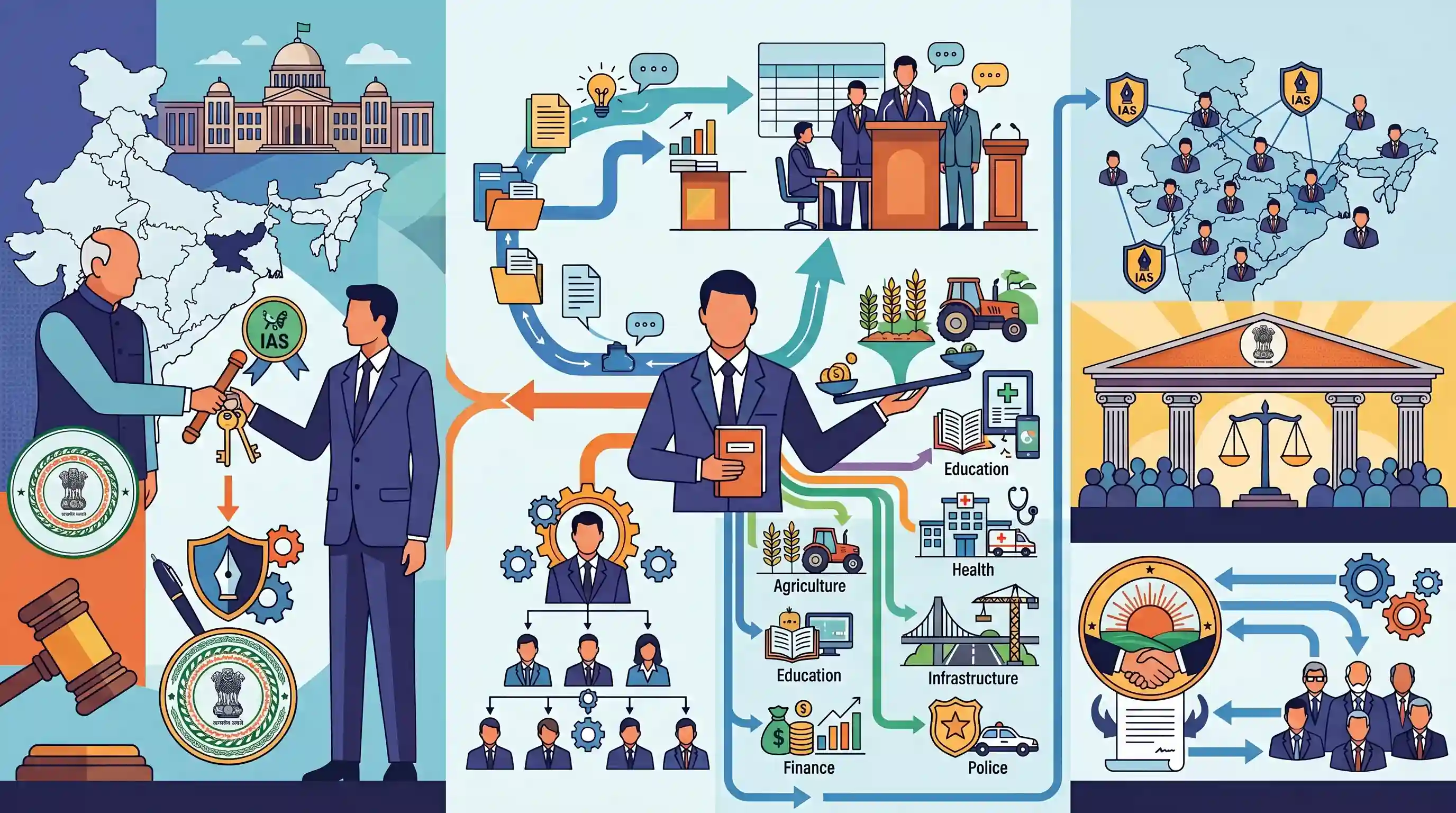
The Jharkhand government has announced the appointment of senior IAS officer Avinash Kumar as the new Chief Secretary of the state. The appointment highlights the administrative dynamics at the state level, where the Chief Secretary serves as the top bureaucratic head, principal advisor to the Chief Minister, and the chief coordinator of all state departments. This reshuffle sheds light on the broader framework of All India Services (AIS) and the functioning of the state executive.
Key Points
- The Jharkhand government has appointed senior IAS officer Avinash Kumar as the state's new Chief Secretary.
- The Chief Secretary acts as the principal advisor to the Chief Minister on all matters of state administration.
- The appointment of the Chief Secretary is made by the Chief Minister, and the position does not have a constitutionally fixed tenure.
- The Chief Secretary coordinates the functioning of all state government departments and is the highest-ranking civil servant in a state.
Important Terms
Chief Secretary

The highest-ranking civil servant in an Indian state, serving as the principal advisor to the Chief Minister and the administrative head of the State Secretariat.
UPSC context
GS Paper 2: State Administration and Governance. Vital for understanding the hierarchy and executive functioning of the state bureaucracy.
All India Services (AIS)
Civil services (IAS, IPS, IFoS) common to both the Union and States, created under Article 312 of the Constitution to ensure administrative unity.
UPSC context
GS Paper 2: Federalism and Civil Services. Tests knowledge of the 'Steel Frame' of Indian administration and Centre-State relations.
Article 312
The constitutional provision empowering the Rajya Sabha to initiate the creation of new All India Services in the national interest by a two-thirds majority.
UPSC context
GS Paper 2: Indian Constitution. A frequent Prelims/Mains topic regarding the special powers of the Rajya Sabha.
State Executive
The branch of state government comprising the Governor, Chief Minister, Council of Ministers, and the permanent bureaucracy responsible for implementing laws.
UPSC context
GS Paper 2: Polity. Essential for understanding the separation of powers and the role of the nominal vs. real executive.
State Secretariat
The central administrative hub of a state government, headed by the Chief Secretary, where policy decisions are processed and departmental coordination occurs.
UPSC context
GS Paper 2: Governance. Relates to the institutional framework for state-level decision-making and administrative efficiency.
Indian Administrative Service (IAS)
The premier civil service of India, whose officers handle general administration, policy implementation, and district-level governance across the country.
UPSC context
GS Paper 4 (Ethics) & GS Paper 2 (Governance). Central to discussions on civil service values, neutrality, and administrative reforms.
Prelims Trap
"The Chief Secretary in a State is appointed by the Governor and holds a fixed tenure."
The Chief Minister exclusively chooses the Chief Secretary. Furthermore, the position has no constitutionally fixed tenure, as they serve at the pleasure of the CM.
Static Concepts Connected
How does the Chief Secretary differ from the Cabinet Secretary?
- Appointment: The Cabinet Secretary is approved by the Appointments Committee of the Cabinet (ACC); the Chief Secretary is chosen directly by the Chief Minister.
- Administrative Status: The Cabinet Secretary is 'first among equals' at the Centre; the Chief Secretary is the undisputed administrative head of the State.
- Residual Powers: The Chief Secretary acts as the 'residual legatee' for state departments not allotted to any secretary; no such role exists for the Cabinet Secretary.
What is the mandate of the State Civil Services Board (CSB)?
- Origin: Mandated by the Supreme Court in the TSR Subramanian case (2013) to insulate the bureaucracy from arbitrary political whims.
- Leadership: The Board is chaired by the Chief Secretary of the respective state government.
- Function: It recommends and regulates the transfers, postings, and disciplinary actions of All India Services officers within the state.
Cross-Topic Patterns
Fixed tenures vs. political alignment
The lack of fixed tenure for Chief Secretaries contrasts sharply with Supreme Court directives (Prakash Singh case) mandating fixed minimum tenures for DGPs to ensure operational autonomy.
Federal administrative friction
IAS officers operate under a dual-control structure: DoPT at the Centre and the Chief Secretary at the State, often causing friction during central deputation orders.

Expect a comparative Prelims question testing the appointment, tenure, and ex-officio roles of the Cabinet Secretary vs Chief Secretary.
Linked PYQs · 3
Linked PYQs · 3
- 2016PrelimsGS1
Consider the following statements: 1. The Chief Secretary in a State is appointed by the Governor of that State. 2. The Chief Secretary in a State has a fixed tenure. Which of the statements given above is/are correct?
- 2020MainsGS2
Institutional quality is a crucial driver of economic performance". In this context suggest reforms in Civil Service for strengthening democracy.
- 2017MainsGS2
Initially Civil Services in India were designed to achieve the goals of neutrality and effectiveness, which seems to be lacking in the present context. Do you agree with the view that drastic reforms are required in Civil Services? Comment.
