Bardhaman JeM terror module arrests and security probe
Source:thestatesman ↗
Why It Matters
Highlights critical internal security challenges within West Bengal, the role of state-level task forces (STF) in countering terrorism, and the localized operational strategies (like unauthorized housing and honey-traps) used by cross-border outfits.
Summary
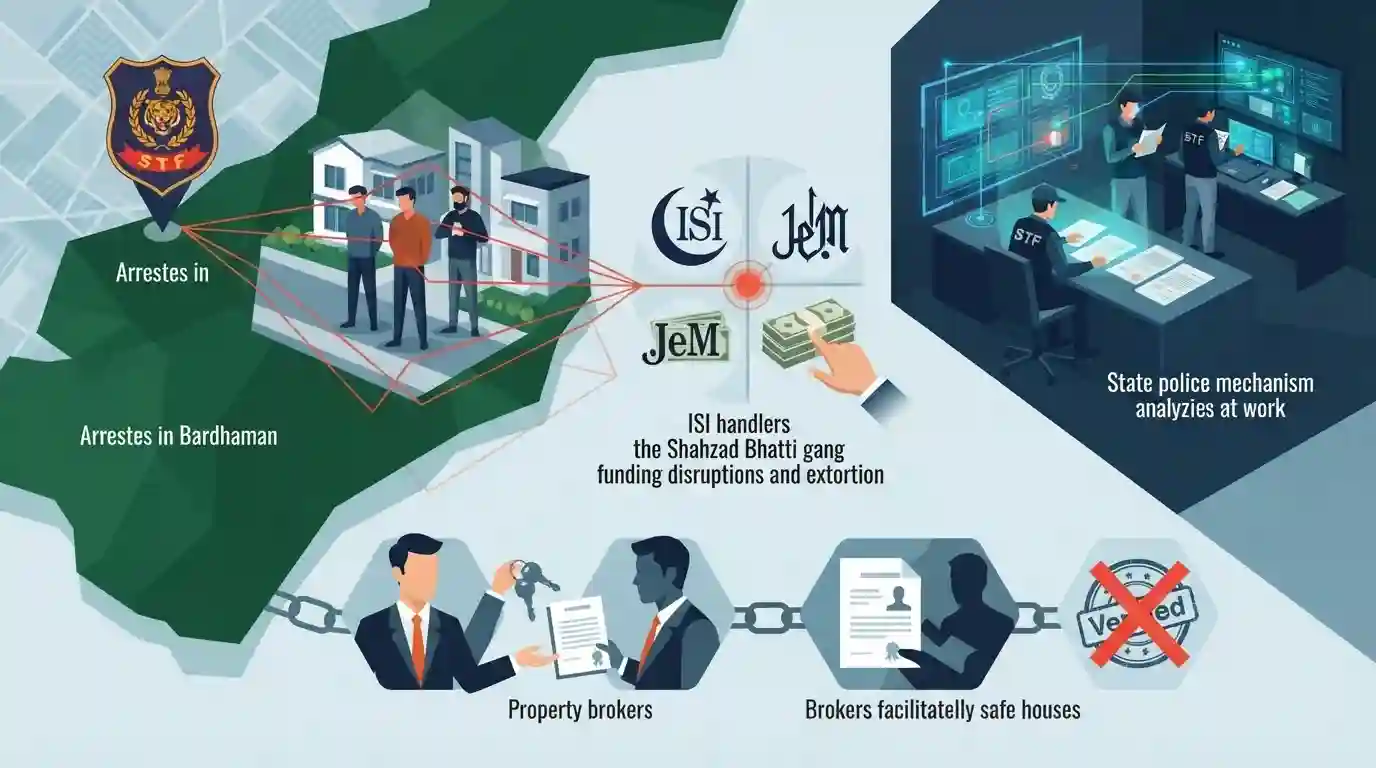
A posh township in West Bengal's Bardhaman has been shaken following the arrest of Hamim Mondal, a key operative of a Pakistan-backed espionage module linked to Jaish-e-Mohammed (JeM). The Bengal Special Task Force (STF) also arrested two of his associates, exposing a network orchestrated by ISI handlers and the Shahzad Bhatti gang aimed at carrying out disruptions and extortion. The incident has cast a spotlight on unauthorized property brokers who allegedly facilitated safe houses for the operatives without verification.
Key Points
- Bengal's Special Task Force (STF) arrested Hamim Mondal from a posh township in Bardhaman for his involvement in an ISI-backed, JeM-linked espionage module.
- Two other close aides, Arpita Sarkar and Aditya Singh, were also arrested for their roles in the terror ring.
- The module, linked to Pakistan's Shahzad Bhatti gang, was tasked with low-cost, high-impact disruptions, including honey-trapping political figures for extortion.
- Investigations are ongoing into unauthorized property brokers in the township who facilitated accommodations for the operatives without proper police verification.
Important Terms
Special Task Force (STF)

A specialized state-level police unit in India designed to counter major criminal activities, insurgencies, and terrorism. The Bengal STF targets urban organized crime, espionage networks, and cross-border terrorism within the state.
UPSC context
GS Paper 3. Highlights the critical role of state police mechanisms and specialized forces in tackling internal security threats and terrorism.
Jaish-e-Mohammed (JeM)
A Pakistan-based extremist militant group founded in 2000. It seeks to separate Jammu and Kashmir from India and has executed major terror attacks, including the 2001 Parliament attack and the 2019 Pulwama bombing.
UPSC context
GS Paper 3. Important for understanding cross-border terrorism, non-state actors, and ongoing security challenges to India's territorial integrity.
Inter-Services Intelligence (ISI)
Pakistan's premier foreign intelligence agency, responsible for espionage and covert operations. Indian authorities consistently link it to the funding, training, and strategic direction of anti-India terror modules and proxy conflicts.
UPSC context
GS Paper 3. Crucial for studying state-sponsored terrorism, the role of external state actors in creating internal security challenges, and espionage networks.
Shahzad Bhatti gang
A Pakistan-based organized crime network involved in cross-border smuggling of arms and narcotics. It facilitates terror operations by providing logistical support, radicalizing youth, and coordinating illicit activities for extremist outfits.
UPSC context
GS Paper 3. Illustrates the dangerous nexus between transnational organized crime and terrorism, highlighting issues like narco-terrorism and illicit arms trafficking.
Prelims Trap
The National Investigation Agency (NIA) has exclusive initial jurisdiction over all terror-related arrests and espionage cases in India.
Law and order is a State subject. State police (STFs) have initial jurisdiction; the NIA takes over scheduled offences upon MHA direction, not exclusively from day one.
Static Concepts Connected
How does organized crime intersect with terrorism in India?
- Funding: Extortion, smuggling, and hawala networks provide the critical financial lifeblood for cross-border terror logistics.
- Logistics: Criminal syndicates supply safe houses, forged documents, unregistered SIM cards, and local operational knowledge.
- Recruitment: Local gangs are increasingly used as recruitment pools for radicalization, acting as disposable foot soldiers for high-impact disruptions.
What are the jurisdictional boundaries of the NIA vs State Police?
- Concurrent Power: NIA has concurrent jurisdiction and can investigate scheduled offences across India without state permission, but states also retain power to investigate.
- Initial Jurisdiction: State police (like STFs) often register the initial FIR. The MHA decides within 15 days if the NIA should take over.
- Scheduled Offences: NIA's power is limited strictly to offences under Acts listed in its schedule, such as the UAPA and Anti-Hijacking Act.
Cross-Topic Patterns
Urban Anonymity and Real Estate Regulation
The use of unregistered property brokers by sleeper cells highlights security loopholes in urban housing, linking internal security directly to weak municipal enforcement and informal real estate markets.
Cyber Social Engineering and Espionage
The module's use of honey-trapping for extortion merges traditional espionage with modern cyber-enabled social engineering, demonstrating a rising threat vector often explored in GS3 cyber-security.

Expect a GS3 Mains question on 'urban anonymity' facilitating sleeper cells and the evolving crime-terror nexus in India's tier-2 cities.
