Jeevan Jyoti Project Establishes Rural Vision Centres in Alwar
Source:The Hindu ↗
Why It Matters
Public health initiatives, rural healthcare infrastructure, and the role of NGOs in supplementing state efforts are key focus areas for RPSC RAS Prelims, often tested under Rajasthan-specific social welfare and development schemes.
Summary
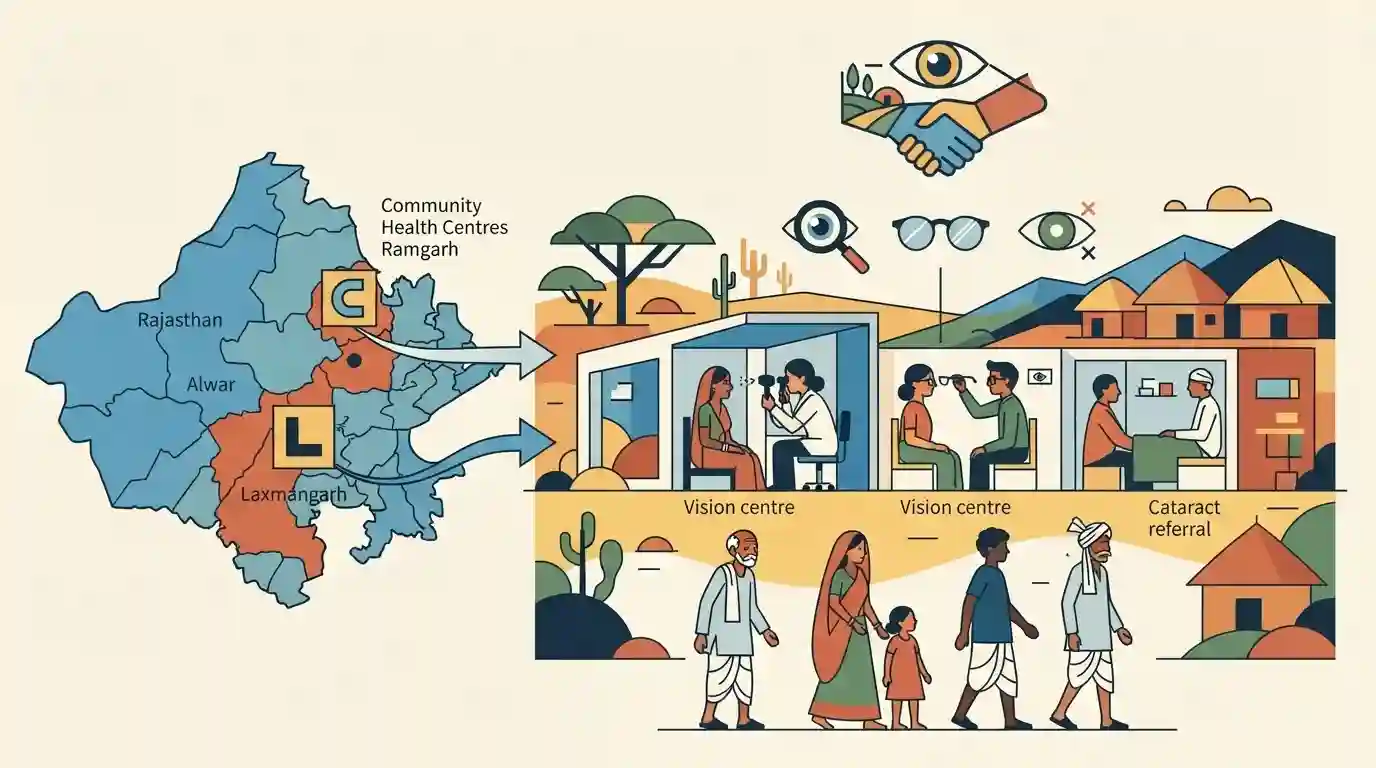
The Jeevan Jyoti Project, an initiative by NGO Sightsavers India, is strengthening rural eye health services in Rajasthan's Alwar district by establishing dedicated vision centres. Located at Community Health Centres (CHCs) in Ramgarh and Laxmangarh, these centres aim to combat preventable blindness by offering comprehensive eye examinations, refractive error corrections, and timely cataract referrals for rural populations who otherwise lack access to specialized healthcare facilities.
Key Points
- The Jeevan Jyoti Project, executed by NGO Sightsavers India, has launched vision centres at Community Health Centres (CHCs) in Alwar, Rajasthan.
- The initiative focuses on strengthening rural eye care in the remote blocks of Ramgarh and Laxmangarh by providing accessible refractive services and cataract identification.
- The project represents a collaborative model wherein non-profits supplement the state's public health infrastructure to reduce preventable blindness in rural areas.
Important Terms
Jeevan Jyoti Project

A collaborative initiative by NGO Sightsavers India and the government to strengthen rural eye health services, establish vision centres, and reduce avoidable blindness in Rajasthan's Alwar district.
UPSC context
Relevant for GS Paper 2 (Health). Illustrates effective NGO-government-corporate partnerships in decentralized rural healthcare delivery.
Sightsavers India
A development organization working to eliminate avoidable blindness and promote equal opportunities for persons with disabilities through inclusive healthcare, education, and advocacy programs across India.
UPSC context
Relevant to GS Paper 2 (Role of NGOs). Highlights the critical contribution of non-state actors to public health and disability rights.
Community Health Centres (CHCs)
Secondary-level facilities in India's three-tier rural healthcare system. Acting as referral units for Primary Health Centres, they provide specialized medical services, including surgery and pediatrics.
UPSC context
Critical for GS Paper 2 (Social Sector/Health). Tests foundational knowledge of India's rural public health infrastructure and service delivery mechanisms.
Prelims Trap
Right to Sight is a centrally mandated statutory right under the National Health Mission.
"Right to Sight" is a pioneering state-level policy implemented by Rajasthan, not a central statutory mandate. It relies heavily on NGO partnerships to reduce blindness prevalence.
Static Concepts Connected
What is the role of Community Health Centres (CHCs) in the rural health tier?
- Referral Hub: CHCs act as the First Referral Units (FRUs) for curative care, handling cases escalated from Primary Health Centres (PHCs).
- Specialist Care: They are mandated to provide specialized care (surgeons, physicians, gynaecologists, pediatricians), though rural India currently faces a ~80% vacancy rate for these roles.
- Infrastructure Norms: A standard CHC serves a population of 80,000 to 1,20,000 and is equipped with 30 beds, an operation theatre, and diagnostic facilities.
What are the core components of the National Programme for Control of Blindness (NPCB)?
- Global First: Launched in 1976 as a centrally-sponsored scheme, making India the first country globally to initiate a dedicated national blindness control program.
- Evolving Mandate: Historically focused on subsidized cataract surgeries, the mandate has expanded to cover diabetic retinopathy, glaucoma, corneal blindness, and refractive errors.
- Decentralized Execution: The program heavily utilizes District Blindness Control Societies (DBCS) and NGO collaborations to facilitate rural screening and outreach camps.
Cross-Topic Patterns
Embedded NGO-State PPP Models
Embedding NGO services within existing state CHCs prevents the creation of parallel health infrastructures. This is an emerging best practice for sustainable capacity building in GS-2 Governance.
State-led Rights-based Welfare
Rajasthan's "Right to Sight" policy demonstrates a regional shift towards statutory health guarantees, setting a precedent for state-led welfare legislation independent of central insurance schemes.

Expect a GS-2 Mains question analyzing NGO-state collaborations to bridge the 80% specialist vacancy gap in rural Community Health Centres.
Linked PYQs · 3
Linked PYQs · 3
- 2024RPSC_PRELIMSGS1
Who among the following are eligible for Amrita Scheme in Rajasthan? (i) Persons with specially abled 40% or more disability. (ii) Specially abled category with more than 40% percent disability. (iii) B.P.L. family persons. (iv) Families where 2 or more people are specially abled. (v) Families with a specially abled transgender.
- 2025RPSC_PRELIMSGS1
Who is eligible for the Aastha scheme in Rajasthan?
- 2025RPSC_PRELIMSGS1
What is the main objective of the “Rajasthan Urban Area Development Program (Phase-III)”?
