PM JANMAN Scheme and Electrification of PVTG Hamlets
Source:The Hindu ↗
Why It Matters
It serves as a highly specific case study for GS2 (Social Justice), demonstrating the real-world impact and execution gaps of flagship tribal welfare policies like the PM JANMAN scheme in providing last-mile connectivity to marginalized PVTGs.
Summary
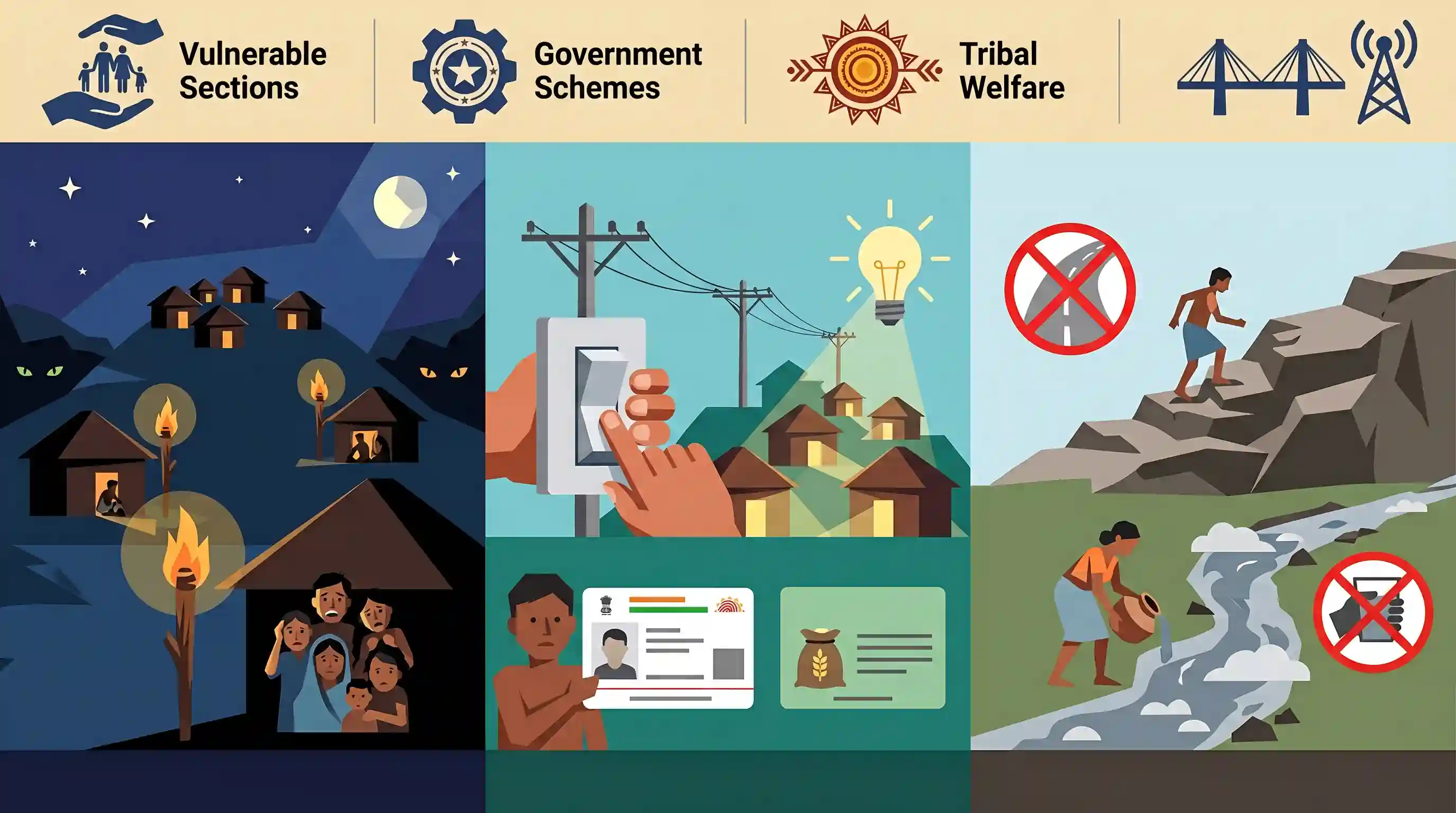
The Particularly Vulnerable Tribal Group (PVTG) Kondh hamlet of Jeelugulova in Anakapalli district, Andhra Pradesh, has received electricity for the first time under the PM JANMAN scheme. Previously, the 50 residents lived without power, relying on traditional wooden torches ('kagadalu') and remaining indoors at night for fear of wild animal attacks. While electrification, along with the provision of Aadhaar and ration cards, marks a significant developmental milestone following local protests and official interventions, the hilltop village still struggles with the absence of fundamental amenities such as a proper road network and safe drinking water supply.
Key Points
- Jeelugulova, a remote hilltop hamlet in Andhra Pradesh's Anakapalli district, received electricity for the first time.
- The hamlet is home to 50 members of the Kondh tribe, recognized as a Particularly Vulnerable Tribal Group (PVTG).
- Electrification was carried out under the Pradhan Mantri Janjati Adivasi Nyaya Maha Abhiyan (PM JANMAN) scheme.
- Before the electrification, villagers relied on traditional wooden torches ('kagadalu') and avoided venturing out at night due to the fear of wild animals.
- Despite recently receiving electricity, Aadhaar cards, and ration cards following protests, the hamlet continues to lack essential infrastructure like an all-weather road and a safe drinking water source.
Important Terms
PM JANMAN (Pradhan Mantri Janjati Adivasi Nyaya Maha Abhiyan)

A 2023 Union Mission focused on improving the socio-economic conditions of 75 Particularly Vulnerable Tribal Groups (PVTGs) through 11 critical interventions like housing, clean water, and electricity.
UPSC context
GS Paper II: Government schemes for vulnerable sections; tests knowledge of tribal welfare and inter-ministerial convergence models.
Particularly Vulnerable Tribal Groups (PVTG)
The most marginalized sub-classification within Scheduled Tribes, identified by criteria including pre-agricultural technology, stagnant/declining population, low literacy, and a subsistence-level economy.
UPSC context
GS Paper I & II: Indian Society and Social Justice; essential for understanding tribal deprivation and targeted development strategies.
Kondh (Tribe)
An indigenous Dravidian tribal group primarily residing in Odisha and Andhra Pradesh. They are known for their unique language (Kui), shifting cultivation (Podu), and traditional forest-based livelihoods.
UPSC context
GS Paper I: Geography and Culture; tests knowledge of major tribal groups, their distribution, and socio-economic challenges.
AP EPDCL (Andhra Pradesh Eastern Power Distribution Company Limited)
The state-owned utility responsible for electricity distribution in the eastern districts of Andhra Pradesh, including the tribal agencies of Visakhapatnam and Anakapalli.
UPSC context
GS Paper II: Governance; represents the role of state agencies in implementing last-mile infrastructure and service delivery.
Zilla Parishad
The highest tier of the three-tier Panchayati Raj system at the district level. It is responsible for planning, coordinating, and implementing rural development and welfare programs.
UPSC context
GS Paper II: Polity & Governance; tests understanding of local self-government and the decentralized planning process.
Prelims Trap
"Particularly Vulnerable Tribal Groups (PVTGs) are distributed across all States and Union Territories of India."
PVTGs are not spread across all states. They are officially recognized in exactly 18 States and 1 Union Territory (Andaman & Nicobar Islands).
Static Concepts Connected
What are the four strict criteria for classifying a community as a PVTG?
- Pre-agricultural tech: Reliance on hunting, gathering, or basic traditional farming techniques without modern agricultural tools.
- Declining population: A stagnant or negatively growing demographic over successive census counts.
- Low literacy: Extremely poor educational attainment compared to the broader scheduled tribe or national average.
- Subsistence economy: Economic activities are strictly limited to survival, with little to no surplus or market integration.
What are the core operational features of the PM-JANMAN scheme?
- Saturation approach: Aims to provide 100% coverage of basic amenities like housing, all-weather roads, safe water, and electricity to isolated PVTG habitations.
- Ministry convergence: Coordinates 11 critical developmental interventions across 9 different central ministries, with the Ministry of Tribal Affairs as the nodal agency.
Cross-Topic Patterns
PVTG Habitat Rights under FRA 2006
PVTGs are uniquely entitled to 'Habitat Rights' under the Forest Rights Act to secure customary territories. The Kondh tribe's infrastructure struggles highlight gaps in realizing these spatial rights.
Linguistic mapping of tribal groups
The Kondh tribe speaks Kui, a South-Central Dravidian language. UPSC frequently tests tribal linguistic families, often tricking candidates by misattributing Dravidian tribal languages to the Austroasiatic family.

Expect a 2026 multi-statement question combining PM-JANMAN convergence mechanisms, PVTG identification criteria, and Kondh geography.
Linked PYQs · 4
Linked PYQs · 4
- 2019PrelimsGS1
Consider the following statements about Particularly Vulnerable Tribal Groups (PVTGs) in India : 1. PVTGs reside in 18 States and one Union Territory. 2. A stagnant or declining population is one of the criteria for determining PVTG status. 3. There are 95 PVTGS officially notified in the country so far. 4. Irular and Konda Reddi tribes are included in the list of PVTGs. Which of the statements given above are correct?
- 2021PrelimsGS1
At the national level, which ministry is the nodal agency to ensure effective implementation of the Scheduled Tribes and Other Traditional Forest Dwellers (Recognition of Forest Rights) Act, 2006?
- 2019MainsGS2
Performance of welfare schemes that are implemented for vulnerable sections is not so effective due to absence of their awareness and active involvement at all stages of policy process. Discuss.
- 2023MainsGS2
“Development and welfare schemes for the vulnerable, by its nature, are discriminatory in approach.” Do you agree? Give reasons for your answer.
