Japanese Encephalitis Vaccination Drive And Disease Vector Risks
Source:The Hindu ↗
Why It Matters
Vector-borne diseases and government immunization programs are recurrent themes in UPSC exams. Understanding the transmission cycle, vectors (Culex mosquitoes), and reservoirs (pigs/water birds) of Japanese Encephalitis is important for questions on public health and science.
Summary
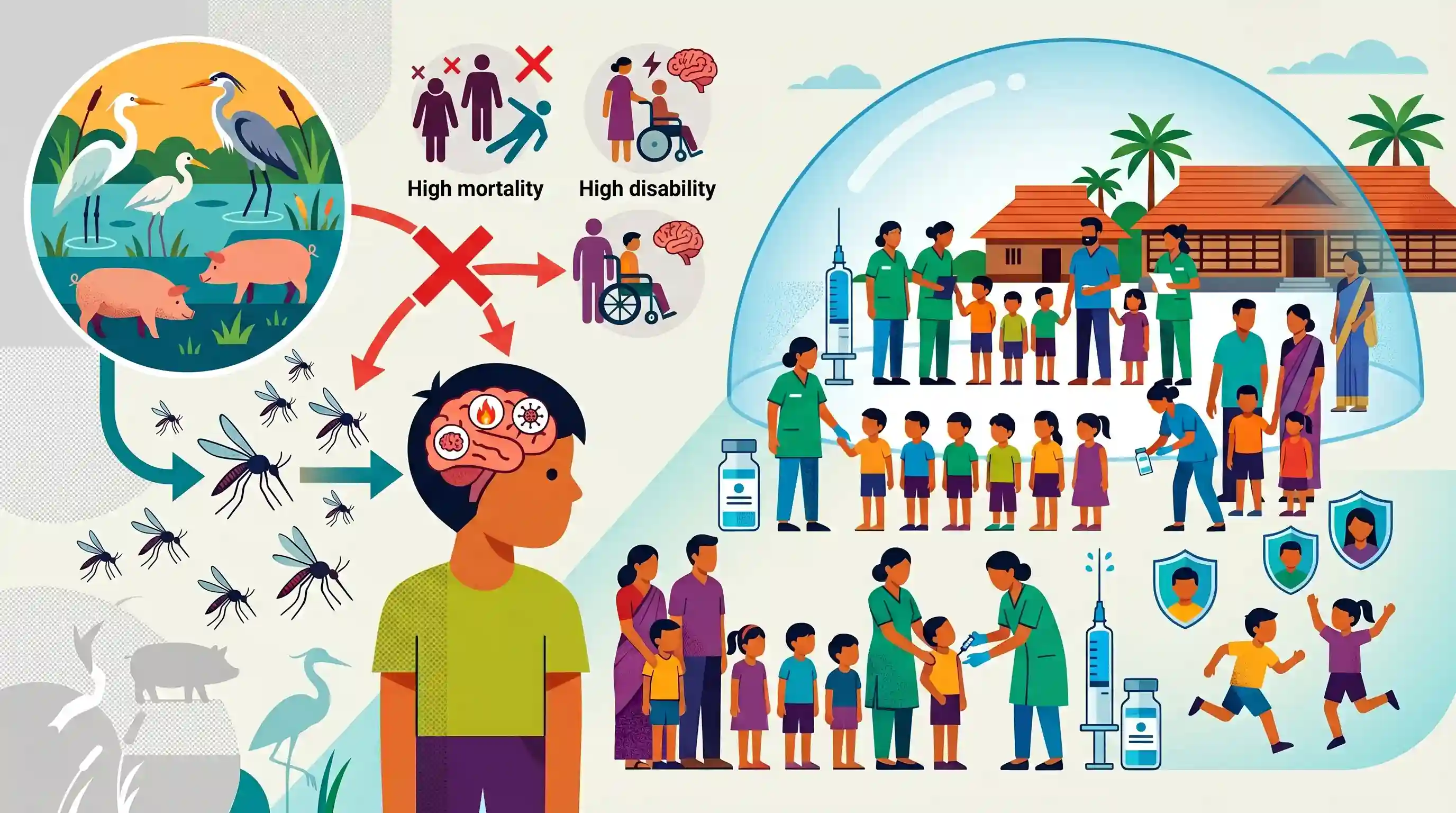
The Health department in Kozhikode, Kerala, is actively conducting a vaccination campaign against Japanese Encephalitis (JE) for children aged 1 to 15, amidst efforts to dispel concerns regarding vaccine safety. JE is a dangerous vector-borne viral disease transmitted by Culex mosquitoes, with pigs and water birds acting as the primary animal reservoirs. While the disease does not spread from human to human, it poses significant public health risks due to its severity. The infection carries a high mortality rate of around 30%, and a substantial proportion of survivors (30%) face lifelong neurological and physical disabilities, making preventive vaccination critical.
Key Points
- The Health department in Kozhikode has launched a Japanese Encephalitis (JE) vaccination drive targeting children aged 1-15, assuring the public of the vaccine's safety.
- JE is a viral disease transmitted to humans through the bites of infected Culex mosquitoes, which acquire the virus from animal reservoirs like pigs and water birds.
- The disease is not transmitted directly from person to person.
- JE is severe, with a mortality rate of approximately 30%, and another 30% of survivors suffer from long-term neurological or physical disabilities.
Important Terms
Japanese Encephalitis (JE)

A mosquito-borne viral infection (flavivirus) causing brain inflammation. Prevalent in Asia, it has a high mortality rate (approx. 30%) and often causes permanent neurological or physical disabilities in survivors. It is not transmissible between humans.
UPSC context
GS Papers II (Health) and III (Science). Tests knowledge of vaccine-preventable diseases and critical public health challenges.
Culex Mosquito
The primary mosquito vector (specifically Culex tritaeniorhynchus) for Japanese Encephalitis. These mosquitoes breed in stagnant water, such as rice paddies, and transmit the virus from animal reservoirs (pigs and birds) to humans.
UPSC context
GS Paper III (Science/Environment). Tests understanding of vector biology, disease transmission cycles, and rural health risks.
Acute Encephalitis Syndrome (AES)
A group of clinically similar neurological disorders characterized by fever and mental confusion. Japanese Encephalitis is a leading viral cause of AES in India, particularly affecting children in endemic regions like Uttar Pradesh and Bihar.
UPSC context
GS Paper II (Health). Tests ability to distinguish between broad clinical syndromes and specific pathological causes in India.
Zoonotic Disease
Diseases naturally transmissible from vertebrate animals to humans. Japanese Encephalitis is a metazoonosis, where the virus cycles between mosquitoes, pigs, and water birds before accidentally infecting humans through a mosquito bite.
UPSC context
GS Paper III (Environment/Science). Highlights the 'One Health' approach and links between ecological health and human epidemics.
Universal Immunization Programme (UIP)
A flagship Indian health program launched in 1985 providing free vaccines against 12+ diseases. The Japanese Encephalitis vaccine is integrated into this program for routine immunization in 343 endemic districts.
UPSC context
GS Paper II (Government Schemes). Tests knowledge of public health infrastructure and maternal/child mortality interventions.
JENVAC
India’s first indigenously developed, inactivated vaccine for Japanese Encephalitis. Created through a public-private partnership (NIV and Bharat Biotech), it represents a significant step toward vaccine self-reliance and national health security.
UPSC context
GS Paper III (Science & Technology). Highlights indigenous technological advancements and 'Atmanirbhar Bharat' in the healthcare sector.
Prelims Trap
The JE vaccine is universally administered nationwide to all children under India's Universal Immunization Programme.
Unlike Polio or BCG, the JE vaccine is a sub-national vaccine. It is selectively administered only in identified endemic districts under the UIP.
Static Concepts Connected
How does the Japanese Encephalitis transmission cycle operate?
- Vector: Transmitted by Culex mosquitoes (such as Culex tritaeniorhynchus), which primarily breed in flooded rice paddies and large water bodies.
- Amplifying Hosts: Pigs and wading water birds act as reservoirs where the virus multiplies and is maintained in the ecosystem.
- Dead-end Hosts: Humans get infected but do not produce enough virus to infect feeding mosquitoes, halting further human-to-mosquito-to-human transmission.
How are vaccines categorized geographically under India's UIP?
- Nationwide rollout: Core vaccines like BCG, OPV, and Measles-Rubella are given to all eligible children across the entire country.
- Endemic-only rollout: The JE vaccine is restricted to specifically identified high-burden or endemic districts, rather than being administered nationally.
Cross-Topic Patterns
Rice Cultivation and Disease Vectors
Flooded paddy fields provide ideal breeding grounds for Culex mosquitoes, linking agricultural cropping patterns directly to endemic public health vulnerabilities.
One Health and Zoonotic Spillover
Because pigs and migratory water birds are primary reservoirs, JE control necessitates a 'One Health' approach integrating human, animal, and environmental management.

2026 prelims will likely contrast Aedes vs Culex vectors, focusing on human-to-human transmission vs dead-end hosts in viral diseases.
Linked PYQs · 5
Linked PYQs · 5
- 2016PrelimsGS1
'Mission Indradhanush' launched by the Government of India pertains to
- 2017PrelimsGS1
Consider the following statements: 1. In tropical regions, Zika virus disease is transmitted by the same mosquito that transmits dengue. 2. Sexual transmission of Zika virus disease is possible. Which of the statements given above is/are correct?
- 2023PrelimsGS1
'Wolbachia method' is sometimes talked about with reference to which one of the following?
- 2020PrelimsGS1
What is the importance of using Pneumococcal Conjugate Vaccines in India? 1. These vaccines are effective against pneumonia as well as meningitis and sepsis. 2. Dependence on antibiotics that are not effective against drug-resistant bacteria can be reduced. 3. These vaccines have no side effects and cause no allergic reactions. Select the correct answer using the code given below:
- 2006PrelimsGS1
Consider the following statements: 1. Meningococcal Meningitis is transmitted from person to person by mosquito bites. 2. Vomiting and neck pain are two of the symptoms of Meningococcal meningitis. Which of the statements given above is/are correct?
