JD(U) Council Passes Resolutions on Leadership Transitions in Bihar
Source:economictimes ↗
Why It Matters
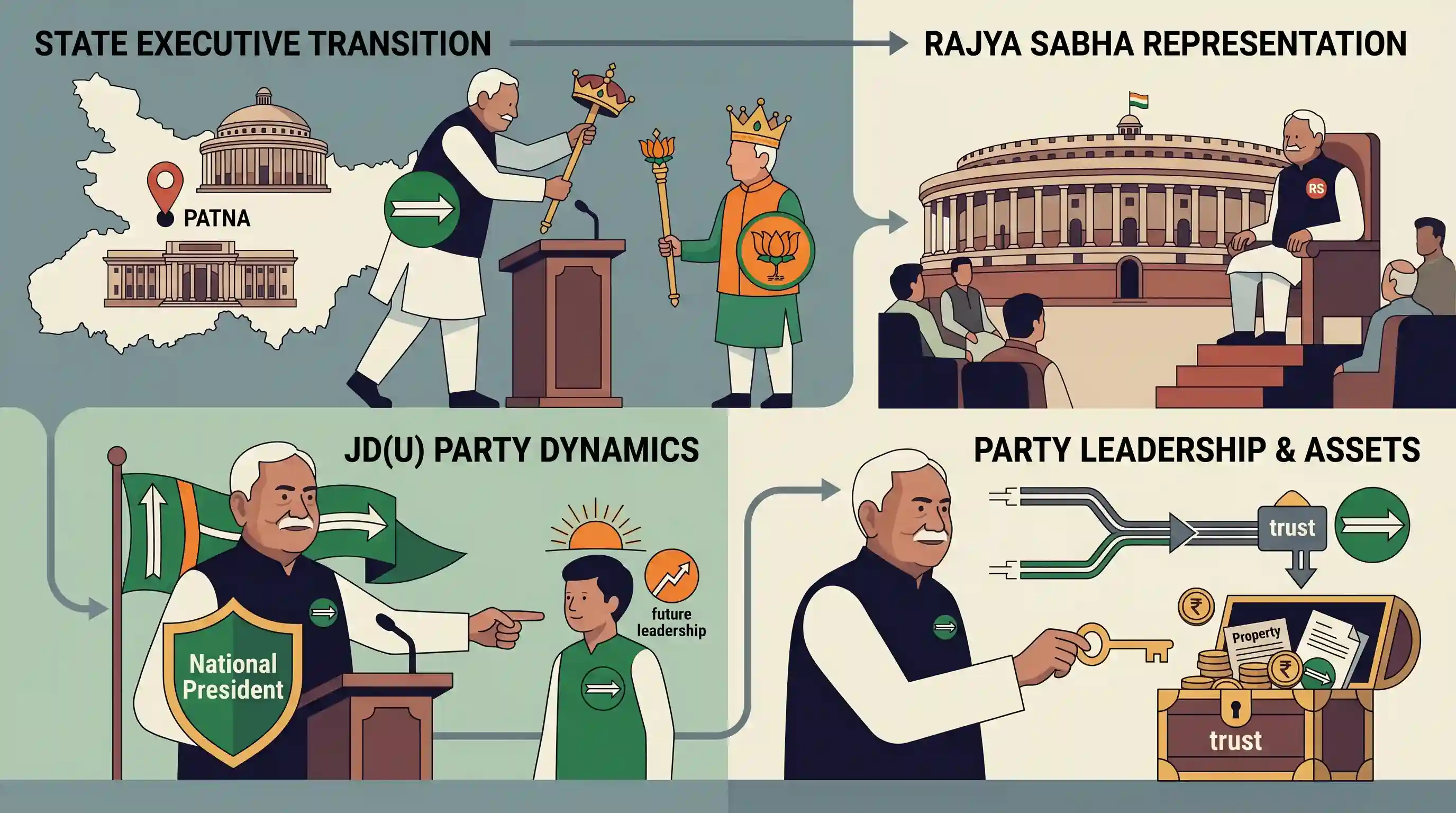
This development marks a significant transition in Bihar state politics—namely, Nitish Kumar stepping down as CM to enter the Rajya Sabha, the appointment of Samrat Choudhary as the first BJP Chief Minister of Bihar, and the elevation of Nishant Kumar within JD(U). Understanding these key political positions, the constitutional processes of CM appointment, and representation in the Rajya Sabha are central to BPSC Prelims polity questions.
Summary
The article covers key political transitions within the Janata Dal (United) (JD(U)) and the wider Bihar coalition government. Nitish Kumar has stepped down as Chief Minister and moved to the Rajya Sabha, with BJP's Samrat Choudhary taking over as Chief Minister. Meanwhile, JD(U) has positioned Nitish Kumar's son, Nishant Kumar, as its future leadership face. Additionally, Nitish Kumar has been ratified as the party's national president and authorized to form a trust to manage party assets.
Key Points
- During joint meetings of its national council and state council, the Janata Dal (United) (JD(U)) officially ratified the re-election of Nitish Kumar as its national president.
- The party's state council passed a resolution identifying Nitish Kumar's son, Nishant Kumar (44), as the party's 'future' and calling for a bigger role for him. Nishant Kumar currently serves as the Health Minister in the Bihar government.
- Nitish Kumar stepped down as the Chief Minister of Bihar in April 2026, shortly after turning 75 in March, and was subsequently elected to the Rajya Sabha.
- Samrat Choudhary has taken over as the current Chief Minister, becoming the first leader from the Bharatiya Janata Party (BJP) to head a government in Bihar. The JD(U) passed a resolution praising his governance and continuity of Kumar's work.
- The JD(U) national council authorized Nitish Kumar to set up a trust to manage the party's movable and immovable assets.
- On the international front, JD(U) passed resolutions welcoming the West Asia agreement between Iran and the United States, and urging a bilateral mechanism to resolve border issues with Nepal.
Important Terms
Janata Dal (United) (JD(U))

A regional political party in India, primarily active in Bihar. Established in 2003, it advocates social democracy and secularism, historically playing a crucial role in state governance and national coalitions.
UPSC context
GS Paper II: Parliament and State Legislatures, role of regional parties, and features of the Representation of People's Act.
Bharatiya Janata Party (BJP)
One of India's principal national political parties, founded in 1980. It champions a nationalist ideology and is currently a dominant force in central governance and multiple state administrations, including Bihar.
UPSC context
GS Paper II: Structural and functional aspects of political parties, multi-party system, and elections in India.
Chief Minister
The elected head of government at the state level in India, appointed by the Governor. The Chief Minister wields de facto executive power and leads the State Council of Ministers.
UPSC context
GS Paper II: State Executive, discretionary powers of the Governor, and federal-state executive relations.
Rajya Sabha
The upper house of India's bicameral Parliament, representing the states and union territories. Members are largely elected by state legislative assemblies, serving as a permanent house for legislative oversight.
UPSC context
GS Paper II: Bicameralism, federalism, representation of states in Parliament, and parliamentary procedures.
Coalition Government
A cabinet of a parliamentary government in which multiple political parties cooperate, reducing the dominance of any single party. This occurs when no party wins an absolute majority in elections.
UPSC context
GS Paper II: Federal structure, coalition politics, political dynamics, and stability of state executive organs.
Prelims Trap
The creation or abolition of a Legislative Council requires a constitutional amendment under Article 368.
Under Article 169, even though the state assembly must pass the resolution by a special majority, Parliament can pass the law creating/abolishing the council by a simple majority, and it is explicitly not considered a constitutional amendment under Article 368.
Static Concepts Connected
How is a Legislative Council created or abolished under Article 169?
- State Resolution: The Legislative Assembly of the concerned state must pass a resolution by a special majority (majority of total membership and 2/3rds of members present and voting).
- Parliamentary Law: Parliament can then approve or reject the resolution by a simple majority (ordinary legislative process).
- No Article 368 Amendment: Such an Act of Parliament is not deemed a constitutional amendment under Article 368, bypassing the complex amendment route.
What are the key provisions of Article 164 regarding State Ministers?
- Appointment Process: The Chief Minister is appointed by the Governor, and other Ministers are appointed by the Governor on the advice of the Chief Minister.
- Responsibility and Tenure: The Ministers hold office during the pleasure of the Governor, but the Council of Ministers is collectively responsible to the Legislative Assembly.
- Non-Legislator Limit: A Minister who is not a member of the State Legislature for any period of six consecutive months ceases to be a Minister at the expiration of that period.
Cross-Topic Patterns
Coalition dynamics and gubernatorial discretion
Shifting state-level coalitions regularly test the limits of the Governor's discretionary powers under Article 163 regarding cabinet appointments and floor tests.
Federalism and sub-national diplomacy
State-level resolutions on border issues (like Bihar-Nepal) highlight the emergence of sub-national diplomacy within India's broader federal foreign policy framework.

State legislative dynamics, specifically Article 169 processes and historic bicameral origins, are high-probability areas for GS-II 2026.
Linked PYQs · 4
Linked PYQs · 4
- 2024-EBPSC_PRELIMSGS1
Who presented the Bihar Budget 2024-25 in the State Assembly?
- 2023BPSC_PRELIMSGS1
The representation in the Rajya Sabha includes
- 2024-IBPSC_PRELIMSGS1
Which of the following Acts converted Unicameral Legislature of Bihar into Bicameral : Bihar Legislative Assembly and Bihar Legislative Council?
- 2022BPSC_PRELIMSGS1
How many seats are reserved for the SC candidates in the Bihar Legislative Assembly?
