JD(U) National Council Endorses Nitish Kumar as National President
Source:The Hindu ↗
Why It Matters
The 'Saat Nischay' (Seven Resolves) program is Bihar's flagship policy framework for regional development and is frequently tested in BPSC examinations. The introduction of 'Saat Nischay-3' and changes in the executive and political leadership of Bihar's ruling party are highly critical for state-specific current affairs.
Summary
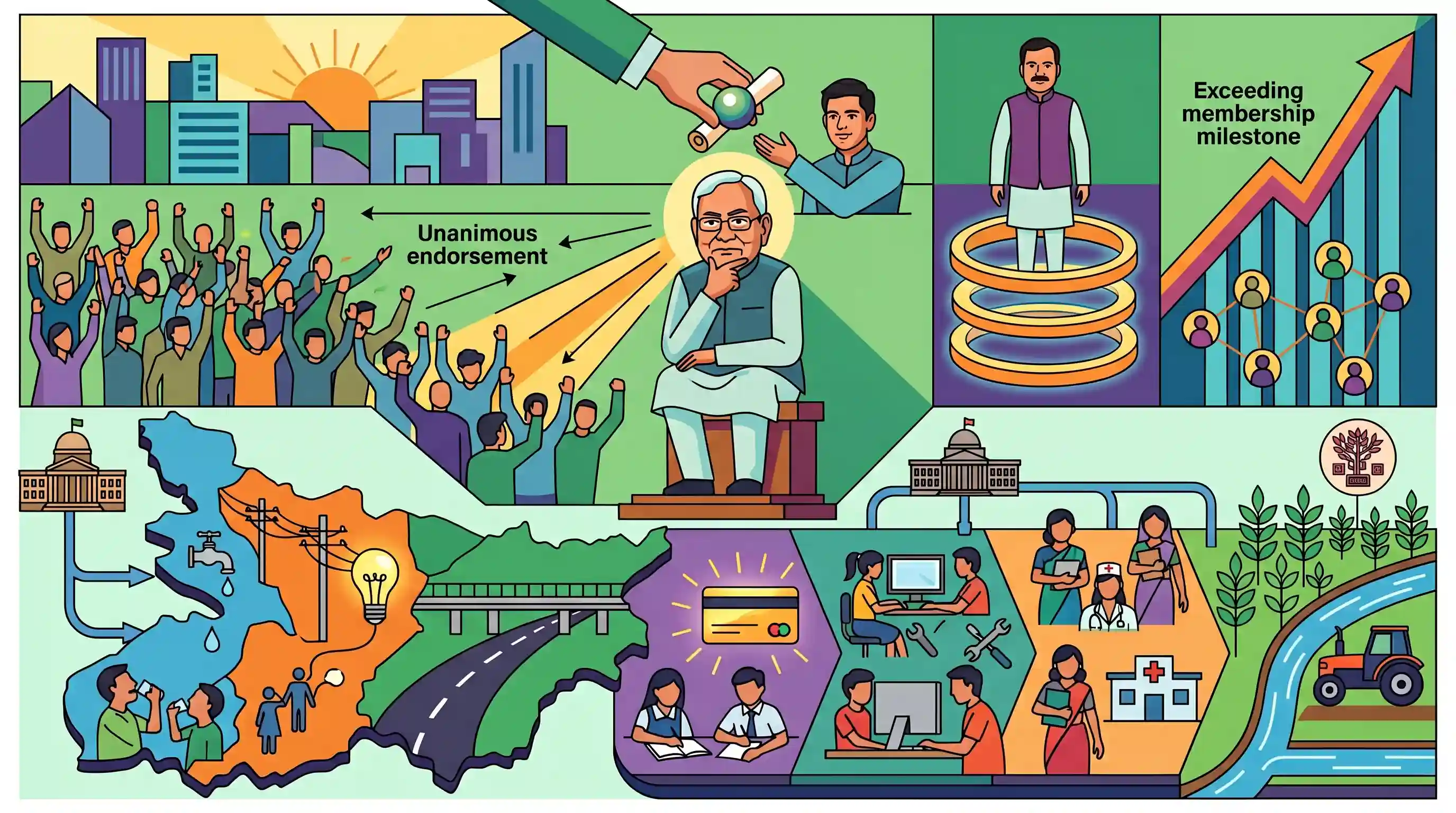
On June 21, 2026, the Janata Dal (United) National Council in Patna unanimously endorsed Nitish Kumar as its national president, while key party leaders declared his son, Nishant Kumar, as the future of the party's political legacy. The council also ratified Umesh Singh Kushwaha as the state president for a third term and highlighted the party's milestone of exceeding 10 million members. Nitish Kumar emphasized that the Bihar government, with central support, is pushing forward public welfare initiatives under the newly formulated 'Saat Nischay-3' (Seven Resolves-3) program.
Key Points
- The JD(U) National Council unanimously endorsed Nitish Kumar as its national president at a meeting in Patna on June 21, 2026.
- Nitish Kumar announced that JD(U)'s primary membership has officially exceeded 10 million (1 crore).
- JD(U) national working president Sanjay Kumar Jha and leader Rajiv Ranjan Singh alias Lalan Singh declared Nitish Kumar's son, Nishant Kumar, as the 'future' to carry forward the party's developmental vision.
- Umesh Singh Kushwaha was unanimously ratified as the JD(U) Bihar State President for a third consecutive term.
- The NDA government in Bihar is implementing welfare and infrastructure schemes, specifically introducing 'Saat Nischay-3' (Seven Resolves-3), with support from the Central government.
- The national council and executive meetings were attended by 223 representatives from 19 states, along with Bihar's Deputy Chief Ministers Bijendra Prasad Yadav and Vijay Kumar Choudhary, and all JD(U) MPs.
Important Terms
Saat Nischay-3 (Seven Resolves-3)

The third phase (2025–2030) of Bihar's flagship development program, targeting income growth, doubling employment, agricultural advancement, industrialization, higher education, healthcare, and infrastructure.
UPSC context
GS Paper II (Welfare Schemes & Governance); tests sub-national governance models and regional socio-economic policies.
Saat Nischay (Seven Resolves) Program
Bihar’s flagship multi-phase development framework launched in 2015 to transform basic infrastructure, civic amenities, employment opportunities, and social welfare across the state.
UPSC context
GS Paper II (State Government Policies); tests understanding of decentralized development frameworks and state welfare agendas.
Janata Dal (United) / JD(U)
A prominent center-left, socialist regional political party in India, primarily active in Bihar and led by Nitish Kumar, advocating for social justice.
UPSC context
GS Paper II (Polity - Regional Parties); tests knowledge of party dynamics and federal structures in India.
National Democratic Alliance (NDA)
A center-right, multi-party political coalition in India led by the Bharatiya Janata Party (BJP), consisting of various national and regional parties.
UPSC context
GS Paper II (Polity - Coalition Governments); tests understanding of electoral alliances and federal governance.
Prelims Trap
A political party that registers over 10 million primary members across multiple states automatically qualifies for 'National Party' status.
ECI's criteria for National Party status under the Symbols Order, 1968 are based strictly on electoral performance (votes/seats), not raw membership size.
Static Concepts Connected
What are the criteria for ECI recognition as a National Party?
- Vote Share Rule: Secure at least 6% of valid votes in four or more states in Lok Sabha or Assembly polls, plus four Lok Sabha seats.
- Seat Share Rule: Win at least 2% of total Lok Sabha seats (11 seats) from at least three different states.
- State Party Rule: Be recognized as a state party in at least four states under the Symbols Order, 1968.
Cross-Topic Patterns
Sub-national welfare vs fiscal federalism
State-led frameworks like 'Saat Nischay' show how regional plans drive localized welfare, highlighting the need for fiscal cooperation with Centrally Sponsored Schemes.
Education quality vs distress outmigration
State-level investments to upgrade higher education institutions directly address regional disparities, attempting to retain local youth talent and counter domestic brain drain.

Mains 2026 may analyze how sub-national welfare models impact regional development and their alignment with cooperative fiscal federalism.
Linked PYQs · 2
Linked PYQs · 2
- 2020BPSC_PRELIMSGS1
Which of the following is not included in Seven Resolves (Saat Nishchay) of Bihar Government?
- 2024-EBPSC_PRELIMSGS1
Who presented the Bihar Budget 2024-25 in the State Assembly?
