JDA Initiates Land Acquisition for Jagatpura Road Link
Source:the-times-of-india ↗
Why It Matters
Infrastructure bottlenecks and statutory urban planning bodies (like the JDA, established under the JDA Act, 1982) are highly relevant topics for the RPSC RAS Prelims. Tracking infrastructure links to industrial clusters such as Prahladpura directly relates to questions on the economic geography of Rajasthan and state governance.
Summary
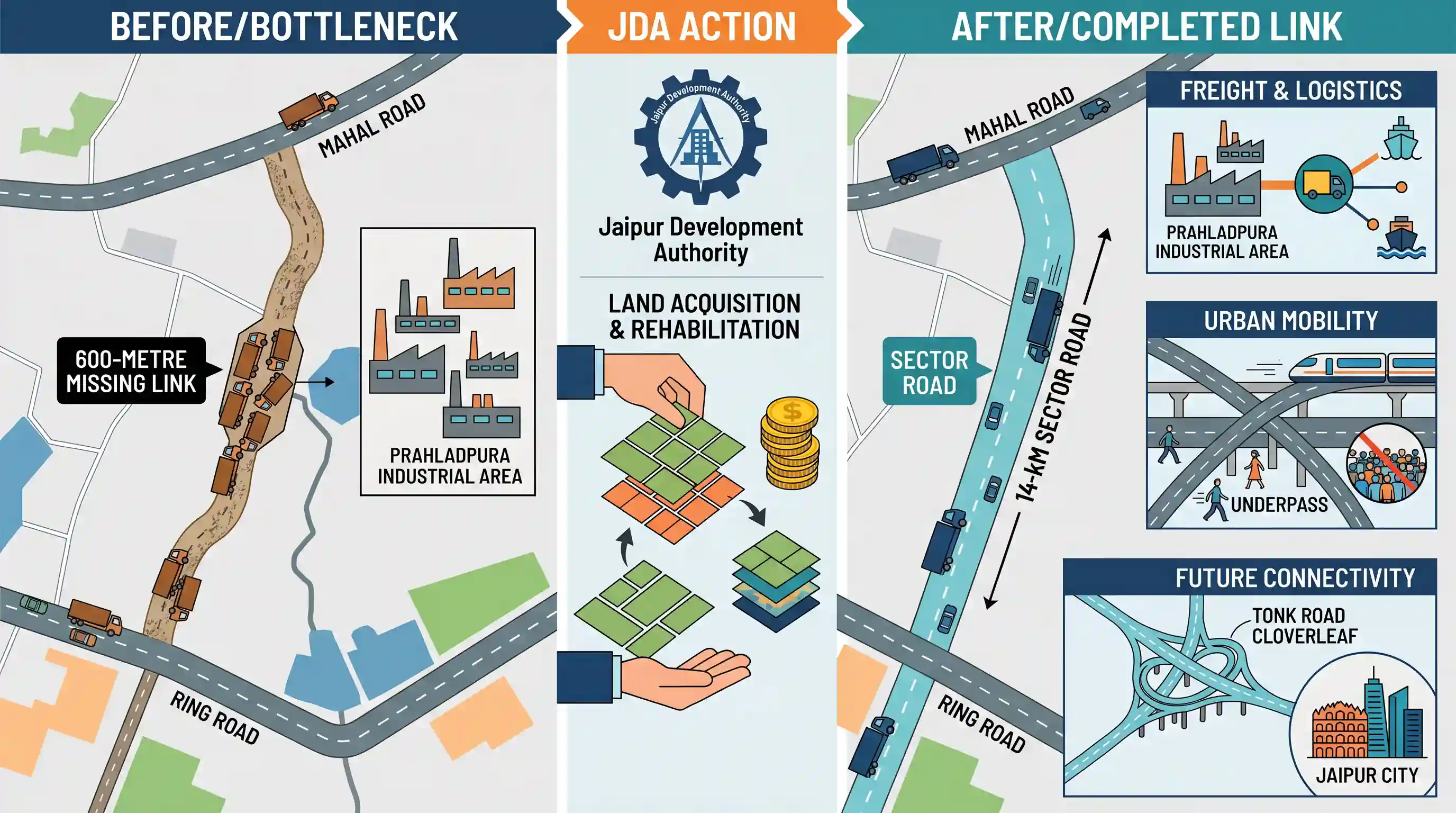
The Jaipur Development Authority (JDA) has initiated a land acquisition process to secure 24,000 square metres of land in Jagatpura. This will resolve a 600-metre missing link bottleneck in the Prahladpura area, completing a 14-km sector road connecting the Ring Road to Mahal Road. The project will establish direct freight and logistics connectivity for approximately 200 units in the Prahladpura Industrial Area and eventually link with the under-construction Tonk Road cloverleaf, improving urban mobility and industrial logistics in the Jaipur region.
Key Points
- The Jaipur Development Authority (JDA) has issued land acquisition notices to 27 landholders for 24,000 square metres of land in Jagatpura.
- The acquisition is aimed at completing a crucial 600-metre missing link of a sector road off Mahal Road in the Prahladpura area (Sanganer).
- The planned sector road is a 14-km-long, 200-foot-wide corridor intended to connect the Jaipur Ring Road with Balaji Crossing on Mahal Road.
- Completing this bottleneck stretch will provide direct high-capacity road access to nearly 200 industrial units in the Prahladpura Industrial Area.
- The land acquisition process involves local administration, including the Sanganer SDM and the concerned JMC deputy commissioner, with compensation paid as per prescribed statutory guidelines.
- In the future, this completed corridor will connect directly to the under-construction cloverleaf on Tonk Road, bypassing the congested Bilwa and Prahladpura underpasses.
Important Terms
Jaipur Development Authority

A statutory urban planning body under the Government of Rajasthan, responsible for implementing the master plan, infrastructure projects, and land development within the Jaipur metropolitan region.
UPSC context
GS Paper II (Statutory Bodies) and GS Paper III (Urban Development), testing urban planning paradigms and local governance execution.
Jaipur Development Authority Act, 1982
The Rajasthan state legislation that created and empowered the Jaipur Development Authority with statutory authority for land acquisition, town planning, zoning, and infrastructure coordination.
UPSC context
GS Paper II (Government Policies & Interventions), testing legislative frameworks for urban decentralization and statutory-body creation.
Jaipur Master Plan
A long-term urban planning and land-use blueprint prepared by the Jaipur Development Authority to direct sustainable growth, infrastructure building, and zoning regulations.
UPSC context
GS Paper I (Urbanization issues) and GS Paper III (Infrastructure), testing sustainable urban planning and metropolitan growth management.
Jaipur Municipal Corporation
The local self-government body responsible for civic administration, public health, sanitation, waste management, and basic municipal services in the city of Jaipur.
UPSC context
GS Paper II (Local Self-Government/74th Amendment Act), testing decentralization, urban local bodies (ULBs), and civic governance.
Prelims Trap
Consent of at least 70% of landholders is mandatory for all infrastructure land acquisitions under the LARR Act, 2013.
Under the LARR Act 2013, the requirement for prior consent (70% for PPP, 80% for private projects) is entirely waived when land is acquired directly by the government for public infrastructure or utility projects.
Static Concepts Connected
What are the core compensation and consent mandates of the LARR Act, 2013?
- Compensation Multiplier: Urban land compensation is 1 to 2 times the market value, whereas rural compensation ranges from 2 to 4 times.
- Mandatory Solatium: A mandatory 100% solatium (additional payment) is imposed on top of the land value to address compulsory acquisition.
- Consent Thresholds: Requires 70% consent for PPP and 80% for private projects, but exempts direct public sector acquisitions for public use.
What is the institutional conflict between Urban Parastatals and elected Local Bodies?
- Overlapping Jurisdictions: State-created statutory development authorities frequently overlap with municipal bodies, diluting the democratic powers mandated by the 74th Amendment.
- Accountability Deficit: Parastatals are headed by state-appointed bureaucrats rather than local elected representatives, resulting in a democratic deficit in urban planning.
Cross-Topic Patterns
Parastatals vs 74th Amendment
Development authorities bypass elected municipal corporations in land planning, creating governance conflicts that weaken democratic decentralization under the 74th Amendment.
Last-mile logistics & Gati-Shakti
Completing micro-bottlenecks in state industrial areas directly aligns with the National Logistics Policy's aim to lower overall transport costs through seamless local linkages.

LARR Act 2013 consent exemptions and the federal-municipal friction of parastatal bodies are highly probable areas for GS-2/3.
Linked PYQs · 4
Linked PYQs · 4
- 2025RPSC_PRELIMSGS1
By which Act was the Jaipur Development Authority established?
- 2024RPSC_PRELIMSGS1
By which Act, the Jaipur Development Authority was established?
- 2025RPSC_PRELIMSGS1
Match List-I with List-II and select the correct answer using the codes given below: List-I – List-II (New industrial areas developed by RIICO in 2023-24) – (Location) A. Nadol – i. Udaipur B. Dharmpura – ii. Jhalawar C. Umaria – iii. Barmer D. Mal Ki Toos – iv. Pali Code : A B C D
- 2025RPSC_PRELIMSGS1
Which of the following parks/zones has not been developed by RIICO in Rajasthan?
