JD(U) Police Complaint: AI Deepfakes and Electoral Misinformation
Source:uniindia ↗
Why It Matters
The incident highlights the critical intersection of technology and democracy, specifically how AI and alleged deepfakes can be weaponized in political campaigns. This poses a significant challenge for electoral bodies and law enforcement in maintaining the integrity of elections and ensuring voters are not misled by manipulated digital media.
Summary
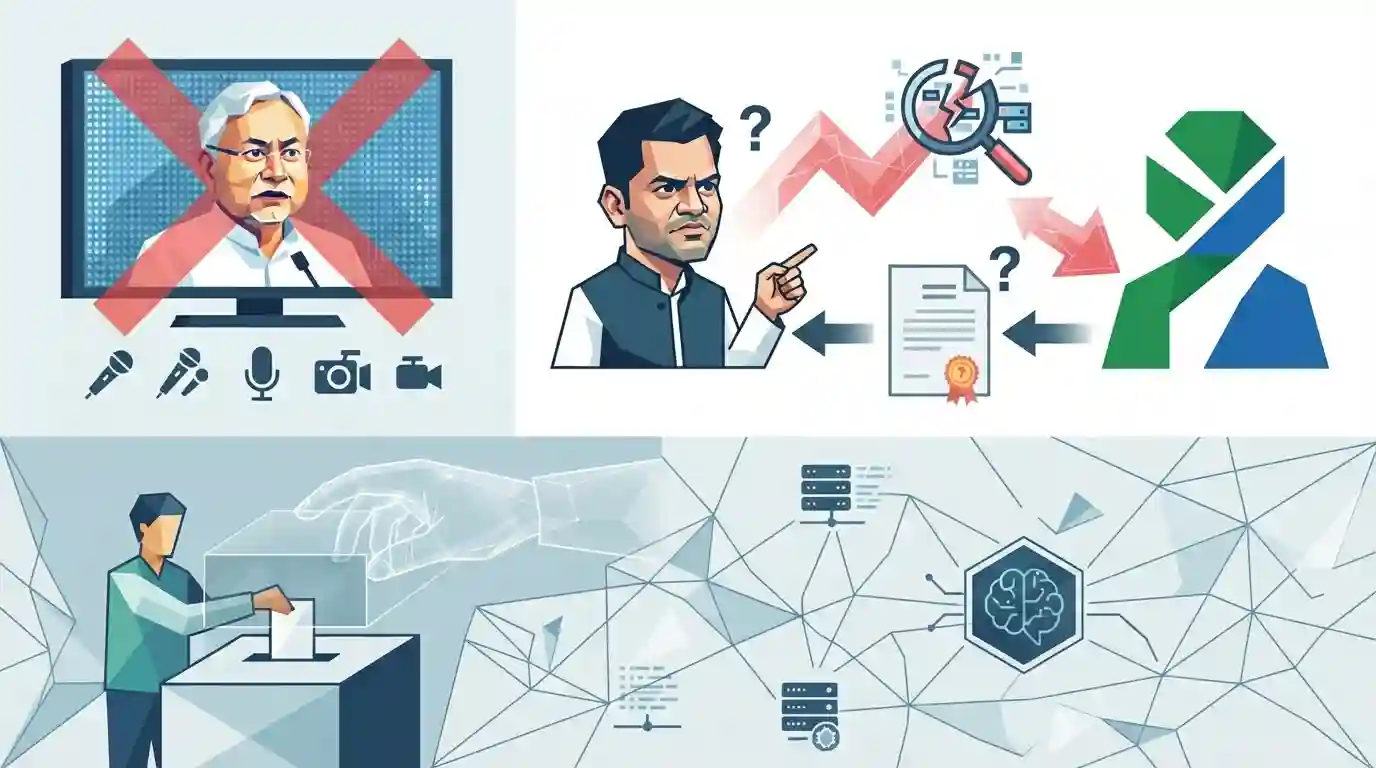
The ruling Janata Dal (United) in Bihar has sought the registration of an FIR against Jan Suraaj Party leader Prashant Kishor over his allegations that a recent campaign video featuring Chief Minister Nitish Kumar is an AI-generated fake. The video involves the Chief Minister appealing for votes for the NDA candidate in the upcoming Bankipur Assembly by-election. JD(U) has defended the video's authenticity, accusing Kishor of spreading misinformation to mislead voters and tarnish the Chief Minister's image. This incident underscores the emerging challenges of regulating digital content and managing the impact of Artificial Intelligence on electoral integrity.
Key Points
- JD(U) filed a police complaint in Patna seeking an FIR against Jan Suraaj Party leader Prashant Kishor.
- The controversy stems from Kishor's claim that a campaign video featuring Bihar Chief Minister Nitish Kumar is an AI-generated fake.
- In the disputed video, Nitish Kumar appeals to voters to support NDA candidate Neeraj Kumar Sinha in the Bankipur Assembly by-election.
- JD(U) asserts the video's authenticity and accuses Kishor of attempting to mislead voters and undermine the electoral process through misinformation.
- The incident highlights the growing concern over the potential misuse of Artificial Intelligence and digital media to influence electoral outcomes.
Important Terms
Janata Dal (United)

A prominent regional political party in India, primarily active in Bihar. Rooted in socialist ideology, it is recognized as a state party and often plays a key role in national coalition politics.
UPSC context
GS Paper II: Regional parties and coalition dynamics; tests understanding of federalism, party systems, and state politics.
Jan Suraaj Party
A political party in Bihar founded on October 2, 2024, by former poll strategist Prashant Kishor. It focuses on grassroots mobilization, regional development, and educational reforms.
UPSC context
GS Paper II: Electoral politics and grassroots democracy; tests understanding of new political movements and state-level electoral trends.
National Democratic Alliance (NDA)
A major center-right political coalition in India formed in 1998, led by the Bharatiya Janata Party, representing a significant bloc in India's multiparty federal structure.
UPSC context
GS Paper II: Coalition governance and federal dynamics; tests a candidate's grasp of political alliances and administrative stability.
Bharatiya Janata Party (BJP)
One of India's two major national political parties, founded in 1980. Rooted in nationalist ideology, it is the leading party of the ruling coalition at the Centre.
UPSC context
GS Paper II: Party systems and national governance; tests knowledge of political party ideologies, electoral dynamics, and executive leadership.
Deepfakes
Highly realistic synthetic media (videos, audio, or images) generated using artificial intelligence, particularly Generative Adversarial Networks (GANs), to replicate or fabricate a person's likeness or voice.
UPSC context
GS Paper III: Cybersecurity and Science & Technology; tests the ethical, security, and administrative challenges of AI-generated misinformation in elections.
Prelims Trap
The Representation of the People Act, 1951, contains explicit statutory provisions penalizing the use of generative AI and deepfakes.
The RPA, 1951 does not contain any direct reference to AI or deepfakes. Misinformation is prosecuted under general provisions of false statements (Sec 123(4)) or the IT Act.
Static Concepts Connected
How does Indian law penalize digital impersonation and deepfakes?
- IT Act Section 66D: Section 66D of the IT Act, 2000 penalizes cheating by personation using computer resources with up to three years of imprisonment.
- IT Rules 2021: Forces social media intermediaries to take down manipulated/impersonated media within 36 hours to retain their Section 79 'Safe Harbor' immunity.
- RPA 1951 Sec 123(4): Section 123(4) deems publishing false statements about a candidate's personal character a 'corrupt practice', which can void an election.
What are the limitations of the Election Commission of India (ECI) in regulating AI?
- Lack of Statutory Backing: The MCC is a voluntary consensus code without independent statutory backing, making speedy enforcement against rapid digital viral loops difficult.
- Jurisdictional Dependence: While Article 324 grants plenary powers for free and fair elections, ECI must rely on the IT Act (MeitY) and state police to execute digital takedowns.
Cross-Topic Patterns
Federalism + Cyber-Crime Jurisdiction
State police registering FIRs under local jurisdictions for digital offenses vs Central MeitY advisories on deepfakes reveals coordination gaps in cybersecurity law enforcement.
Deepfakes + Article 19(1)(a) Free Speech
Banning synthetic campaign media tests the boundaries of reasonable restrictions under Article 19(2) vs the right to political expression and digital parody.

Mains 2026 is highly likely to evaluate the adequacy of RPA 1951 and IT Act 2000 in preserving electoral integrity against deepfakes.
Linked PYQs · 2
Linked PYQs · 2
- 2024-EBPSC_PRELIMSGS1
Match List – I with List – II: List I: 1. The Constitution 2. The Fundamental Rights 3. The Directive Principles of State Policy 4. The Citizenship List II: a. Part II of the Constitution of India b. Part I of the Constitution of India c. Part III of the Constitution of India d. Part IV of the Constitution of India
- 2023BPSC_PRELIMSGS1
Which of the following technologies will be enabled by the 5G mobile communication networks? 1. Internet of Things 2. Edge Computing 3. Network Slicing Select the correct answer using the codes given below.
