Contributions of Jayant Narlikar to Indian Astrophysics
Source:Indian Express ↗
Why It Matters
Jayant Narlikar is one of India's most prominent scientists. His contributions are highly relevant for the GS3 syllabus covering the achievements of Indians in science and technology, as well as institutional building in space research.
Summary
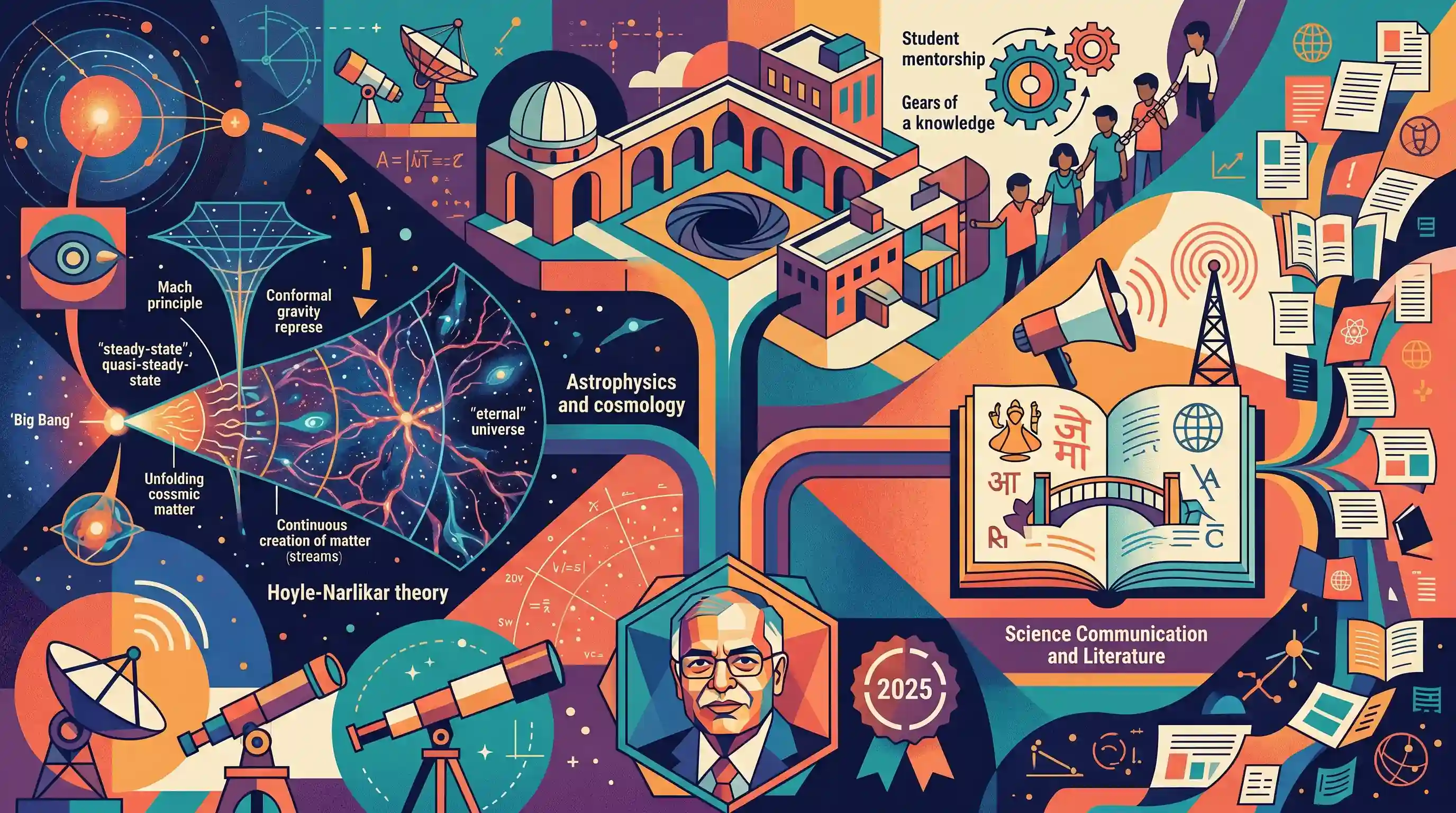
Jayant Narlikar, a globally recognized Indian astrophysicist, passed away in 2025. He made significant contributions to astrophysics, most notably through the Hoyle-Narlikar theory, and played a crucial role in building India's scientific capabilities as the founder of IUCAA in Pune. He was equally celebrated for his efforts to popularise science through literature in Marathi and English.
Key Points
- Eminent Indian astrophysicist Jayant Narlikar (1938-2025) passed away, leaving behind a legacy of institutional building and scientific excellence.
- He is best known for the Hoyle-Narlikar theory of conformal gravity, formulated with Sir Fred Hoyle, which presented an alternative to the Big Bang theory by supporting a steady-state universe.
- Narlikar was the founding director of the Inter-University Centre for Astronomy and Astrophysics (IUCAA) in Pune, transforming it into a premier institute for space and astrophysical research in India.
- Beyond technical research, he was a prolific science communicator, writing extensively in English and Marathi to make complex scientific concepts accessible to the general public.
Important Terms
Inter-University Centre for Astronomy and Astrophysics (IUCAA)

An autonomous institution established in 1988 by the UGC to democratize research in astronomy and astrophysics across Indian universities, founded by Dr. Jayant Narlikar.
UPSC context
GS III (Science & Tech): Important for understanding institutional frameworks that promote specialized scientific research in India.
Hoyle-Narlikar Theory
A conformal theory of gravity proposed by Fred Hoyle and Jayant Narlikar as an alternative to General Relativity, attempting to integrate Mach’s Principle into cosmology.
UPSC context
GS III (Space): Tests knowledge of Indian contributions to theoretical physics and alternatives to standard cosmological models.
Steady State Theory
A cosmological model proposing an eternal, unchanging universe where density remains constant through the continuous creation of matter, contrasting with the Big Bang’s single-origin event.
UPSC context
GS III (Space/Science): Relevant for understanding the evolution of cosmological thought and historical debates in astrophysics.
Science Communication
The practice of making complex scientific concepts accessible to the public; Narlikar was a pioneer in this via Marathi and English science fiction and literature.
UPSC context
GS IV (Ethics/Values) & GS II: Relates to the Constitutional duty to develop 'scientific temper' (Article 51A(h)).
Vigyan Ratna Award
India’s highest scientific honor, awarded posthumously to Jayant Narlikar in 2025 for his lifelong contributions to physics and cosmology.
UPSC context
Prelims: Important for 'Awards and Honors' and recognizing top-tier Indian scientific leadership.
Creation Field (C-field)
A hypothesis introduced in the Hoyle-Narlikar theory representing a negative-energy field that facilitates the continuous creation of matter to maintain constant cosmic density.
UPSC context
GS III: A technical concept within non-standard cosmology attributed to Indian research.
Mach's Principle
A philosophical principle stating that an object's inertia is determined by its interaction with all other matter in the universe, which Narlikar sought to prove mathematically.
UPSC context
GS III: Foundational concept in gravitational physics explored by Indian scientists.
Prelims Trap
"Jayant Narlikar's conformal gravity theories provided mathematical support for the Big Bang model."
Narlikar was a leading proponent of the Steady State theory, which directly challenged the Big Bang model by positing a universe with no beginning or end.
Static Concepts Connected
How do the Big Bang and Steady State theories differ?
- Big Bang: Proposes the universe originated from a single, infinitely dense point (singularity) and has been expanding ever since.
- Steady State: Argues the universe is constantly expanding but maintains constant density through the continuous creation of new matter.
- Current Consensus: The discovery of Cosmic Microwave Background (CMB) radiation in the 1960s heavily favored the Big Bang, marginalizing the Steady State model.
What is the Constitutional mandate for scientific temper?
- Article 51A(h): It mandates every citizen "to develop the scientific temper, humanism and the spirit of inquiry and reform."
- Significance: While non-justiciable, it serves as a guiding principle for state education policy and was actively championed by science communicators like Narlikar.
Cross-Topic Patterns
IUCAA's role in ISRO missions
Autonomous institutions like Pune's IUCAA are critical for ISRO. IUCAA developed the SUIT payload for Aditya-L1, bridging foundational astrophysics with active space exploration.
UNESCO Kalinga Prize & Indian S&T
Narlikar's 1996 Kalinga Prize for science popularisation connects GS-3 (Achievements of Indians) with GS-2 (International awards), noting the prize was originally funded by India's Kalinga Foundation.

Expect a Prelims question matching Indian scientists (Narlikar, SN Bose, Chandrasekhar) with their core cosmological theories.
Linked PYQs · 2
Linked PYQs · 2
- 2016MainsGS3
Discuss India's achievements in the field of Space Science and Technology. How the application of this technology has helped India in its socio-economic development?
- 2016PrelimsGS1
With reference to 'Astrosat', the astronomical observatory launched by India, which of the following statements is/are correct? 1. Other than USA and Russia, India is the only country to have launched a similar observatory into space. 2. Astrosat is a 2000 kg satellite placed in an orbit at 1650 km above the surface of the Earth. Select the correct answer using the code given below.
