JAXA Reusable Rocket Test Advances Space Launch Technology
Source:The Hindu ↗
Why It Matters
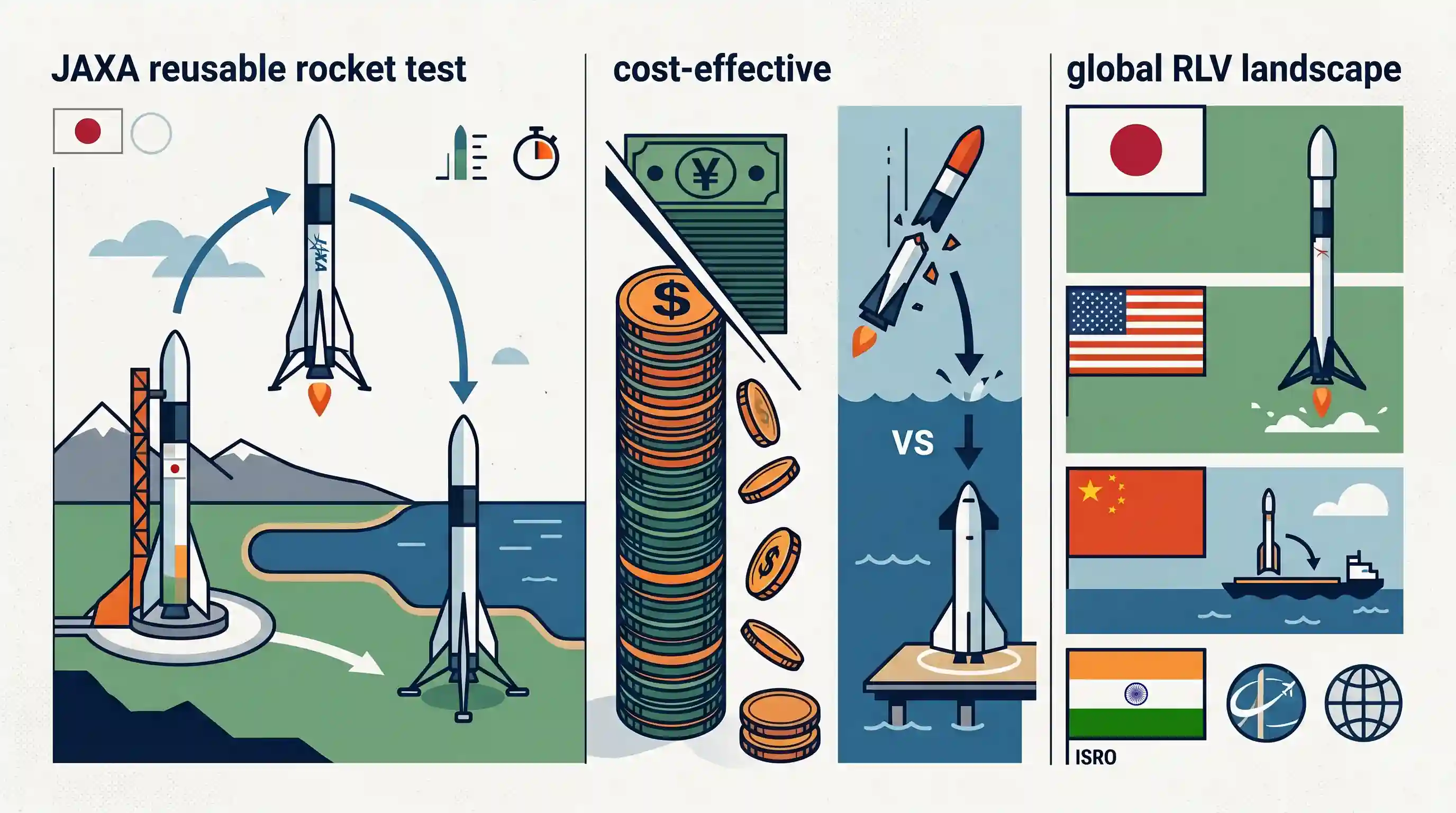
This development highlights the accelerating global race for cost-effective space access through Reusable Launch Vehicle (RLV) technology. Understanding these advancements is crucial for evaluating India's own RLV-TD program, the competitiveness of NewSpace India Limited (NSIL) in the global satellite launch market, and the wider trend of space sector commercialization.
Summary
Japan's aerospace agency, JAXA, successfully conducted the first liftoff and landing test of its prototype reusable rocket on July 11, 2026, in Noshiro, Akita. The prototype flew for 40 seconds and reached an altitude of 10 meters, demonstrating vertical takeoff and landing capabilities. Reusable launch vehicle (RLV) technology is critical for slashing launch costs, as rocket first stages are the most expensive components. This breakthrough places Japan in the competitive global RLV arena, which is currently dominated by SpaceX and challenged by China's recent sea-based recovery successes. The development highlights the accelerating global and private-sector race in cost-effective space launch capabilities.
Key Points
- JAXA successfully completed the first liftoff and landing test of its prototype reusable rocket at the Noshiro test site in Akita, Japan.
- The flight lasted 40 seconds, reaching a height of 10 meters, validating critical vertical takeoff and vertical landing (VTVL) technology.
- The primary driver behind RLV technology is cost reduction, as the first stage is the most expensive part of a rocket and reusability dramatically slashes launch costs.
- This test is part of a global space-tech race where SpaceX has been dominant since 2017 with Falcon 9, and China recently tested a sea-based booster recovery system.
- Japan is boosting its space industry competitiveness through private sector involvement (like Honda's subsidiary in June 2025) and its flagship H3 rocket, which successfully launched in June 2026.
- For India, ISRO is actively developing the RLV-TD to achieve similar low-cost access to space, making this global trend highly relevant for India's commercial space ambitions.
Important Terms
Japan Aerospace Exploration Agency (JAXA)

Japan's national aerospace agency responsible for space research, satellite development, and launch operations, which successfully tested the experimental reusable rocket RV-X in July 2026.
UPSC context
GS Paper 3 (Science and Technology); tests knowledge of global space agencies and international technology milestones.
Reusable Launch Vehicle Technology Demonstrator (RLV-TD)
ISRO's technology demonstration program consisting of a series of experimental missions designed to develop essential technologies for a fully reusable, low-cost two-stage-to-orbit launch vehicle.
UPSC context
GS Paper 3 (Science and Technology); tests understanding of indigenous space programs and reusability advancements.
Indian Space Policy 2023
A comprehensive policy framework approved by India to reform the space sector, promoting private sector participation across the space value chain and delineating roles of ISRO, NSIL, and IN-SPACe.
UPSC context
GS Paper 3 (Science and Technology); tests knowledge of space governance, reforms, and privatizing the space economy.
IN-SPACe
An autonomous, single-window nodal agency under the Department of Space established to promote, authorize, and regulate space activities of non-governmental private entities in India.
UPSC context
GS Paper 3 (Space Tech); tests knowledge of institutional mechanisms promoting the private space industry.
NewSpace India Limited (NSIL)
A wholly owned Government of India public sector enterprise and the commercial arm of ISRO, mandated to scale up industrial participation and market space products globally.
UPSC context
GS Paper 3 (Space Economy); tests familiarity with commercialization of space and public sector enterprises.
H3 Rocket
Japan's flagship liquid-propellant, single-use launch vehicle developed by JAXA and Mitsubishi Heavy Industries, which is planned to be replaced by lower-cost reusable systems in the 2030s.
UPSC context
GS Paper 3 (Science and Tech); tests awareness of major international launch vehicles and their economic viability.
Prelims Trap
ISRO's Pushpak (RLV-TD) utilizes propulsive Vertical Takeoff and Vertical Landing (VTVL) to recover its reusable technology demonstrator.
ISRO's Pushpak is a winged body designed for Vertical Takeoff and Horizontal Landing (VTHL) on a runway, unlike the VTVL propulsive vertical landings of SpaceX or JAXA.
Static Concepts Connected
What are the structural and operational differences between VTVL and VTHL recovery?
- Landing mechanism: VTVL uses retro-propulsive thrust to land vertically on a pad, while VTHL uses wings and landing gear to glide and land horizontally on a runway.
- Weight penalties: VTVL requires carrying extra reserve propellant for landing, whereas VTHL requires structural weight for wings, control surfaces, and thermal shielding.
- Target missions: VTVL is optimized for heavy first-stage booster recovery, while VTHL is ideal for orbital spaceplanes returning delicate cargo or crew.
What is the Expander Bleed Cycle in rocket propulsion?
- Working principle: Fuel cools the combustion chamber, vaporizes to drive the turbopump, and is then expelled/bled overboard instead of being reinjected.
- Key advantages: Eliminates complex, high-pressure pre-burners, resulting in simpler, highly reliable, and significantly cheaper rocket engines.
- Inherent limitation: Lower maximum thrust compared to staged combustion cycles, limiting its use to upper stages or medium-lift configurations.
Cross-Topic Patterns
Space Debris & Liability Convention
RLV adoption aligns with the UN Space Debris Mitigation Guidelines by minimizing discarded rocket stages in orbit, reducing future liabilities under the 1972 Space Liability Convention.
Launch Commercialization & Quad Synergy
Low-cost Japanese (H3) and Indian (RLV) launchers challenge SpaceX's market monopoly, offering affordable, secure satellite deployment options for Indo-Pacific partner nations.

Expect a conceptual question contrasting VTVL (propulsive landing) with ISRO's VTHL (winged runway landing) RLV-TD architecture.
Linked PYQs · 2
Linked PYQs · 2
- 2018PrelimsGS1
With reference to India's satellite launch vehicles, consider the following statements: 1. PSLVs launch the satellites useful for Earth resources monitoring whereas GSLVs are designed mainly to launch communication satellites. 2. Satellites launched by PSLV appear to remain permanently fixed in the same position in the sky, as viewed from a particular location on Earth. 3. GSLV Mk III is a four-staged launch vehicle with the first and third stages using solid rocket motors; and the second and fourth stages using liquid rocket engines. Which of the statements given above is/are correct?
- 2016MainsGS3
Discuss India's achievements in the field of Space Science and Technology. How the application of this technology has helped India in its socio-economic development?
