Japanese delegation visits ISRO to review LUPEX lunar mission
Source:The Hindu ↗
Why It Matters
The LUPEX mission represents a critical juncture in India's space program, highlighting a shift towards sophisticated international collaborations in planetary exploration. It underlines ISRO's evolving capabilities, its strategic partnership with Japan (JAXA), and its long-term roadmap that includes lunar sample returns and manned lunar missions.
Summary
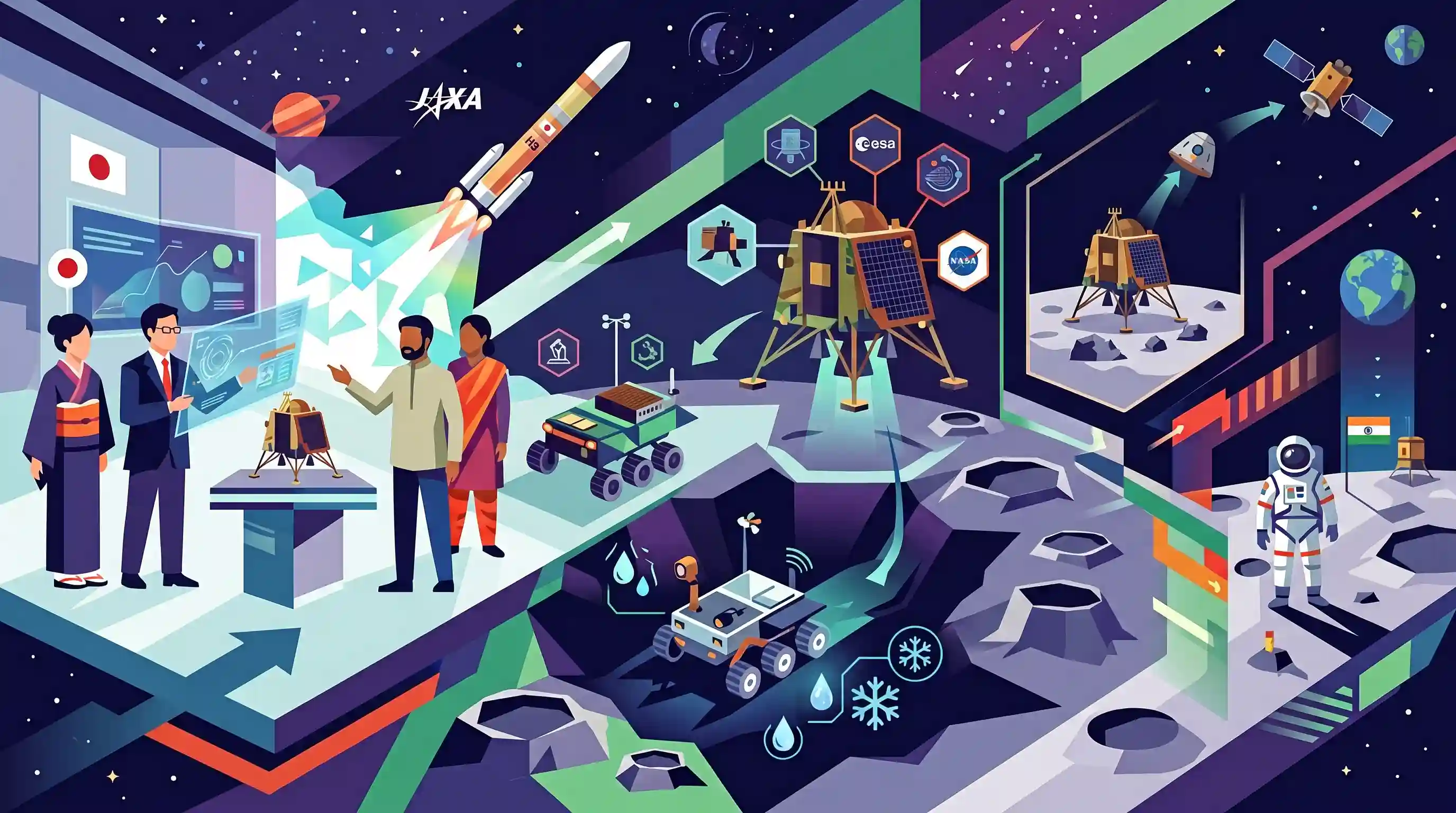
A high-level Japanese delegation recently visited ISRO to review the progress of the joint Chandrayaan-5, or Lunar Polar Exploration (LUPEX), mission. Planned to launch aboard JAXA's H3-24L vehicle, the mission targets the lunar South pole's Permanently Shadowed Regions (PSRs) to prospect for volatile materials like water. Integrating an Indian-made lander with a Japanese rover, LUPEX incorporates scientific instruments from multiple international space agencies including ESA and NASA. The mission marks a significant milestone in India-Japan strategic technology cooperation and acts as a vital stepping stone for ISRO's future endeavors, including a lunar sample return mission and sending an astronaut to the moon by 2040.
Key Points
- A Japanese delegation visited ISRO to evaluate the progress of the joint LUPEX (Chandrayaan-5) lunar mission.
- The LUPEX mission aims to investigate lunar volatile materials such as water near the Permanently Shadowed Region (PSR) of the lunar South pole.
- The mission will utilize JAXA's H3-24L launch vehicle, integrating an ISRO-developed lander with a Japanese rover produced by MHI.
- Scientific instruments for the mission are being contributed collaboratively by ISRO, JAXA, ESA, and NASA.
- This joint venture serves as a precursor to India's upcoming lunar sample return mission and its long-term objective of landing an Indian on the moon by 2040.
- Further India-Japan space cooperation is being explored, including the development of robotic arms for space stations and launching scientific satellites.
Important Terms
LUPEX (Lunar Polar Exploration) mission

A joint robotic lunar mission by ISRO and JAXA targeting the South Pole to investigate water-ice and demonstrate advanced surface exploration technologies.
UPSC context
GS Paper III: Space Technology; GS Paper II: Bilateral Partnerships (India-Japan) and strategic cooperation.
Chandrayaan-5
The Indian designation for the LUPEX mission, representing the fifth lunar mission in the Chandrayaan series focused on polar resource prospecting.
UPSC context
GS Paper III: Achievements of Indians in science & technology; indigenization of technology.
Permanently Shadowed Regions (PSRs)
Deep lunar craters at the poles that never receive sunlight, maintaining temperatures low enough to trap water ice and other volatile substances.
UPSC context
GS Paper III: Scientific concepts and lunar resource exploration.
Volatiles
Chemical elements or compounds (such as water, ammonia, or methane) with low boiling points that are preserved as ice in the Moon's polar regions.
UPSC context
GS Paper III: Science and technology-related developments and lunar geology.
H3 Launch Vehicle
Japan's next-generation heavy-lift rocket, developed by JAXA and Mitsubishi Heavy Industries, slated to launch the joint LUPEX mission.
UPSC context
GS Paper III: Global developments in space launch technology and inter-agency collaboration.
JAXA (Japan Aerospace Exploration Agency)
Japan’s national aerospace agency and India’s primary partner for LUPEX, responsible for the rover and the launch vehicle components.
UPSC context
GS Paper II: International relations and bilateral technological collaborations.
ISRO (Indian Space Research Organisation)
India’s primary space agency, leading the development of the LUPEX lander and charting the nation's 2040 human lunar landing goal.
UPSC context
GS Paper III: Role of national institutions in technological indigenization.
Prelims Trap
Chandrayaan-5 (LUPEX) will be launched entirely using ISRO's indigenous heavy-lift LVM3 launch vehicle.
LUPEX is a joint mission that relies on Japan's JAXA for the H3 launch vehicle and the lunar rover. ISRO is providing the lander, not the launch vehicle.
Static Concepts Connected
What are Permanently Shadowed Regions (PSRs) on the lunar surface?
- Geographical location: Found at the lunar poles, primarily inside deep craters where the low angle of solar illumination prevents sunlight from ever reaching the crater floor.
- Thermal environment: They function as 'cold traps' with temperatures plummeting below -200°C, remaining undisturbed for billions of years.
- Strategic significance: Highly likely to contain preserved water ice and volatile chemicals, which are critical resources for sustaining future manned lunar bases and generating fuel.
How do the Artemis Accords influence India-Japan space cooperation?
- Shared framework: Both India and Japan are signatories, providing a common, US-led multilateral framework for peaceful lunar exploration, interoperability, and space resource extraction.
- Geopolitical alignment: It serves as a democratic, rules-based geopolitical alternative to the China-Russia led International Lunar Research Station (ILRS) initiative.
Cross-Topic Patterns
Space Diplomacy & The Quad
The ISRO-JAXA deep space tie-up aligns with the Quad Space Working Group's goals, leveraging bilateral synergy to counterbalance China's rising dominance in lunar resource exploration.
Bharatiya Antariksha Station (BAS) linkage
Talks on developing robotic arms for space stations feed directly into India's goal of establishing its own space station (BAS) by 2035, requiring advanced in-orbit servicing technology.

Expect a 2026 Prelims statement question testing the exact division of labor in LUPEX: JAXA launch vehicle/rover vs. ISRO lander.
Linked PYQs · 3
Linked PYQs · 3
- 2023MainsGS3
What is the main task of India's third moon mission which could not be achieved in its earlier mission? List the countries that have achieved this task. Introduce the subsystems in the spacecraft launched and explain the role of the Virtual Launch Control Centre' at the Vikram Sarabhai Space Centre which contributed to the successful launch from Sriharikota.
- 2019MainsGS2
‘The time has come for India and Japan to build a strong contemporary relationship, one involving global and strategic partnership that will have a great significance for Asia and the world as a whole.’ Comment.
- 2016PrelimsGS1
Consider the following statements: The Mangalyaan launched by ISRO 1. is also called the Mars Orbiter Mission 2. made India the second country to have a spacecraft orbit the Mars after USA 3. made India the only country to be successful in making its spacecraft orbit the Mars in its very first attempt Which of the statements given above is/are correct?
