Japan Launches New Cargo Spacecraft Using H3 Rocket
Source:The Hindu ↗
Why It Matters
Understanding international developments in space technology and launch vehicles is crucial for the UPSC syllabus. Japan's H3 rocket and HTV-X1 spacecraft exemplify the global shift towards cost-effective space transportation and autonomous access to space, providing a comparative context to India's own space endeavors like Gaganyaan and ISRO's launch vehicle developments.
Summary
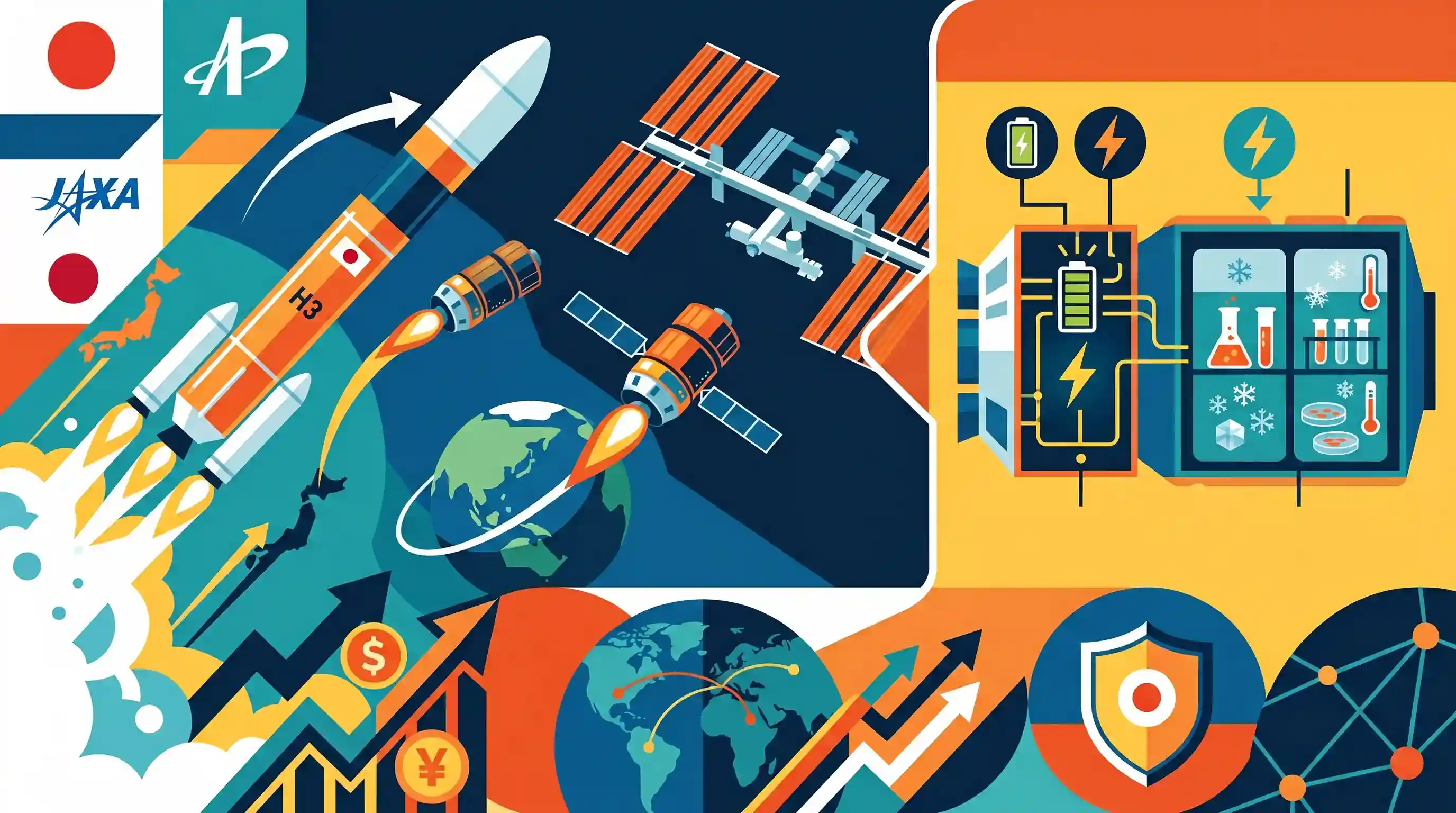
Japan has successfully launched its new HTV-X1 cargo spacecraft aboard its flagship H3 rocket to deliver supplies to the International Space Station (ISS). Developed by JAXA and Mitsubishi Heavy Industries, the HTV-X1 succeeds the Kounotori spacecraft and introduces the ability to supply continuous power during flight, facilitating the transport of temperature-controlled lab samples. The successful launch reinforces the reliability of the H3 rocket, which replaces the H-2A to improve Japan's cost-competitiveness in the global space market and secure stable space access for national security.
Key Points
- Japan successfully launched the HTV-X1 unmanned cargo spacecraft to the International Space Station (ISS) using its new H3 rocket.
- HTV-X1 is the successor to the Kounotori spacecraft and boasts enhanced capabilities, including continuous power supply during flight to support temperature-sensitive biological samples.
- The H3 launch vehicle replaces the aging H-2A rocket, aiming to make Japan's space program more cost-competitive in the global commercial space market.
- Autonomous and reliable space transport capabilities, demonstrated by the H3's consecutive successful launches, are viewed as essential for Japan's national security and strategic autonomy in space.
Important Terms
HTV-X (Cargo Spacecraft)

Japan's next-generation uncrewed cargo spacecraft designed to resupply the International Space Station (ISS) and the future Lunar Gateway. It offers increased payload and flight-power capabilities.
UPSC context
GS Paper III (Science & Tech); tests knowledge of international space logistics and Japan's evolving role in deep-space exploration.
H3 Rocket
Japan’s new flagship liquid-fuelled launch vehicle developed by JAXA and Mitsubishi Heavy Industries to provide cost-competitive and flexible access to space, replacing the H-IIA series.
UPSC context
GS Paper III (Science & Tech); highlights global space market competition and technological indigenization.
JAXA (Japan Aerospace Exploration Agency)
Japan's national aerospace agency responsible for space research, satellite development, and exploration; equivalent to India's ISRO and a key partner in international space missions.
UPSC context
GS Paper II (International Relations); vital for understanding India-Japan bilateral space cooperation.
Kounotori (H-II Transfer Vehicle)
Japan's retired uncrewed cargo transfer vehicle (2009–2020) that successfully delivered supplies to the ISS and pioneered the "capture-and-berthing" technique using a robotic arm.
UPSC context
GS Paper III (Science & Tech); provides historical context for the evolution of space transport systems.
Mitsubishi Heavy Industries (MHI)
A major Japanese industrial conglomerate and the primary contractor for JAXA’s launch vehicles, highlighting the significant role of the private sector in Japan's space program.
UPSC context
GS Paper III (Indigenization of Technology); illustrates the public-private partnership model in high-tech manufacturing.
LUPEX Mission (Lunar Polar Exploration Mission)
A joint mission between India (ISRO) and Japan (JAXA) to explore the Moon's South Pole, planned to utilize Japan's H3 rocket for the launch.
UPSC context
GS Paper III (Science & Tech); directly links Japan's space progress to India’s space exploration roadmap.
Prelims Trap
"HTV-X1 is Japan's first indigenous crewed spacecraft to the International Space Station."
HTV-X1 is purely an uncrewed cargo transport. Japan has not yet developed an indigenous crewed spacecraft; its astronauts rely on US or Russian vehicles for ISS transit.
Static Concepts Connected
What is the ISRO-JAXA Lunar Polar Exploration (LUPEX) mission?
- Joint venture: A collaborative mission to the lunar south pole where ISRO provides the lander and JAXA provides the rover.
- Launch vehicle: The mission will be launched using Japan's newly operational flagship heavy-lift H3 rocket.
- Primary objective: To investigate the abundance of lunar water-ice resources and demonstrate advanced surface exploration technologies.
What types of spacecraft currently service the International Space Station (ISS)?
- Crewed spacecraft: Vehicles like SpaceX Crew Dragon, Boeing Starliner, and Russia's Soyuz transport astronauts to the station.
- Uncrewed cargo: Vehicles like Japan's HTV-X, Russia's Progress, SpaceX Cargo Dragon, and Northrop Grumman's Cygnus deliver supplies and experiments.
Cross-Topic Patterns
India-Japan LUPEX mission synergy
The H3 rocket's successful deployment directly impacts India's lunar ambitions, as H3 is the designated launch vehicle for the upcoming ISRO-JAXA joint Lunar Polar Exploration (LUPEX) mission.
Commercial space launch market competition
Japan's transition to the cost-effective H3 rocket mirrors India's push with NGLV and SSLV, highlighting the geopolitical race to capture the global commercial heavy-lift space market.

Expect a 2026 question on the LUPEX mission testing the exact division of labor: ISRO (lander) vs JAXA (rover and H3 launch vehicle).
Linked PYQs · 3
Linked PYQs · 3
- 2025PrelimsGS1
Consider the following space missions : I. Axiom-4 II. SpaDeX III. Gaganyaan How many of the space missions given above encourage and support micro-gravity research?
- 2023MainsGS3
What is the main task of India's third moon mission which could not be achieved in its earlier mission? List the countries that have achieved this task. Introduce the subsystems in the spacecraft launched and explain the role of the Virtual Launch Control Centre' at the Vikram Sarabhai Space Centre which contributed to the successful launch from Sriharikota.
- 2017MainsGS3
India has achieved remarkable successes in unmanned space missions including the Chandrayaan and Mars Orbitter Mission, but has not ventured into manned space missions. What are the main obstacles to launching a manned space mission, both in terms of technology and logistics? Examine critically.
