जापान में गहरे समुद्र में खनन और दुर्लभ पृथ्वी तत्व निष्कर्षण
स्रोत:द हिंदू ↗
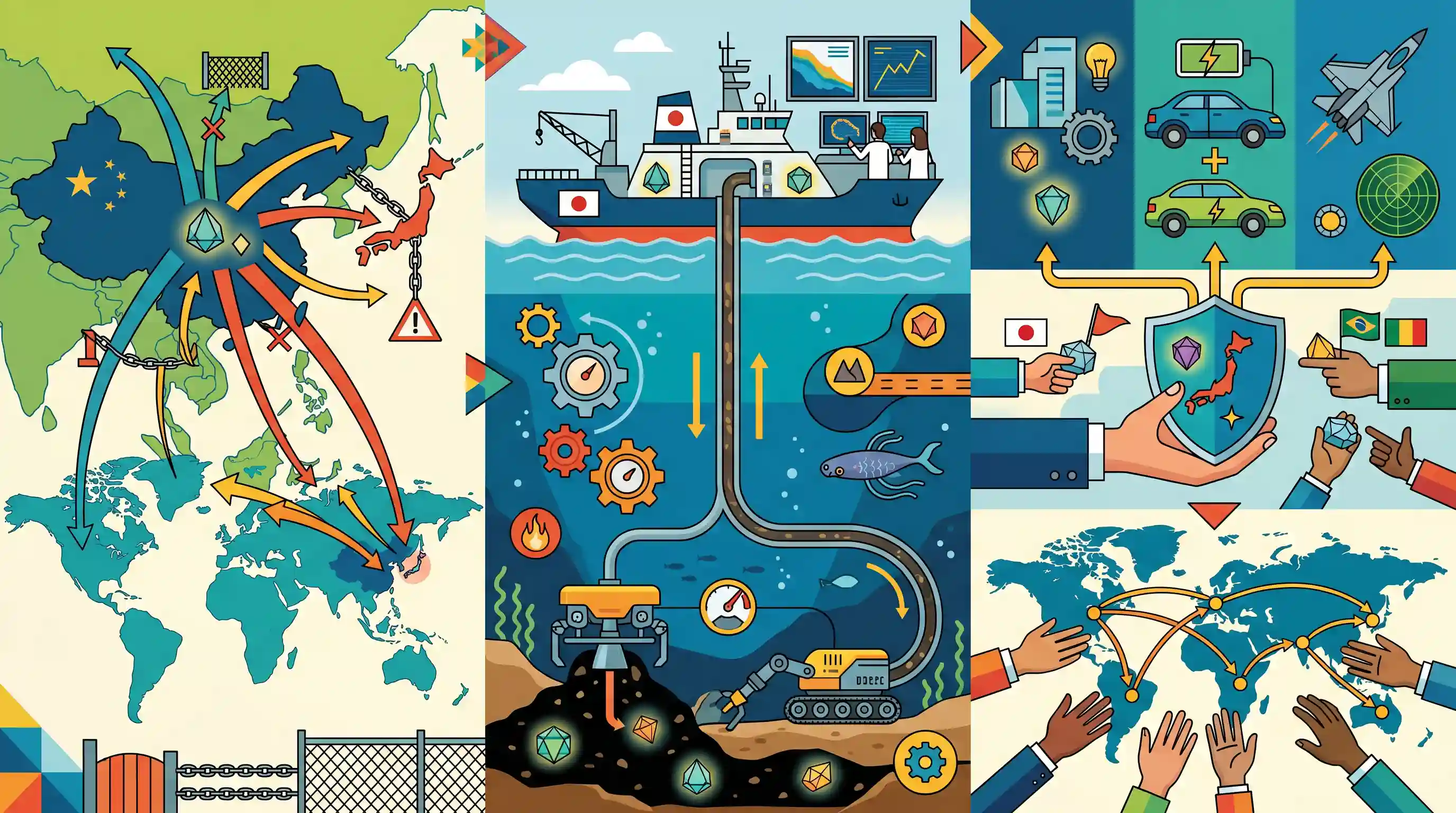
क्यों मायने रखता है
This development sits at the intersection of Science & Technology (deep-sea mining innovation), Geography (resource distribution), and International Relations (supply chain resilience against Chinese dominance). It provides a concrete example for answers discussing critical mineral security, the blue economy, and strategic decoupling from monopolies.
सारांश
Japan has achieved a major milestone by successfully extracting rare-earth-rich mud from the deep seabed during a test mission. Operating at extreme depths, the project aims to secure an independent supply of critical minerals like dysprosium and neodymium, which are essential for high-tech industries, electric vehicles, and defense applications. The mission is heavily driven by geopolitical strategy, as Tokyo seeks to reduce its near-total reliance on China for rare earth elements. Amidst growing trade tensions and Beijing's recent export controls on critical materials, Japan's success in deep-sea mining highlights the escalating global race to build resilient, alternative supply chains and secure resource sovereignty.
मुख्य बिंदु
- Japan has successfully retrieved rare-earth-rich mud from the deep seabed during a pioneering test mission.
- The extracted mud contains critical minerals such as dysprosium and neodymium, which are crucial for electric vehicles, renewable energy infrastructure, and advanced defense technologies.
- The mission represents a significant technological leap in deep-sea mining, operating at extreme ocean depths (approximately 6,000 meters).
- This initiative is a strategic response to reduce Japan's heavy reliance on China for rare earth elements, motivated by recent Chinese export restrictions on dual-use tech materials.
- The development underscores a broader global push among Western and allied nations to build resilient, alternative critical mineral supply chains.
महत्वपूर्ण शब्द
Rare Earth Elements (REEs)

A group of 17 metallic elements (15 lanthanides, scandium, and yttrium) vital for high-tech industries and defense; they are rarely found in concentrated, economically viable forms.
UPSC context
GS Paper III (Economy/S&T); tests knowledge of strategic resources, China's processing monopoly, and India's monazite reserves.
UNCLOS
समुद्री क्षेत्रों, नौवहन अधिकारों और क्षेत्रीय जल तथा उच्च सागर (high seas) में समुद्री संसाधनों के प्रबंधन को नियंत्रित करने वाला प्राथमिक अंतर्राष्ट्रीय कानूनी ढांचा (1982)।
UPSC context
GS Paper II (International Relations); essential for understanding maritime disputes, sovereignty, and international ocean governance.
Critical Minerals
Minerals essential for economic growth and national security, often characterized by high supply risk due to geographical concentration or processing dominance by a few nations.
UPSC context
GS Paper III (Economy/Security); tests awareness of India’s resource security policies, energy transition needs, and global supply chain resilience.
Deep Sea Mining
The process of extracting minerals from the ocean floor at depths greater than 200 meters, targeting deposits like polymetallic nodules, sulphides, and cobalt-rich crusts.
UPSC context
GS Paper III (Environment/S&T); tests understanding of the 'Blue Economy' vs. environmental preservation and marine biodiversity impacts.
International Seabed Authority (ISA)
An autonomous organization established under UNCLOS to organize and regulate mineral-related activities in international seabed areas beyond national jurisdiction ('The Area').
UPSC context
GS Paper II (International Institutions); tests knowledge of global bodies regulating the 'Common Heritage of Mankind.'
Exclusive Economic Zone (EEZ)
An area up to 200 nautical miles from the coast where a state has exclusive sovereign rights for exploring and managing natural resources.
UPSC context
GS Paper II/III (Geography/IR); tests knowledge of maritime boundaries and a nation’s rights over seabed resources.
प्रारंभिक ट्रैप
The International Seabed Authority (ISA) regulates all deep-sea mining globally.
ISA only regulates the 'Area' (international waters). Mining within a country's Exclusive Economic Zone (EEZ), like Japan's current efforts, falls exclusively under its domestic sovereign rights.
संबंधित अवधारणाएँ
What is the role of the International Seabed Authority (ISA) under UNCLOS?
- Primary Mandate: Regulates deep seabed mining and exploration in the "Area" (international seabed beyond the limits of national jurisdiction).
- Origin: Established in 1994 as an intergovernmental body under the UN Convention on the Law of the Sea (UNCLOS).
- India's Status: India is a member state and holds exclusive exploration contracts in the Central Indian Ocean Basin (CIOB).
What are Rare Earth Elements (REEs) and their strategic applications?
- Composition: A set of 17 metallic elements on the periodic table, comprising 15 lanthanides plus scandium and yttrium.
- Geological Properties: They are not actually "rare" in the earth's crust, but are highly dispersed, making economically viable extraction difficult and highly polluting.
- Strategic Applications: Crucial for manufacturing permanent magnets (Neodymium, Dysprosium) used in electric vehicles, wind turbines, and advanced defense electronics.
अंतर-विषय पैटर्न
Deep Ocean Mission & Matsya 6000
Japan’s 6,000m test parallels India’s Deep Ocean Mission, which aims to send the manned submersible 'Matsya 6000' to similar depths to explore polymetallic nodules and rare earths.
Minerals Security Partnership (MSP)
Japan's attempt to break Chinese REE dominance aligns with the US-led Minerals Security Partnership, which India joined in 2023 to build resilient global supply chains for critical minerals.

Expect a multi-statement question in 2026 blending ISA's jurisdiction over 'The Area', REE applications, and India's Deep Ocean Mission.
संबद्ध PYQ · 3
संबद्ध PYQ · 3
- 2021PrelimsGS1
Consider the following statements : 1. The Global Ocean Commission grants licences for seabed exploration and mining in international waters. 2. India has received licences for seabed mineral exploration in international waters. 3. 'Rare earth minerals' are present on seafloor in international waters. Which of the statements given above are correct?
- 2025PrelimsGS1
Consider the following statements : Statement I: Some rare earth elements are used in the manufacture of flat television screens and computer monitors. Statement II : Some rare earth elements have phosphorescent properties. Which one of the following is correct in respect of the above statements?
- 2024MainsGS2
‘The West is fostering India as an alternative to reduce dependence on China's supply chain and as a strategic ally to counter China's political and economic dominance.’ Explain this statement with examples.
