Sanae Takaichi Victory Signals Assertive Japanese Foreign Policy
Source:Indian Express ↗
Why It Matters
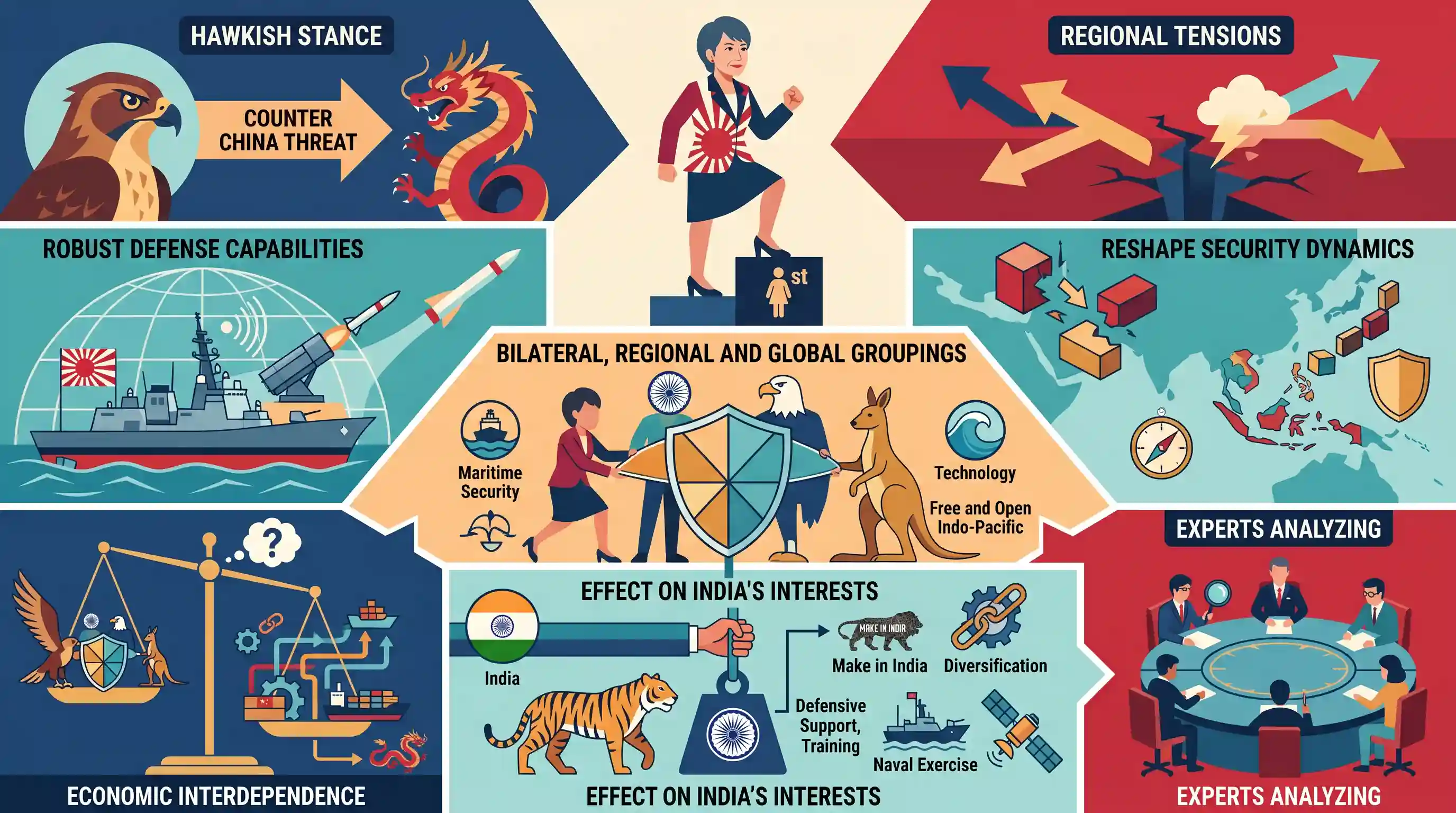
Japan is a critical strategic partner for India, especially within frameworks like the Quad. A more assertive Japanese foreign policy under PM Takaichi towards China influences the balance of power in the Indo-Pacific, directly impacting India's regional security calculus and maritime interests.
Summary
Sanae Takaichi's historic win to become Japan's Prime Minister signals a potential paradigm shift in East Asian geopolitics. Known for her conservative and hawkish stance, her leadership raises critical questions about the future trajectory of Sino-Japanese relations. Her prioritization of countering the "China threat" through robust defense capabilities could escalate regional tensions while simultaneously reshaping security dynamics in the Indo-Pacific. Experts are closely analyzing how her administration will balance complex economic interdependence with Beijing against an assertive foreign policy and deepened strategic alliances.
Key Points
- Sanae Takaichi's historic election as Japan's Prime Minister brings a prominent conservative and hawkish leader to the helm.
- Her strong stance on national security prioritizes bolstering Japan's defense capabilities to counter the rising "China threat."
- The leadership transition is likely to strain Sino-Japanese diplomatic and economic relations, raising concerns over regional flashpoints.
- Her tenure is expected to influence the broader Indo-Pacific security architecture, potentially deepening strategic ties with allies to counterbalance Beijing.
Important Terms
Liberal Democratic Party (LDP)

Japan's dominant conservative political party, in power almost continuously since 1955. It generally supports a pro-U.S. alliance, free-market economics, and constitutional revision to strengthen national defense.
UPSC context
GS Paper II (International Relations). Crucial for analyzing Japan's political stability and strategic shifts impacting the Indo-Pacific.
Indo-Pacific
A geopolitical region spanning the Indian and Pacific Oceans. It is the central theater for the Quad and initiatives aimed at ensuring a "free, open, and rules-based" maritime order.
UPSC context
GS Paper II & III. Essential for questions on global power shifts, maritime security, and India's Act East Policy.
Sino-Japanese Relations
Bilateral relations between Asia's two largest economies, marked by deep trade interdependence but severely strained by territorial disputes, wartime history, and competing regional security visions.
UPSC context
GS Paper II. Focuses on regional power dynamics and the "China factor" driving India-Japan strategic convergence.
Article 9 (Japanese Constitution)
The "pacifist" clause in Japan's 1947 Constitution that renounces war and the maintenance of armed forces. Hawkish leaders seek its revision to formalize Japan's military capabilities.
UPSC context
GS Paper II. Relevant for understanding Japan's transition toward a more proactive defense posture in the 21st century.
Economic Security
A policy framework focused on protecting supply chains, critical technologies (like semiconductors), and infrastructure from external coercion. Takaichi was Japan's first minister for this portfolio.
UPSC context
GS Paper II & III. Vital for discussing the India-Japan Special Strategic Partnership and supply chain resilience initiatives.
Senkaku Islands
A group of uninhabited, Japanese-administered islands in the East China Sea claimed by China (as Diaoyu). They represent a major territorial flashpoint in East Asian geopolitics.
UPSC context
GS Paper II. A key case study for maritime territorial disputes and potential triggers for regional conflict.
Prelims Trap
Japan's Article 9 completely prohibits the maintenance of armed forces and prevents participation in collective defense alliances.
While Article 9 renounces war, Japan maintains robust Self-Defense Forces (SDF) and reinterpreted the constitution in 2014 to allow for 'collective self-defense'.
Static Concepts Connected
What is the significance of Article 9 of the Japanese Constitution?
- Pacifist principle: A clause in the post-WWII constitution outlawing war as a means to settle international disputes.
- Self-Defense Forces (SDF): Despite the clause, Japan maintains a highly capable military restricted primarily to defensive roles.
- Collective self-defense: A 2014 reinterpretation allows Japanese forces to aid allies under attack, marking a shift toward active regional security.
What are Japan's primary maritime territorial disputes in East Asia?
- Senkaku/Diaoyu Islands: Administered by Japan but claimed by China and Taiwan; a major regional flashpoint in the East China Sea.
- Kuril Islands: Occupied by the Soviet Union at the end of WWII and currently administered by Russia; claimed by Japan.
- Dokdo/Takeshima Islands: Controlled by South Korea but claimed by Japan, causing periodic diplomatic friction.
Cross-Topic Patterns
Supply Chain Resilience Initiative (SCRI)
Japan's push to economically de-risk from China directly links to the India-Japan-Australia Supply Chain Resilience Initiative (SCRI), elevating trade diversification to a core national security imperative.
Minilaterals evolving into deterrence architectures
A hawkish Japanese leadership accelerates the shift of groupings like the Quad and US-Japan-Philippines trilaterals from broad diplomatic dialogues toward explicit deterrence architectures.

Japan's constitutional reinterpretation (Article 9) combined with its Taiwan policy is a prime candidate for a 2026 GS-II Mains IR question.
Linked PYQs · 4
Linked PYQs · 4
- 2019MainsGS2
‘The time has come for India and Japan to build a strong contemporary relationship, one involving global and strategic partnership that will have a great significance for Asia and the world as a whole.’ Comment.
- 2020MainsGS2
What is the significance of Indo-US defence deals over Indo-Russian defence deals? Discuss with reference to stability in the Indo-Pacific region.
- 2014MainsGS2
With respect to the South China sea, maritime territorial disputes and rising tension affirm the need for safeguarding maritime security to ensure freedom of navigation and over flight throughout the region. In this context, discuss the bilateral issues between India and China.
- 2024MainsGS2
‘The West is fostering India as an alternative to reduce dependence on China's supply chain and as a strategic ally to counter China's political and economic dominance.’ Explain this statement with examples.
