Japanese Leadership Succession and Indo Pacific Security Dynamics
Source:Indian Express ↗
Why It Matters
Japan is a critical strategic partner for India in the Indo-Pacific (e.g., QUAD). Changes in Japan's domestic leadership and its resulting diplomatic friction with China directly impact the regional security architecture, maritime stability in the East China Sea, and the broader balance of power in Asia.
Summary
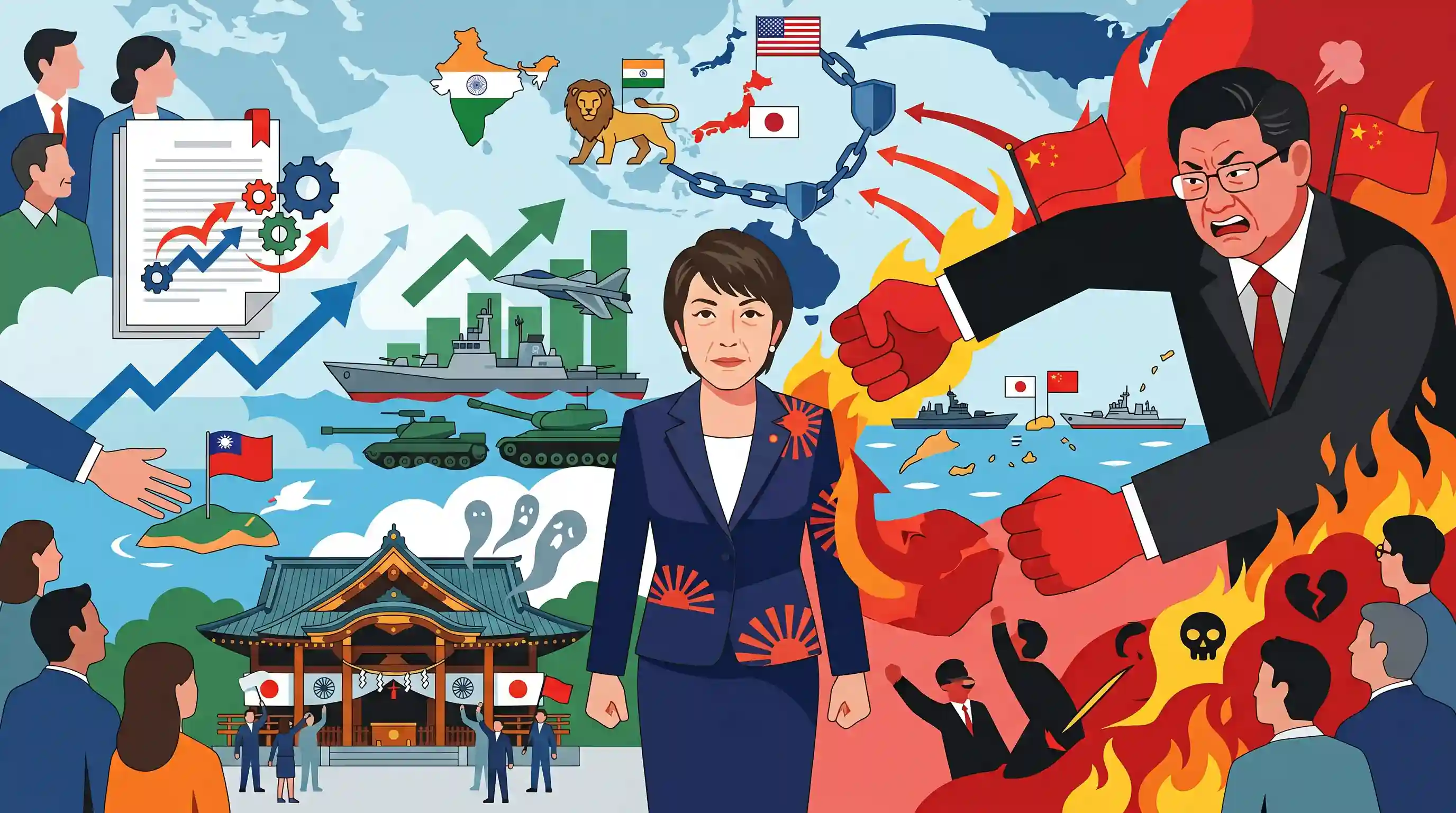
The political prominence of conservative Japanese leader Sanae Takaichi has significant geopolitical implications, particularly triggering strong reactions from China. Known for her hawkish stance, Takaichi advocates for revising Japan's pacifist constitution, boosting defense spending, and strengthening ties with Taiwan. Her visits to the controversial Yasukuni Shrine further aggravate historical grievances with Beijing. While her approach aligns with strengthening Indo-Pacific security frameworks against a rising China, it also risks escalating bilateral tensions in the East China Sea over disputes like the Senkaku Islands.
Key Points
- Sanae Takaichi represents the conservative, hawkish wing of Japan's ruling Liberal Democratic Party (LDP), known for her strong national security postures and alignment with the late Shinzo Abe's policies.
- Her political rise and electoral successes have drawn sharp criticism from Beijing, which views her policies—such as advocating for the amendment of Japan's pacifist Constitution (Article 9)—as a return to Japanese militarism.
- Takaichi's regular visits to the Yasukuni Shrine, which honors Japan's war dead including convicted Class-A war criminals, remains a major flashpoint in Sino-Japanese relations.
- Her strong support for Taiwan and advocacy for increased defense spending present a direct challenge to China's regional ambitions, particularly concerning the East China Sea and the disputed Senkaku/Diaoyu Islands.
- For the broader Indo-Pacific, a hawkish Japanese leadership bolsters deterrence architectures like the QUAD but simultaneously raises the risk of regional escalation with China.
Important Terms
Japanese Constitution (Article 9)

A "peace clause" in Japan's 1947 Constitution where the nation formally renounces war and the maintenance of "war potential" (armed forces) to settle international disputes.
UPSC context
GS II (International Relations); tests understanding of Japan’s pacifist-to-proactive defense shift and its impact on Indo-Pacific security architecture.
Free and Open Indo-Pacific (FOIP)
A strategic vision promoting a rules-based regional order, maritime security, and economic connectivity across the Indian and Pacific Oceans, initially proposed by Japan.
UPSC context
GS II (Bilateral/Global Groupings); core to India’s 'Act East' policy and maritime security cooperation with partners like Japan.
QUAD
The Quadrilateral Security Dialogue comprising India, USA, Japan, and Australia, focused on ensuring a free, open, and stable Indo-Pacific through strategic and functional cooperation.
UPSC context
GS II (Regional Groupings); frequently tested regarding its evolution and impact on India’s strategic interests and regional security.
Yasukuni Shrine
A Tokyo Shinto shrine honoring Japan's war dead; enshrinement of WWII war criminals makes leader visits a significant diplomatic flashpoint with China and South Korea.
UPSC context
GS II (Bilateral Relations); highlights how historical grievances and domestic politics in developed nations influence regional diplomatic stability.
Senkaku Islands
Uninhabited islands in the East China Sea administered by Japan but claimed by China (as Diaoyu), serving as a major maritime territorial dispute.
UPSC context
GS II (International Relations); essential for mapping global territorial disputes and analyzing maritime assertiveness in the Indo-Pacific.
Liberal Democratic Party (LDP)
Japan's dominant conservative political party; it advocates for strong national defense, constitutional reform, and a 'Peace through Strength' agenda in the Indo-Pacific.
UPSC context
GS II (Effect of Policies of Developed Countries); focuses on how Japanese domestic political shifts drive its regional leadership and defense stance.
Prelims Trap
"The Senkaku Islands are a disputed territory located in the South China Sea."
Senkaku (Diaoyu) Islands are located in the East China Sea, not the South China Sea. Do not confuse them with the Spratly or Paracel disputes.
Static Concepts Connected
What is Article 9 of the Japanese Constitution?
- Pacifism clause: Formally renounces war as a sovereign right of the nation and bans the threat or use of force to settle international disputes.
- Self-Defense Forces: Historically prohibited maintaining traditional military forces, though successive governments have interpreted it to permit the Japanese Self-Defense Forces (JSDF).
- Amendment push: Hawkish leaders argue for amending it to formally legitimize the military and increase defense spending amid rising regional threats from China and North Korea.
What is the strategic geography of the Senkaku Islands?
- Location: Situated in the East China Sea, northeast of Taiwan. They are critical for monitoring maritime traffic and naval movements in the region.
- Claimants: Currently administered by Japan (Senkaku), but actively claimed by both China (Diaoyu) and Taiwan (Tiaoyutai) based on historical records.
- Resource potential: Beyond geopolitical positioning, the surrounding waters are rich fishing grounds and hold potential undiscovered underwater oil and gas reserves.
Cross-Topic Patterns
Article 9 & Quad's security evolution
Japan's departure from strict constitutional pacifism towards higher defense spending shifts the Quad from a purely diplomatic dialogue closer to a hard-power security architecture in the Indo-Pacific.
Historical revisionism vs Asian diplomacy
Visits to the Yasukuni Shrine showcase how domestic political signaling in Japan routinely derails bilateral trade and diplomatic normalization efforts with neighboring China and South Korea.

Prelims 2026 will likely feature a pairs-matching question linking Senkaku, Kuril, and Spratly islands to their respective seas.
Linked PYQs · 2
Linked PYQs · 2
- 2019MainsGS2
‘The time has come for India and Japan to build a strong contemporary relationship, one involving global and strategic partnership that will have a great significance for Asia and the world as a whole.’ Comment.
- 2022PrelimsGS1
Which one of the following statements best reflects the issue with Senkaku Islands, sometimes mentioned in the news?
