Japan PM Resigns After Election Defeat and Trade Friction
Source:The Hindu ↗
Why It Matters
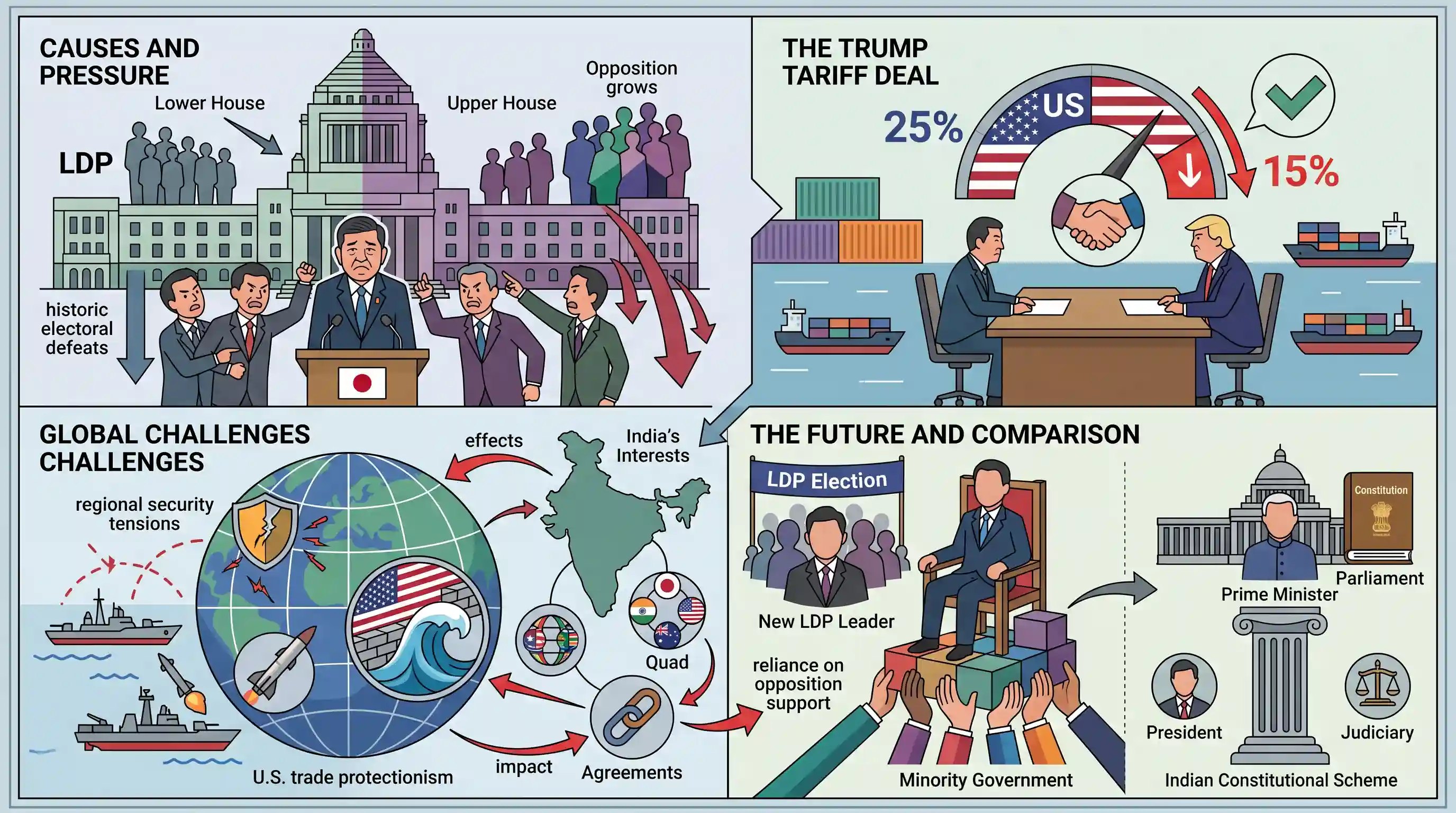
Japan is a vital strategic and economic partner for India, especially within the Indo-Pacific framework and the Quad. Political instability or a weak minority government in Tokyo could hamper decisive policy-making and strategic initiatives in the region. Furthermore, the Japan-U.S. tariff negotiations highlight broader trends in global trade protectionism that candidates must analyze regarding their potential impact on India's economy and WTO reforms.
Summary
Japanese Prime Minister Shigeru Ishiba has announced his resignation following intense pressure from within his ruling Liberal Democratic Party (LDP) after historic electoral defeats that cost the coalition its majorities in both parliamentary houses. Despite his initial reluctance to step down amid critical challenges such as U.S. trade protectionism and regional security tensions, Ishiba yielded after consultations with senior party figures. Notably, his brief tenure saw a successful negotiation with U.S. President Donald Trump to reduce tariffs on Japan from 25% to 15%. The LDP will soon elect a new leader who will face the difficult task of leading a minority government reliant on opposition support.
Key Points
- Japanese Prime Minister Shigeru Ishiba has stepped down following the ruling Liberal Democratic Party's (LDP) historic failure to secure a majority in both the upper and lower houses of parliament.
- Ishiba had initially resisted resignation, citing the need to avoid a political vacuum amid pressing issues like inflation, regional tensions, and U.S. tariffs.
- Before his resignation, Ishiba successfully negotiated with U.S. President Donald Trump to lower tariffs imposed on Japan from 25% to 15%.
- The LDP will hold a party leadership vote to choose a replacement, with candidates including Shinjiro Koizumi, Sanae Takaichi, and Yoshimasa Hayashi.
- The incoming Prime Minister will have to navigate a divided parliament and manage a minority government, requiring cooperation with splintered opposition parties to pass legislation.
Important Terms
Liberal Democratic Party (LDP)

Japan's dominant conservative political party, ruling almost continuously since 1955. It emphasizes pro-business policies, traditional values, and a strong security partnership with the United States.
UPSC context
GS Paper II: Comparison of constitutional schemes; critical for analyzing Japan's political stability and Indo-Japan strategic ties.
Japan-U.S. Alliance
The cornerstone of Indo-Pacific security based on the 1960 treaty. It involves U.S. military presence in Japan and reciprocal cooperation against regional threats like China and North Korea.
UPSC context
GS Paper II: International Relations; impacts regional security architectures and the functional dynamics of the QUAD.
Minority Government
A government formed when the ruling party or coalition lacks an absolute majority in parliament, necessitating support from other parties to pass laws and maintain confidence.
UPSC context
GS Paper II: Indian Constitution—Parliamentary System; tests understanding of coalition politics, stability, and legislative challenges.
Trade Protectionism
Economic policy restricting imports through tariffs, quotas, or regulations to protect domestic industries. Shigeru Ishiba’s resignation followed pressures from such global trade shifts.
UPSC context
GS Paper II & III: International Relations and Economy; affects global trade governance, supply chains, and India’s interests.
National Diet
Japan's bicameral legislature, comprising the House of Representatives and the House of Councillors. It is the sole law-making organ of the Japanese state.
UPSC context
GS Paper II: Comparison of the Indian constitutional scheme with that of other countries' parliamentary structures.
Prelims Trap
Japan's Upper House is indirectly elected by regional representatives, identical to India's Rajya Sabha.
Japan's National Diet is bicameral, but BOTH the House of Representatives (lower) and House of Councillors (upper) are directly elected by the public.
Static Concepts Connected
How does Japan's parliamentary system contrast with India's?
- Upper House: Japan's House of Councillors is directly elected, unlike India's indirectly elected Rajya Sabha.
- Cabinet Rules: The Japanese Constitution explicitly mandates that the PM and all Ministers must be civilians.
- PM Appointment: Japan's PM is formally designated by the Diet, whereas India's PM is appointed by the President.
How does a Minority Government function?
- Definition: The ruling party/coalition lacks an absolute majority in the lower house but governs via external support.
- Confidence: It survives by winning confidence motions through formal pacts or ad-hoc support from opposition splinters.
- Indian Context: India experienced this at the Centre during the Chandra Shekhar (1990) and Deve Gowda (1996) regimes.
Cross-Topic Patterns
Political flux & Quad continuity
A minority government in Tokyo may face hurdles in passing expanded defense budgets, potentially slowing momentum for the Quad and the Indo-Japan Supply Chain Resilience Initiative (SCRI).
Bilateral trade bargaining vs WTO
Japan's direct negotiation with the US to lower tariffs from 25% to 15% exemplifies the global shift toward bilateral trade deal-making over multilateral WTO dispute resolutions.

Japan's directly elected upper house and civilian-cabinet mandate compared to India's parliament is a high-probability Prelims statement.
Linked PYQs · 3
Linked PYQs · 3
- 2018MainsGS2
What are the key areas of reform if the WTO has to survive in the present context of "Trade War', especially keeping in mind the interest of India?
- 2019MainsGS2
‘The time has come for India and Japan to build a strong contemporary relationship, one involving global and strategic partnership that will have a great significance for Asia and the world as a whole.’ Comment.
- 2023MainsGS2
Compare and contrast the British and Indian approaches to Parliamentary sovereignty.
