Japan parliamentary elections begin under PM Sanae Takaichi leadership
Source:The Hindu ↗
Why It Matters
Japan is a crucial strategic partner for India and a core member of the Quad. Japan's move away from its pacifist constitution toward a more militarized stance directly impacts regional stability in the Indo-Pacific, efforts to counter an assertive China, and the broader geopolitical calculus. For UPSC aspirants, linking Japan's internal political shift toward nationalism with its foreign policy and Indo-Pacific security is highly relevant for GS Paper 2.
Summary
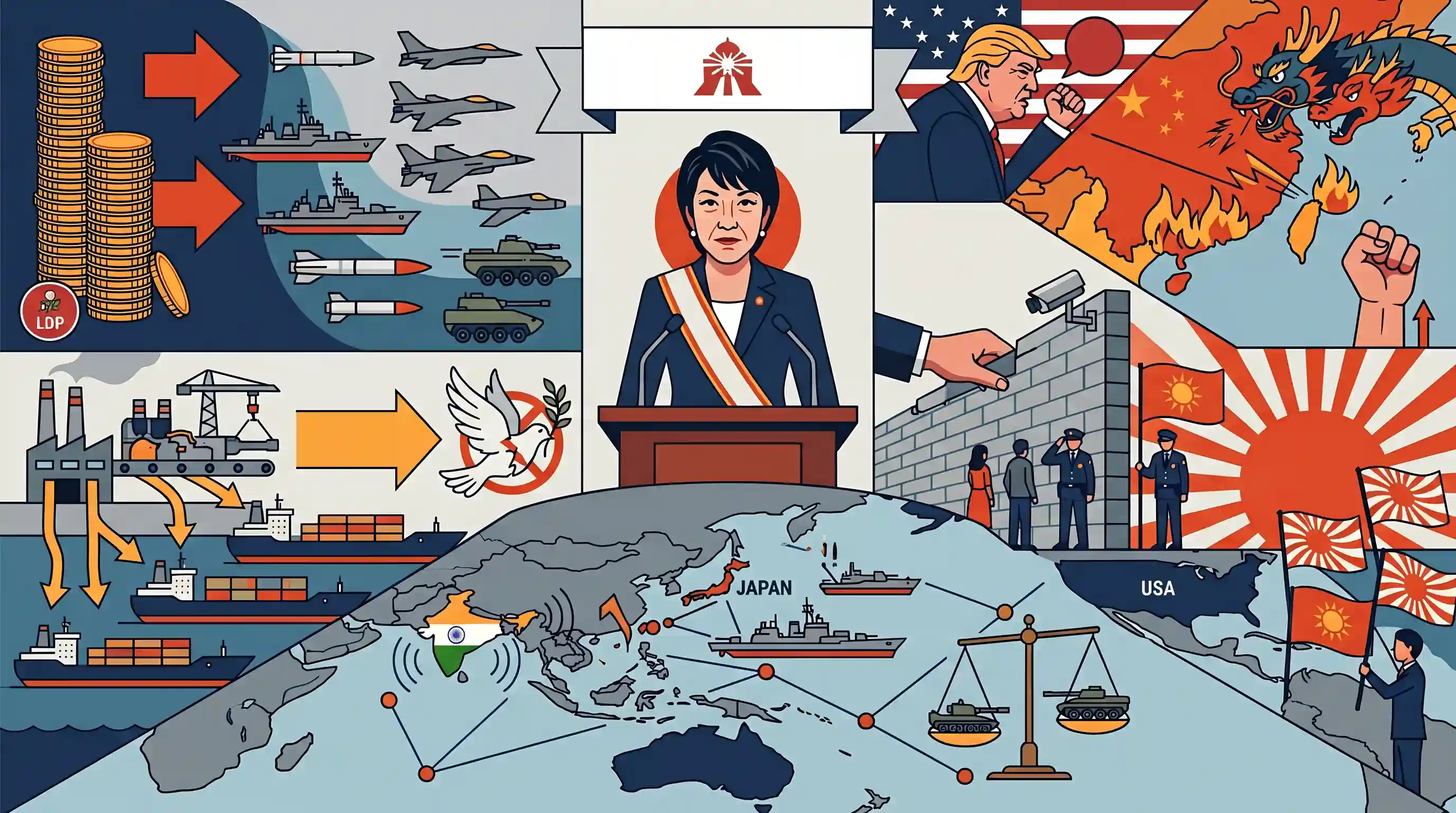
Japanese Prime Minister Sanae Takaichi, an ultraconservative leader of the Liberal Democratic Party (LDP), is seeking a strong mandate in the February 2026 parliamentary elections. Pushing a right-wing agenda, she aims to increase defense spending, lift bans on weapons exports, and move Japan away from its postwar pacifist principles. These defense shifts are heavily influenced by rising geopolitical tensions with China over Taiwan, alongside pressure from U.S. President Donald Trump. Furthermore, Takaichi's platform features stricter immigration policies, highlighting a growing trend of sovereign nationalism in Japanese domestic politics. This historic departure from pacifism holds profound implications for Indo-Pacific security architectures, alliances, and regional power dynamics.
Key Points
- Japanese Prime Minister Sanae Takaichi is seeking a massive mandate for the ruling Liberal Democratic Party (LDP) in the February 2026 national elections.
- Takaichi, an ultraconservative and Japan\'s first female leader, is advocating a definitive shift away from Japan\'s postwar pacifist principles.
- Her agenda includes boosting military capabilities, lifting bans on weapons exports, and increasing defense spending, driven in part by pressure from U.S. President Donald Trump.
- The proposed militarization aims to counter Chinese aggression, particularly concerning Taiwan, radically altering the regional security architecture.
- Domestically, Takaichi\'s platform leverages rising nationalism by proposing tougher policies on foreigners and immigrants amidst demographic challenges.
Important Terms
Article 9 of the Japanese Constitution

A clause in Japan’s 1947 Constitution renouncing war and the maintenance of 'war potential.' Recent interpretations allow 'collective self-defense,' while proposed revisions aim to formalize Japan’s military status.
UPSC context
GS Paper 2 (Comparison of Constitutions); tests understanding of global pacifist legal frameworks and their regional security impact.
Liberal Democratic Party (LDP)
Japan’s dominant conservative political party since 1955. Under Prime Minister Sanae Takaichi, it advocates for increased defense spending, constitutional revision, and a more assertive role in the Indo-Pacific.
UPSC context
GS Paper 2 (International Relations); relevant for analyzing the impact of foreign domestic politics on India’s strategic interests.
Japan Innovation Party (Nippon Ishin no Kai)
A right-leaning, reformist party and LDP coalition partner. It champions constitutional reform, administrative decentralization (Osaka Metropolis Plan), and stricter immigration management including potential population caps.
UPSC context
GS Paper 2 (Global Political Trends); examines how coalition shifts in developed countries influence international security and trade.
Sanseito
A populist, ultraconservative party emphasizing 'sovereign nationalism.' Its platform proposes strict caps on foreign residents and a rebalancing of the U.S.-Japan alliance toward greater military independence.
UPSC context
GS Paper 2 (Effect of Policies); tests awareness of rising nationalism and its effects on global migration and alliances.
Indo-Pacific Security Architecture
The evolving framework of alliances (e.g., Quad) and norms intended to ensure stability. Japan’s move toward 'deterrence-oriented balancing' is a critical pillar of this architecture.
UPSC context
GS Paper 2 (International Relations); central to India's 'Act East' policy and regional maritime security.
Three Non-Nuclear Principles
Japan's 1967 policy pledging not to possess, manufacture, or permit nuclear weapons. These principles are under debate as Japan seeks a more proactive security doctrine.
UPSC context
GS Paper 2 (International Relations); relevant for discussions on nuclear non-proliferation and global security shifts.
Prelims Trap
Article 9 of the Japanese Constitution strictly prohibits the country from maintaining any armed forces or self-defense units.
Japan maintains heavily armed Self-Defense Forces (SDF). Article 9 renounces war as a sovereign right, but the Supreme Court interprets it to allow minimum forces for self-defense.
Static Concepts Connected
How does Japan's Constitution compare to India's regarding international peace?
- Constitutional Mandate: Japan's Article 9 explicitly renounces war and offensive military forces. India’s Article 51 (DPSP) directs the State to promote international peace but places no restrictions on military buildup.
- Head of State: Japan is a constitutional monarchy where the Emperor is merely a symbol of the State, whereas India is a republic with an indirectly elected President as Head of State.
What is the strategic impact of Japan lifting its arms export ban?
- Defense Tech Transfers: Moves beyond the strict 'five categories' limit, allowing joint development and export of lethal hardware (like missiles and fighter jets) to strategic partners like India.
- Indo-Pacific Deterrence: Shifts Japan from a passive pacifist state to a proactive security provider in the Indo-Pacific, directly aimed at deterring Chinese hegemony around the Taiwan Strait.
Cross-Topic Patterns
Article 9 revision + Quad security
Japan's departure from strict pacifism opens doors for lethal defense tech-transfers to India, subtly transforming the Quad into a more robust security architecture against China.
Demographics vs. Sovereign Nationalism
Japan's severe aging population necessitates immigrants, yet its right-wing politics demands stricter borders. This perfectly contrasts India's demographic dividend which actively seeks global mobility pacts.

Expect a 2026 GS2 Mains question linking Japan's Article 9 dilution to the Quad's changing military posture and India's defense ties.
Linked PYQs · 4
Linked PYQs · 4
- 2019MainsGS2
‘The time has come for India and Japan to build a strong contemporary relationship, one involving global and strategic partnership that will have a great significance for Asia and the world as a whole.’ Comment.
- 2025MainsGS2
"With the waning of globalization, post-Cold War world is becoming a site of sovereign nationalism.” Elucidate.
- 2021MainsGS2
The newly tri-nation partnership AUKUS is aimed at countering China's ambitions in the Indo-Pacific region. Is it going to supersede the existing partnerships in the region? Discuss the strength and impact of AUKUS in the present scenario.
- 2020MainsGS2
What is the significance of Indo-US defence deals over Indo-Russian defence deals? Discuss with reference to stability in the Indo-Pacific region.
