Japan Climate Monitoring Satellite and H 2A Rocket Retirement
Source:The Hindu ↗
Why It Matters
Provides comparative global context for India's own space endeavours (like ISRO's earth observation satellites and launch vehicles such as LVM3/PSLV). It highlights the increasing intersection of space technology with climate change mitigation and the growing commercialization of the global space transport market.
Summary
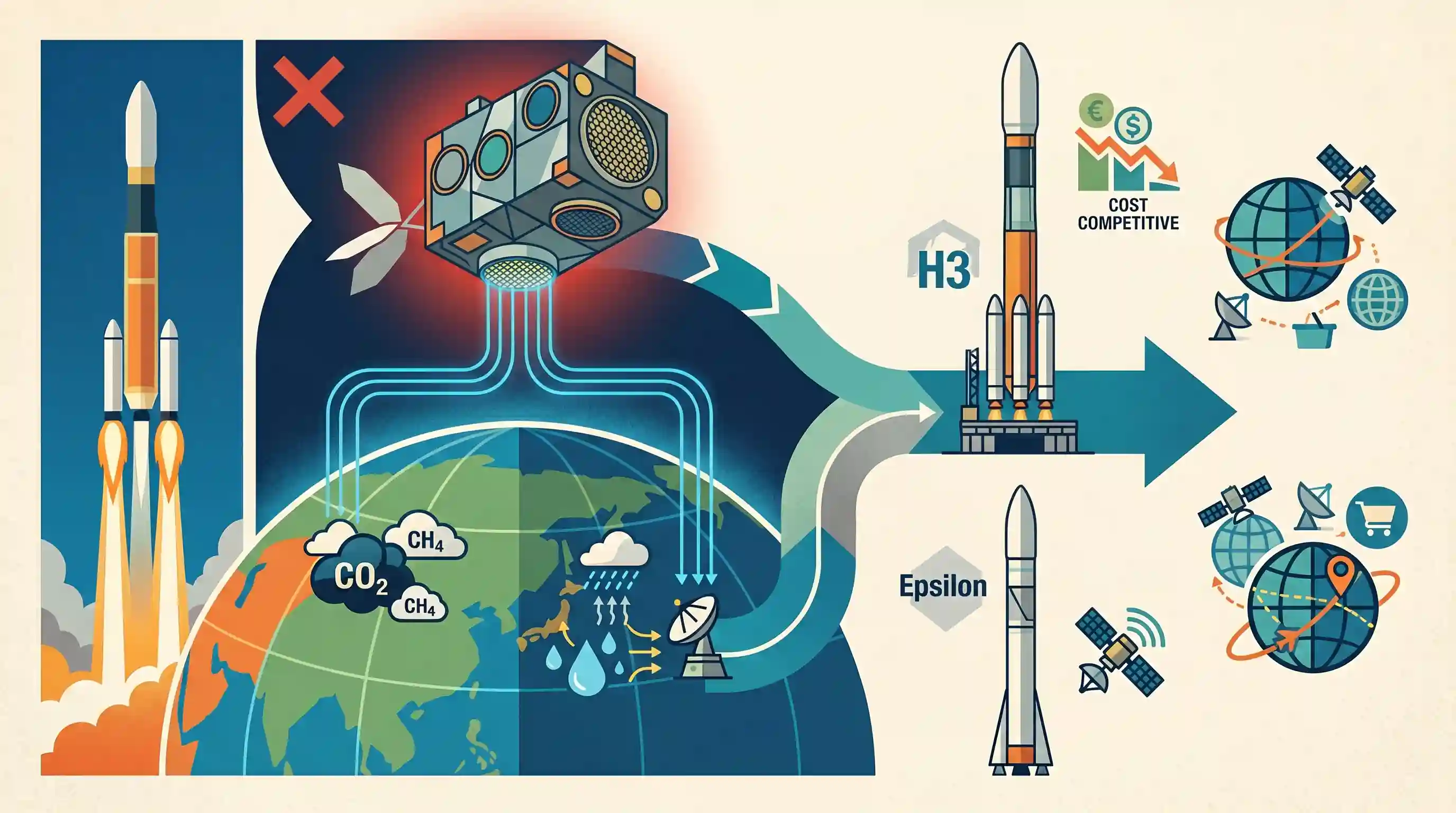
Japan successfully launched the GOSAT-GW climate change monitoring satellite on the 50th and final flight of its mainstay H-2A rocket. The satellite will provide critical global data on greenhouse gases and the water cycle. Following this launch, Japan will fully transition to its newer, more cost-competitive H3 rocket and the smaller Epsilon system to enhance its standing in the commercial space transport market.
Key Points
- Japan successfully launched the GOSAT-GW satellite, a third-generation mission designed to monitor greenhouse gases like carbon and methane, and the water cycle.
- The satellite will distribute high-resolution data on sea surface temperature and precipitation globally to aid climate change mitigation efforts.
- The launch marked the 50th and final flight of Japan\'s highly reliable liquid-fuel H-2A rocket, which debuted in 2001 and had a 98% success rate.
- Japan is replacing the H-2A with the newer, more cost-effective H3 rocket as its flagship launch vehicle to remain commercially competitive in the global space market.
- Japan is also developing the smaller Epsilon rocket system to cater to diverse customer needs in the satellite launch industry.
Important Terms
GOSAT-GW

A Japanese Earth observation satellite tracking greenhouse gases (CO2, methane) and the global water cycle. It provides high-resolution data to support climate science and the Paris Agreement's transparency requirements.
UPSC context
GS-III (Science & Tech/Environment); relevant for international climate monitoring frameworks and satellite-based environmental surveillance.
H-2A Rocket
Japan's flagship liquid-fuel launch vehicle from 2001 to 2026. Known for its 98% success rate, it was the mainstay for critical missions like SLIM and Hayabusa2 before its final flight.
UPSC context
GS-III (Science & Tech); focuses on the evolution of launch vehicle technology and global space transportation history.
H3 Rocket
Japan's next-generation, cost-effective flagship rocket designed to replace the H-2A. It features a modular design and LE-9 engines to compete in the commercial satellite launch market.
UPSC context
GS-III (Science & Tech); highlights global competition in space transport and the shift toward cost-efficient, heavy-lift capabilities.
SLIM (Smart Lander for Investigating Moon)
JAXA's precision lunar lander, nicknamed "Moon Sniper," which successfully demonstrated a soft landing within 100 meters of its target in 2024, making Japan the fifth nation to reach the Moon.
UPSC context
GS-III (Science & Tech); tests knowledge of precision landing technologies and Indo-Japanese space collaborations like LUPEX.
JAXA (Japan Aerospace Exploration Agency)
Japan's national aerospace agency responsible for satellite development, space exploration, and aviation research. It is a key international partner for ISRO in lunar and climate missions.
UPSC context
GS-III (Science & Tech); essential for understanding international space relations and comparative institutional frameworks in space research.
Epsilon Launch Vehicle
A solid-fuel, compact launch vehicle developed by Japan for small scientific satellites. It uses automated inspection systems and simplified operations to lower costs and increase space access.
UPSC context
GS-III (Science & Tech); covers different propulsion systems (solid vs liquid) and the growing market for small-satellite launches.
Prelims Trap
GOSAT-GW is a joint Earth observation satellite mission launched by ISRO and JAXA.
GOSAT-GW is strictly a Japanese mission. The major ISRO-JAXA joint mission is LUPEX (Lunar Polar Exploration), which will utilize Japan's new H3 rocket.
Static Concepts Connected
How do Solid and Liquid rocket propellants differ in space missions?
- Solid Propellants: Provide high initial thrust but cannot be throttled or easily stopped once ignited. They are ideal for initial lift-off boosters or small satellites (like Japan's Epsilon or India's SSLV).
- Liquid Propellants: Deliver higher specific impulse and can be precisely controlled, shut down, and restarted. They are crucial for upper stages requiring complex orbital maneuvers.
- Cryogenic Engines: An advanced liquid propulsion system using super-cooled gases (liquid hydrogen/oxygen) offering maximum efficiency and payload capacity for heavy-lift rockets like the H3 or GSLV Mk-III.
How do Earth Observation Satellites monitor greenhouse gases and the water cycle?
- Optical Spectrometry: Satellites analyze reflected sunlight. Gases like CO2 and methane absorb specific infrared wavelengths, creating unique, identifiable spectral signatures in the atmospheric data.
- Active LIDAR: Rather than relying on sunlight, some advanced satellites fire laser pulses at Earth and measure the backscatter to precisely calculate gas concentrations day or night.
- Microwave Radiometry: Earth Observation Satellites use microwave radiometers and radar scatterometers to track sea surface temperatures, soil moisture, and precipitation patterns crucial for global climate modeling.
Cross-Topic Patterns
Commercial launch vehicle transition
Japan's shift to the cost-competitive H3 rocket mirrors India's parallel push with LVM3 and SSLV to capture the global commercial space transport market via NSIL.
Space data for climate goals
High-resolution GHG data from satellites like GOSAT-GW provides verifiable global emission metrics, essential for enforcing UNFCCC Paris Agreement targets and monitoring cross-border carbon footprints.

Expect a multi-statement question on foreign launch vehicles (H3, Falcon 9) utilized by ISRO, alongside the ISRO-JAXA LUPEX mission.
Linked PYQs · 4
Linked PYQs · 4
- 2022MainsGS3
Discuss global warming and mention its effects on the global climate. Explain the control measures to bring down the level of greenhouse gases which cause global warming, in the light of the Kyoto Protocol, 1997.
- 2025MainsGS3
What is Carbon Capture, Utilization and Storage (CCUS)? What is the potential role of CCUS in tackling climate change?
- 2023MainsGS3
What is the main task of India's third moon mission which could not be achieved in its earlier mission? List the countries that have achieved this task. Introduce the subsystems in the spacecraft launched and explain the role of the Virtual Launch Control Centre' at the Vikram Sarabhai Space Centre which contributed to the successful launch from Sriharikota.
- 2022MainsGS3
Launched on 25th December, 2021, James Webb Space Telescope has been much in the news since then. What are its unique features which make it superior to its predecessor Space Telescopes ? What are the key goals of this mission ? What potential benefits does it hold for the human race?
