Japan successfully launches flagship H3 rocket into orbit
Source:The Hindu ↗
Why It Matters
UPSC frequently evaluates candidates on advancements in space technology and international space missions. Japan's H3 rocket launch highlights the growing commercialization of space, the critical challenge of space debris mitigation, and the rising competition between national space agencies and private players. These themes are directly relevant to the GS3 syllabus (Science and Technology) and offer valuable context for understanding the global space landscape and India's (ISRO's) comparative standing.
Summary
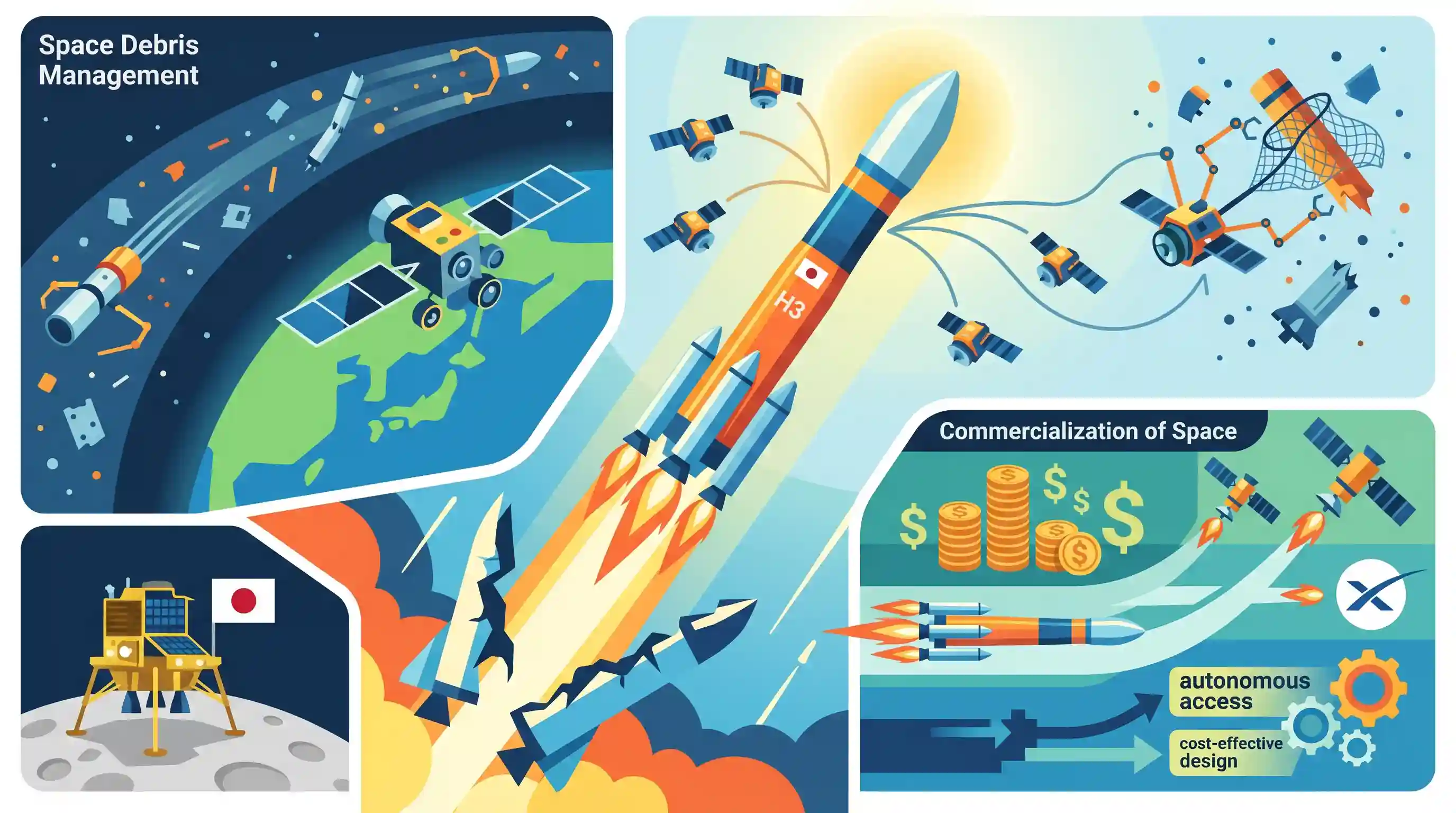
Japan's space agency, JAXA, successfully launched its new flagship H3 rocket, placing an Earth-observation satellite and five other small satellites into orbit. Notably, one of these satellites is equipped to test space debris capture technology. This successful mission marks a vital recovery for Japan's space program following a prior launch failure. The H3 rocket is designed for greater cost-effectiveness and reliability, key factors as Japan seeks to maintain autonomous space access and compete for global commercial satellite launch contracts against dominant private companies like SpaceX. The launch builds on Japan's recent milestone of landing the SLIM probe on the Moon.
Key Points
- Japan successfully launched its new flagship H3 rocket, carrying six small satellites into orbit after a previous launch failure.
- One of the deployed satellites is specifically designed to test technologies for capturing and mitigating space debris.
- The H3 rocket was developed to provide high flexibility, reliability, and better cost performance than its predecessor, the H-2A.
- Japan aims to use the H3 to compete in the lucrative global commercial satellite launch market, currently dominated by private firms such as SpaceX.
- The mission follows Japan's successful soft landing of the uncrewed SLIM probe on the Moon, further demonstrating its growing space exploration capabilities.
Important Terms
H3 Launch Vehicle

Japan's next-generation flagship medium-lift rocket, developed by JAXA and Mitsubishi Heavy Industries to provide high-reliability, flexible, and low-cost access to space.
UPSC context
GS Paper III (Science & Technology); tests knowledge of international space launch systems and commercial competition.
SLIM (Smart Lander for Investigating Moon)
A JAXA mission nicknamed "Moon Sniper" that achieved the first-ever high-precision lunar soft-landing (within 100 meters) in January 2024.
UPSC context
GS Paper III (S&T); significant for its precision technology and collaboration with ISRO.
JAXA (Japan Aerospace Exploration Agency)
Japan's national aerospace agency responsible for research, satellite development, and flagship missions like Hayabusa and the H3 rocket program.
UPSC context
GS Paper III (S&T); a key strategic partner for India in bilateral space exploration.
Space Debris Mitigation
Technologies and strategies, such as capturing or de-orbiting defunct satellites, aimed at managing man-made "space junk" to ensure orbital safety.
UPSC context
GS Paper III (Environment/S&T); critical for orbital sustainability and the "Kessler Syndrome" threat.
LUPEX (Lunar Polar Exploration Mission)
A planned joint mission between ISRO (India) and JAXA (Japan) to explore the Moon’s South Pole for water ice and resources.
UPSC context
GS Paper II (IR) and GS III (S&T); highlights Indo-Japanese technological and strategic cooperation.
Commercialization of Space
The transition of space activities from purely state-run programs to market-driven ventures involving private companies, low-cost launches, and satellite services.
UPSC context
GS Paper III (Economy/S&T); relevant for global space economy trends and India's Space Policy 2023.
Prelims Trap
"The upcoming LUPEX mission is a joint initiative between ISRO and NASA to explore the Moon's South Pole."
LUPEX is a joint ISRO-JAXA mission, not NASA. Japan provides the H3 launch vehicle and the rover, while India provides the lunar lander.
Static Concepts Connected
What is Kessler Syndrome and how is space debris mitigated globally and in India?
- Kessler Syndrome: A theoretical scenario where Low Earth Orbit object density causes cascading collisions, generating exponential debris and hindering future space access.
- Mitigation Methods: Active Debris Removal (ADR) via nets/magnets (tested in this H3 launch), passivation, and post-mission disposal by lowering orbits to burn up in the atmosphere.
- India's Project NETRA: ISRO's early warning system for space object tracking and analysis, established to protect Indian satellites from debris and collision hazards.
What are the distinct roles of NSIL and IN-SPACe in India's space commercialization?
- NSIL: The commercial arm of ISRO under DOS, responsible for producing launch vehicles (like LVM3), technology transfer, and commercializing ISRO's R&D globally.
- IN-SPACe: The independent nodal agency functioning under DOS to authorize, promote, and regulate non-governmental private sector participation in Indian space activities.
Cross-Topic Patterns
LUPEX + Lunar South Pole
Japan’s H3 rocket is slated to launch the ISRO-JAXA LUPEX mission. This explicitly links Japan's new heavy-lift capabilities to India's post-Chandrayaan-3 lunar exploration roadmap.
Space Debris + Global Commons
Debris capture technology addresses the tragedy of the commons in Low Earth Orbit, integrating space sustainability with international governance and the Outer Space Treaty.

Expect a 'pairs matching' question in Prelims 2026 linking lunar missions (LUPEX, SLIM, Artemis) with their respective space agencies.
Linked PYQs · 3
Linked PYQs · 3
- 2018PrelimsGS1
With reference to India's satellite launch vehicles, consider the following statements: 1. PSLVs launch the satellites useful for Earth resources monitoring whereas GSLVs are designed mainly to launch communication satellites. 2. Satellites launched by PSLV appear to remain permanently fixed in the same position in the sky, as viewed from a particular location on Earth. 3. GSLV Mk III is a four-staged launch vehicle with the first and third stages using solid rocket motors; and the second and fourth stages using liquid rocket engines. Which of the statements given above is/are correct?
- 2023PrelimsGS1
Which one of the following countries has its own Satellite Navigation System?
- 2016MainsGS3
Discuss India's achievements in the field of Space Science and Technology. How the application of this technology has helped India in its socio-economic development?
