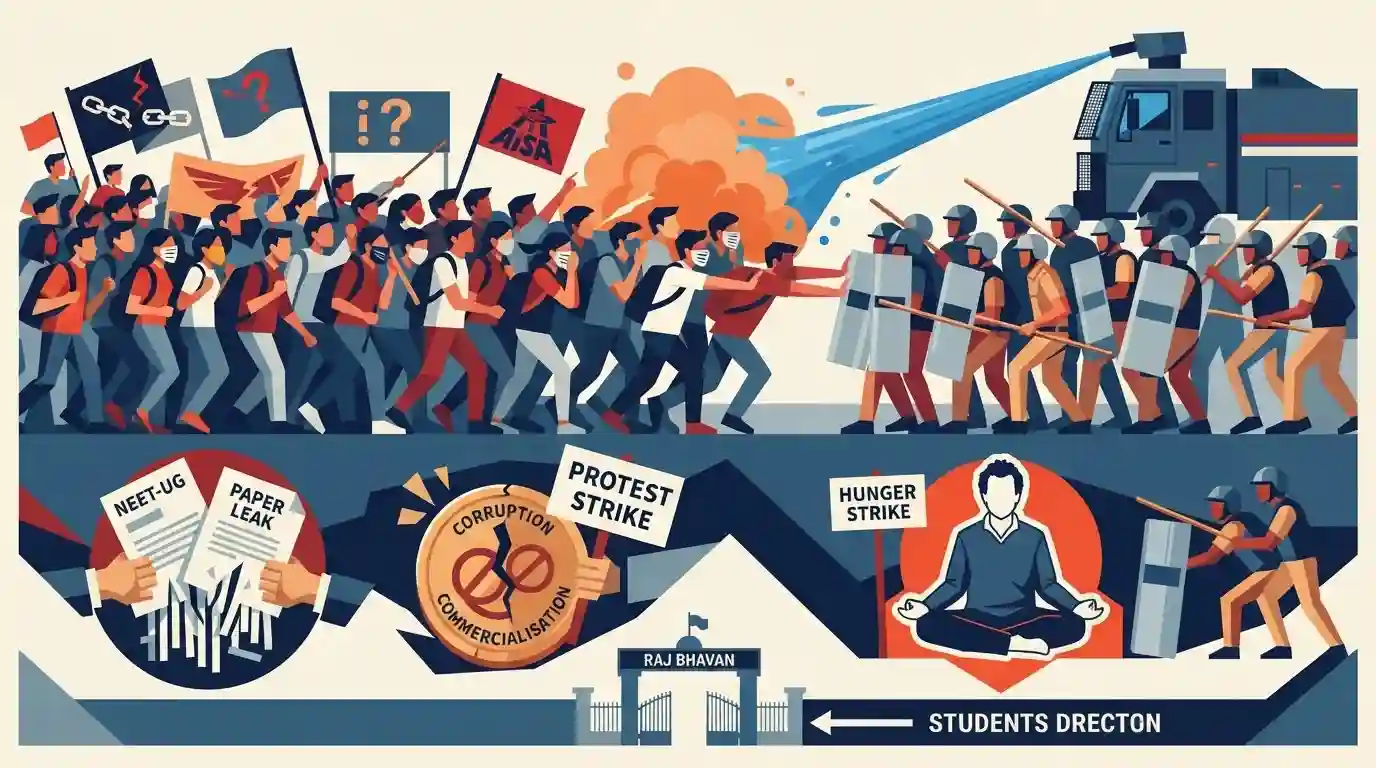
Patna police disperse student protesters with lathi charge
Source:Indian Express ↗
Why It Matters
This event illustrates the complex intersection of the constitutional right to peaceful assembly (Article 19), police handling of student demonstrations (public order), and the role of student organizations as active pressure groups. It also highlights the systemic governance challenges plaguing the national education system, specifically regarding high-stakes competitive examinations and institutional accountability.
Summary
A violent clash erupted in Patna at JP Golambar when police resorted to water cannons, tear gas, and a baton charge to halt a march by the All India Students Association (AISA) towards Raj Bhavan. The students were demonstrating in solidarity with ongoing protests at Delhi's Jantar Mantar, calling for the resignation of Union Education Minister Dharmendra Pradhan and highlighting issues of paper leaks (specifically NEET-UG), systemic corruption, and commercialisation in India's education sector. The agitation intensified following police action against activist Sonam Wangchuk during his hunger strike in Delhi.
Key Points
- Student protesters under the All India Students Association (AISA) marched toward Patna's Raj Bhavan, demanding the resignation of Union Education Minister Dharmendra Pradhan over competitive examination paper leaks (specifically NEET-UG) and corruption.
- Patna Police deployed multiple layers of barricades, water cannons, tear gas, and carried out a baton charge (lathi-charge) to disperse the crowd when protesters tried to push through JP Golambar.
- The protest was organized in solidarity with the ongoing student demonstrations at Delhi's Jantar Mantar and the recent police actions against protesters there.
- Climate activist and educator Sonam Wangchuk was recently removed by Delhi Police from his hunger strike at Jantar Mantar and shifted to Safdarjung and then Medanta Hospital, triggering widespread student solidarity protests across the country.
- The student agitations highlight deeper issues regarding the integrity of competitive exams, commercialisation of education, and the administration of the national education sector.
Important Terms
National Eligibility cum Entrance Test (NEET-UG)

A centralized, nationwide entrance examination in India conducted by the National Testing Agency (NTA) for admission to undergraduate medical (MBBS), dental (BDS), and AYUSH courses.
UPSC context
GS Paper II (Education/Social Sector Issues); tests knowledge of central examination administration, equity, and educational governance.
National Testing Agency (NTA)
An autonomous, premier testing organization under India's Ministry of Education, established to conduct efficient, transparent, and standardized entrance examinations for higher educational institutions.
UPSC context
GS Paper II (Polity/Governance); tests knowledge of autonomous bodies, public policy reforms in education, and exam integrity issues.
Pressure Groups
Organized collectives of individuals who actively promote, defend, or lobby for their shared interests to influence government decisions, policy-making, or implementation without directly contesting elections.
UPSC context
GS Paper II (Polity); tests understanding of formal/informal associations, interest articulation, and their role in a democracy.
All India Students Association (AISA)
A left-wing student organization and pressure group in India, active in university campus politics and nationwide educational advocacy.
UPSC context
GS Paper II (Polity - Pressure Groups); tests the understanding of student-led informal associations and their impact on public policy.
Right to Peaceful Assembly (Article 19(1)(b))
A fundamental constitutional right in India granting citizens the liberty to gather peacefully and without arms for lawful purposes, subject to reasonable restrictions.
UPSC context
GS Paper II (Fundamental Rights); tests legal-constitutional understanding of civil liberties, public order management, and reasonable restrictions.
Prelims Trap
The right to assemble peaceably under Article 19(1)(b) can be restricted on grounds of decency, morality, or friendly relations with foreign states.
These restrictions apply to freedom of speech (Article 19(2)), not peaceable assembly (Article 19(3)), which can only be restricted on public order and sovereignty/integrity of India.
Static Concepts Connected
What are the restrictions on the Right to Assemble under Article 19(3)?
- Permissible grounds: Restricted only in the interest of public order or the sovereignty and integrity of India.
- Exclusions: Grounds like decency, morality, or friendly relations with foreign states do not apply to assembly.
What is the administrative and legal character of the NTA?
- Non-statutory status: Established as an autonomous society registered under the Societies Registration Act, 1860, not by Parliament.
- Accountability: Operating under the Ministry of Education, it is fully subject to the Right to Information Act, 2005.
Cross-Topic Patterns
Central exams vs. State public order
National-level testing anomalies (NEET) spark localized law-and-order crises, showing how Union-level educational policies directly impact State-list policing responsibilities.
Article 19(1)(b) vs. executive police powers
The constitutional right to peaceably assemble frequently conflicts with preventive policing powers under the BNSS to declare assemblies unlawful in public interest.

A 2026 question may test the operational grounds of the Public Examinations Act 2024 paired with the non-statutory character of the NTA.
Linked PYQs · 3
Linked PYQs · 3
- 2017MainsGS3
Mob violence is emerging as a serious law and order problem in India. By giving suitable examples, analyze the causes and consequences of such violence.
- 2021MainsGS2
“Pressure groups play a vital role in influencing public policy making in India.” Explain how the business associations contribute to public policies.
- 2015MainsGS2
The quality of higher education in India requires major improvements to make it internationally competitive. Do you think that the entry of foreign educational institutions would help improve the quality of higher and technical education in the country? Discuss.
