Jan Vishwas Bill and Decriminalisation of Minor Offences
Source:Indian Express ↗
Why It Matters
Understanding the Jan Vishwas legislation is crucial for civil services aspirants as it highlights India's shift toward trust-based governance, regulatory rationalisation, and reforms aimed at reducing the burden on courts while fostering economic growth.
Summary
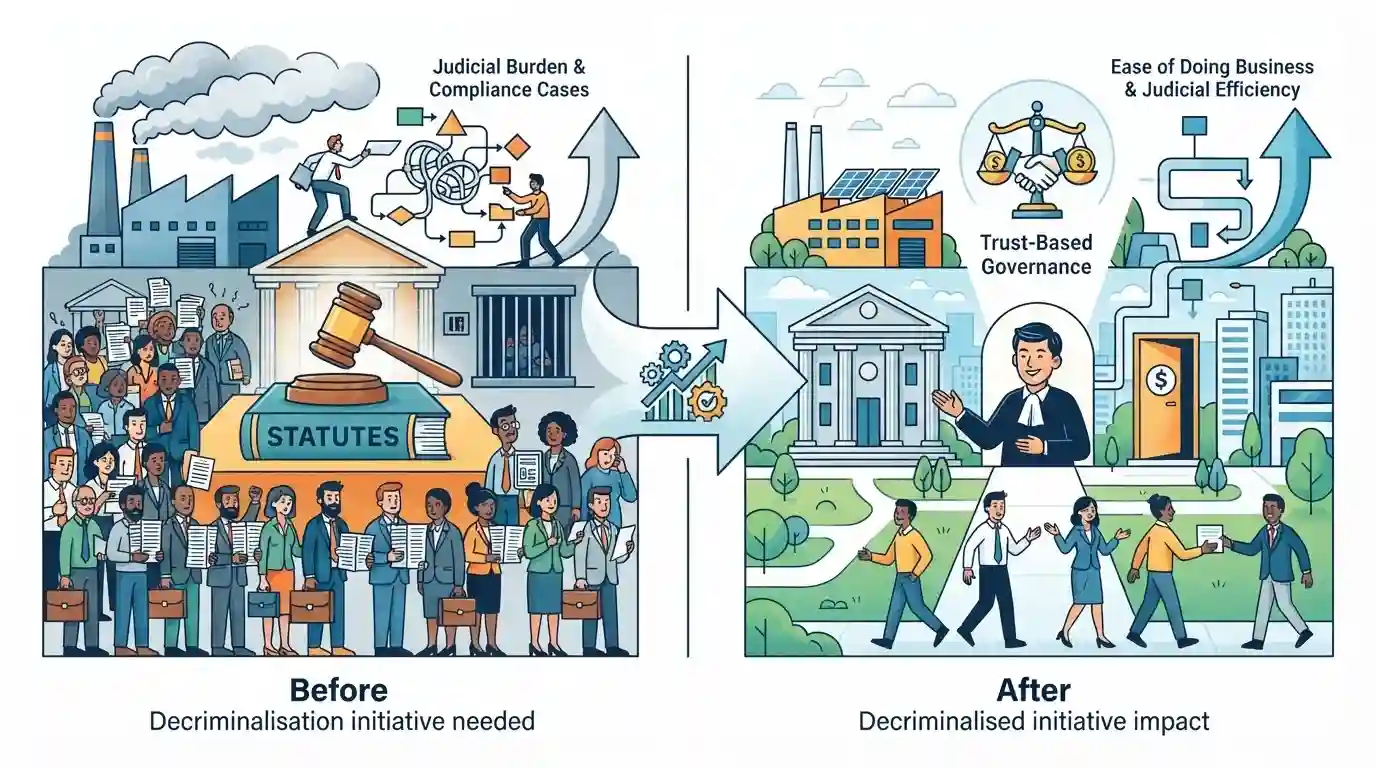
The Jan Vishwas legislative initiative seeks to decriminalise minor technical and procedural offences across multiple statutes, replacing imprisonment with monetary penalties to promote ease of doing business, ease of living, and reduce judicial backlog through trust-based governance.
Key Points
- The Jan Vishwas legislative framework focuses on decriminalising minor technical and procedural defaults to improve the ease of doing business and living in India.
- It replaces criminal penalties like imprisonment with monetary penalties, compounding of offences, and administrative mechanisms for various minor statutory violations.
- The initiative aims to reduce the burden on the Indian judicial system by curbing unnecessary litigation stemming from trivial compliance issues.
- It addresses over-regulation by shifting the regulatory approach from punitive measures to trust-based governance.
Important Terms
Jan Vishwas Bill

A legislative initiative aimed at decriminalising minor technical and procedural offences across various central statutes by replacing imprisonment with monetary penalties to promote ease of doing business.
UPSC context
UPSC GS Paper II & III: Important Government Policies, Governance, and Ease of Doing Business initiatives.
Jan Vishwas Act
Legislation that amends multiple Central Acts to shift towards trust-based governance, reducing compliance burdens and easing judicial backlogs by decriminalising minor technical violations.
UPSC context
UPSC GS Paper II: Governance, transparency, institutional reforms, and regulatory compliance frameworks in India.
Decriminalisation
The process of removing criminal penalties like imprisonment for minor regulatory breaches, replacing them with civil penalties or monetary fines to foster a business-friendly environment.
UPSC context
UPSC GS Paper II & III: Judicial reforms, reducing court backlogs, and reforming bureaucratic compliance burdens for MSMEs.
Prelims Trap
decriminalises all statutory violations across central and state legislations by entirely replacing criminal liability with civil fines.
Aspirants often assume Jan Vishwas repeals all criminal penalties across all central laws. In reality, it targets only minor, technical, and procedural defaults while retaining severe criminal penalties for willful fraud or public safety breaches.
Static Concepts Connected
What is the difference between criminal liability and civil/administrative penalties in regulatory governance?
- Intent Standard:: Mens Rea requirement typically needed for criminal offences, whereas regulatory/civil violations often impose strict liability.
- Enforcement Impact:: Criminal penalties involve imprisonment, social stigma, and the criminal justice machinery; civil penalties rely on monetary fines and administrative adjudication.
- Judicial Burden:: Criminal cases burden courts under adversarial trials, while administrative mechanisms use compounding, compounding fees, and adjudicating officers to resolve disputes swiftly.
Cross-Topic Patterns
Decriminalisation & Judicial Backlog Reforms
The Jan Vishwas shift from criminal imprisonment to administrative civil penalties mirrors broader structural reforms aimed at reducing systemic judicial backlogs and reforming archaic colonial-era penal codes.

Jan Vishwas trust-based governance + ease of doing business will feature in a multi-statement Prelims question on regulatory reforms.
Linked PYQs · 2
Linked PYQs · 2
- 2024MainsGS2
What are the aims and objects of recently passed and enforced, The Public Examination (Prevention of Unfair Means) Act, 2024? Whether University/State Education Board examinations, too, are covered under the Act ?
- 2024MainsGS3
Discuss the merits and demerits of the four 'Labour Codes' in the context of labour market reforms in India. What has been the progress so far in this regard?
