Jan Vishwas Bill and Decriminalisation of Minor Offences
Source:Indian Express ↗
Why It Matters
Crucial for understanding regulatory reforms, ease of doing business, judicial de-congestion, and the shift from punitive compliance to administrative penalties in Indian governance.
Summary
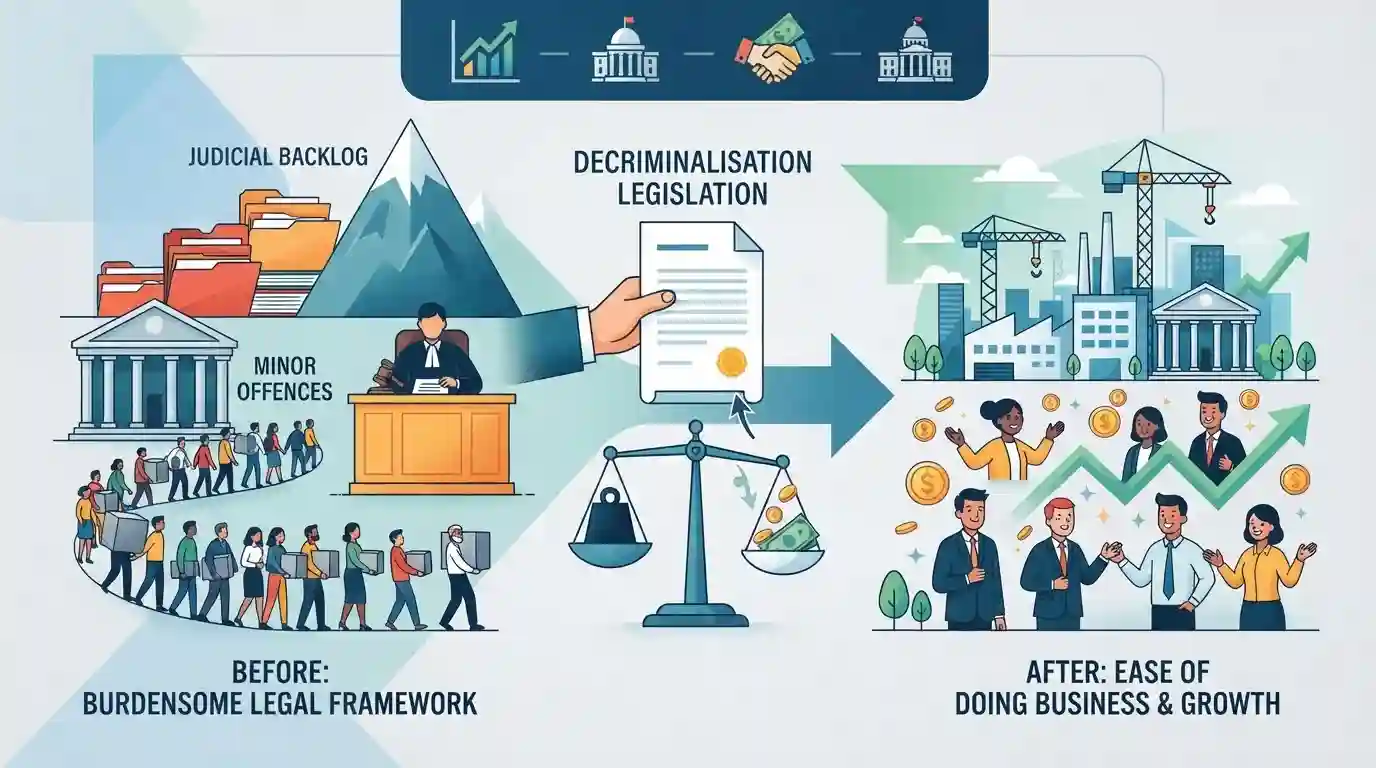
The Jan Vishwas legislative framework targets the decriminalisation of minor offences across various laws in India. By replacing jail terms with monetary penalties, the initiative aims to reduce judicial backlog, enhance ease of doing business, and eliminate unnecessary regulatory friction for businesses and citizens.
Key Points
- The Jan Vishwas legislation focuses on decriminalising minor, technical, or procedural defaults across multiple statutes to reduce the compliance burden.
- It aims to replace imprisonment clauses with monetary penalties or administrative mechanisms, fostering ease of doing business and living.
- The move seeks to de-clog the judicial system by resolving minor infractions through alternative adjudication mechanisms like compounding of offences and administrative penalties.
- It balances regulatory oversight by ensuring severe deterrence against major or malicious violations while giving relief for inadvertent administrative lapses.
Important Terms
Jan Vishwas Bill

A landmark Indian legislative framework aimed at enhancing ease of doing business and trust-based governance by decriminalising minor technical or procedural offences across various central acts and replacing jail terms with monetary penalties.
UPSC context
UPSC GS Paper II (Polity & Governance) and GS Paper III (Economy - Growth & Development); tests knowledge of legal reforms and regulatory compliance.
Jan Vishwas Amendment Act
Enacted legislation that amends multiple central acts to replace imprisonment with civil fines, reduce judicial backlog, and eliminate unnecessary compliance burdens for businesses and citizens.
UPSC context
UPSC GS Paper II (Government Policies & Interventions) and GS Paper III (Ease of Doing Business); tests understanding of legislative changes improving the business climate.
Parliament of India
The supreme legislative body of India consisting of the President, Lok Sabha, and Rajya Sabha, responsible for enacting laws, including significant regulatory reforms like the Jan Vishwas framework.
UPSC context
UPSC GS Paper II (Indian Constitution & Polity - Parliament & State Legislatures); tests fundamental structures and legislative processes.
Ministry of Commerce and Industry
The Union ministry responsible for formulating and implementing industrial policies, promoting investment, and driving initiatives to improve the ease of doing business in India.
UPSC context
UPSC GS Paper III (Economy - Industrial Policy & Growth); tests institutional roles in fostering economic development and regulatory ease.
Static Concepts Connected
What are the key mechanisms used by the state to reduce judicial backlog and regulatory friction?
- Decriminalisation: Replacing criminal imprisonment clauses for minor procedural defaults with civil monetary penalties and administrative adjudication mechanisms.
- Compounding: Settling minor offences outside courts through payment of specified sums, avoiding lengthy criminal trials.
- Administrative Adjudication: Establishing departmental adjudicating officers to impose penalties instead of routing every technical breach through criminal courts.
Cross-Topic Patterns
Ease of Doing Business & Compliance Burden
Decriminalising technical defaults complements insolvency reforms and labor code rationalisation to slash India's overall compliance burden.
Judicial Backlog & Alternative Dispute Resolution
Shifting from criminal penalties to civil monetary fines directly addresses court pendency, supporting judicial infrastructure reforms.

Jan Vishwas framework's shift to civil penalties vs continuing criminal liability for grave offences will be tested via analytical statements.
Linked PYQs · 2
Linked PYQs · 2
- 2024MainsGS2
What are the aims and objects of recently passed and enforced, The Public Examination (Prevention of Unfair Means) Act, 2024? Whether University/State Education Board examinations, too, are covered under the Act ?
- 2024MainsGS3
Discuss the merits and demerits of the four 'Labour Codes' in the context of labour market reforms in India. What has been the progress so far in this regard?
