Jan Vishwas Bill and Decriminalisation of Minor Offences
Source:Indian Express ↗
ఇది ఎందుకు ముఖ్యం
Understanding the Jan Vishwas framework is essential for assessing India's regulatory reforms, efforts to reduce compliance burdens, and strategies to improve the ease of doing business and reduce judicial backlogs.
సారాంశం
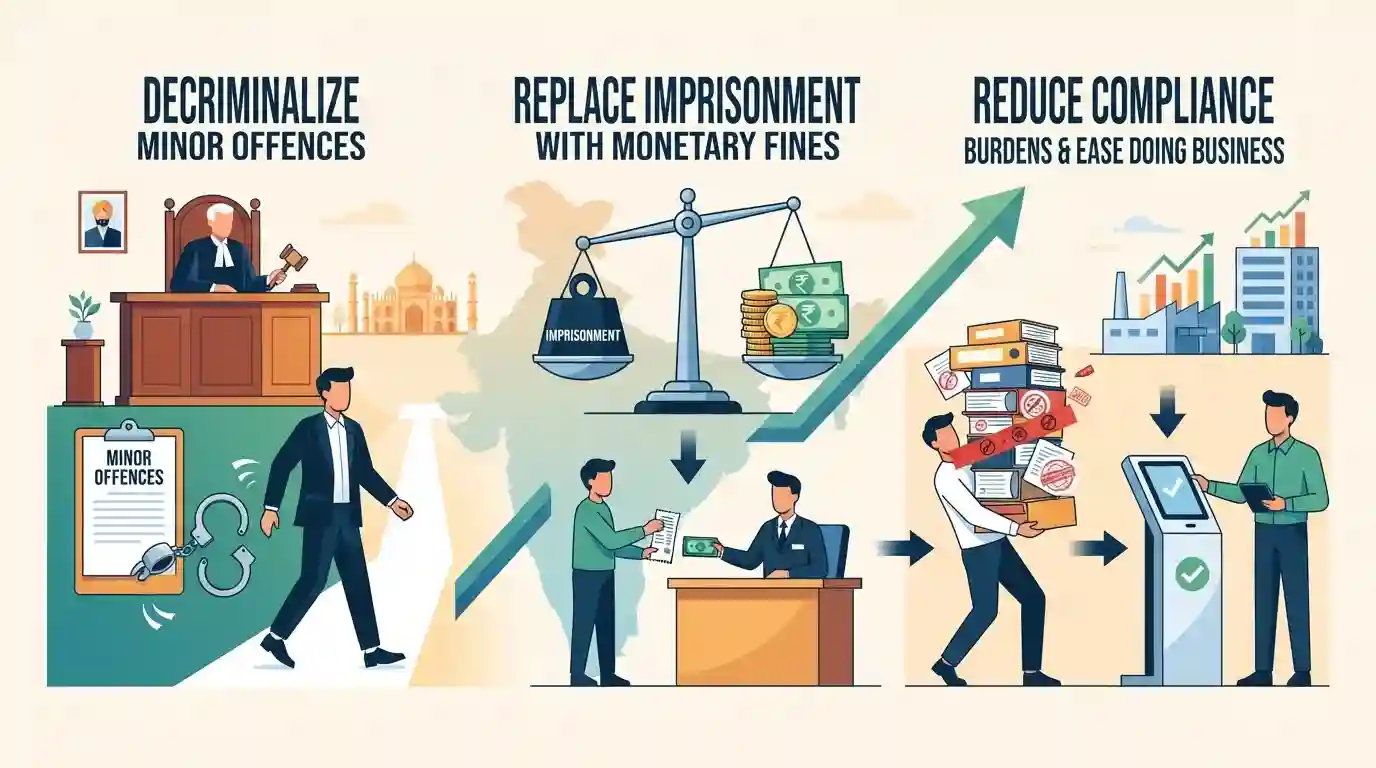
The Jan Vishwas initiative aims to decriminalize minor offences, replace imprisonment clauses with monetary fines, and reduce compliance burdens to enhance Ease of Doing Business and curb judicial delays in India.
ముఖ్య అంశాలు
- The Jan Vishwas legislation focuses on decriminalizing minor, technical, or procedural offences to reduce the compliance burden and promote Ease of Doing Business in India.
- It converts several criminal penalties involving imprisonment into monetary penalties or compounding of offences, ensuring proportionality in punishment.
- The initiative addresses judicial backlogs and over-criminalization by removing minor infractions from criminal courts and shifting them to administrative mechanisms or civil penalties.
- Key regulatory changes are designed to build trust between the government and businesses, fostering foreign investment and economic growth.
ముఖ్యమైన పదాలు
Jan Vishwas Bill

A landmark legislation aimed at decriminalizing minor technical and procedural offenses by replacing imprisonment clauses with monetary or civil penalties, thereby enhancing ease of doing business and reducing judicial backlog.
UPSC context
GS Paper II & III (Polity & Governance, Economy - Growth & Development); tests knowledge of regulatory reforms and ease of doing business.
Jan Vishwas Act
An enactment that amends multiple central laws to remove criminal liabilities for minor violations, shifting towards a trust-based governance model and administrative adjudication.
UPSC context
GS Paper III (Economy - Government Policies & Interventions); tests understanding of legislative measures aimed at improving India's business ecosystem.
ప్రిలిమ్స్ ఉచ్చు
decriminalizing minor offences means complete immunity or abolition of all regulatory penalties for procedural lapses.
Aspirants often assume Jan Vishwas completely abolishes penalties for technical breaches, whereas it replaces criminal imprisonment with civil monetary fines and compounding.
అనుసంధానమైన స్థిర భావనలు
What are the key mechanisms used under Indian law to reduce judicial backlogs and over-criminalization?
- Decriminalisation: Replacing imprisonment with monetary penalties or compounding of offences for technical or procedural non-compliances.
- Administrative Adjudication: Appointing executive Adjudicating Officers to settle disputes outside traditional criminal court hierarchies.
- Graded Penalties: Introducing graded penalties and periodic escalation clauses to maintain deterrence without clogging courts.
అంతర-అంశ నమూనాలు
Decriminalisation + Judicial Backlogs + Corporate Governance
Judicial backlogs addressed through administrative tribunals and decriminalisation mirror similar structural reforms in corporate law via the Companies Act compounding provisions.
Trust-based Governance + Ease of Doing Business + FDI
Shifting from punitive state control to trust-based governance directly supports supply-chain resilience and FDI attraction goals similar to PLI schemes.

Jan Vishwas penalty-rationalisation and Adjudicating Officer mechanisms will feature in a statement-based prelims question.
అనుసంధాన PYQలు · 2
అనుసంధాన PYQలు · 2
- 2024MainsGS2
What are the aims and objects of recently passed and enforced, The Public Examination (Prevention of Unfair Means) Act, 2024? Whether University/State Education Board examinations, too, are covered under the Act ?
- 2024MainsGS3
Discuss the merits and demerits of the four 'Labour Codes' in the context of labour market reforms in India. What has been the progress so far in this regard?
