Jan Vishwas Bill Decriminalisation and Compliance Reforms
Source:Indian Express ↗
ఇది ఎందుకు ముఖ్యం
This topic is critical for understanding administrative reforms, the evolution of criminal law and regulatory frameworks in India, and policy measures aimed at improving the ease of doing business and reducing judicial backlogs.
సారాంశం
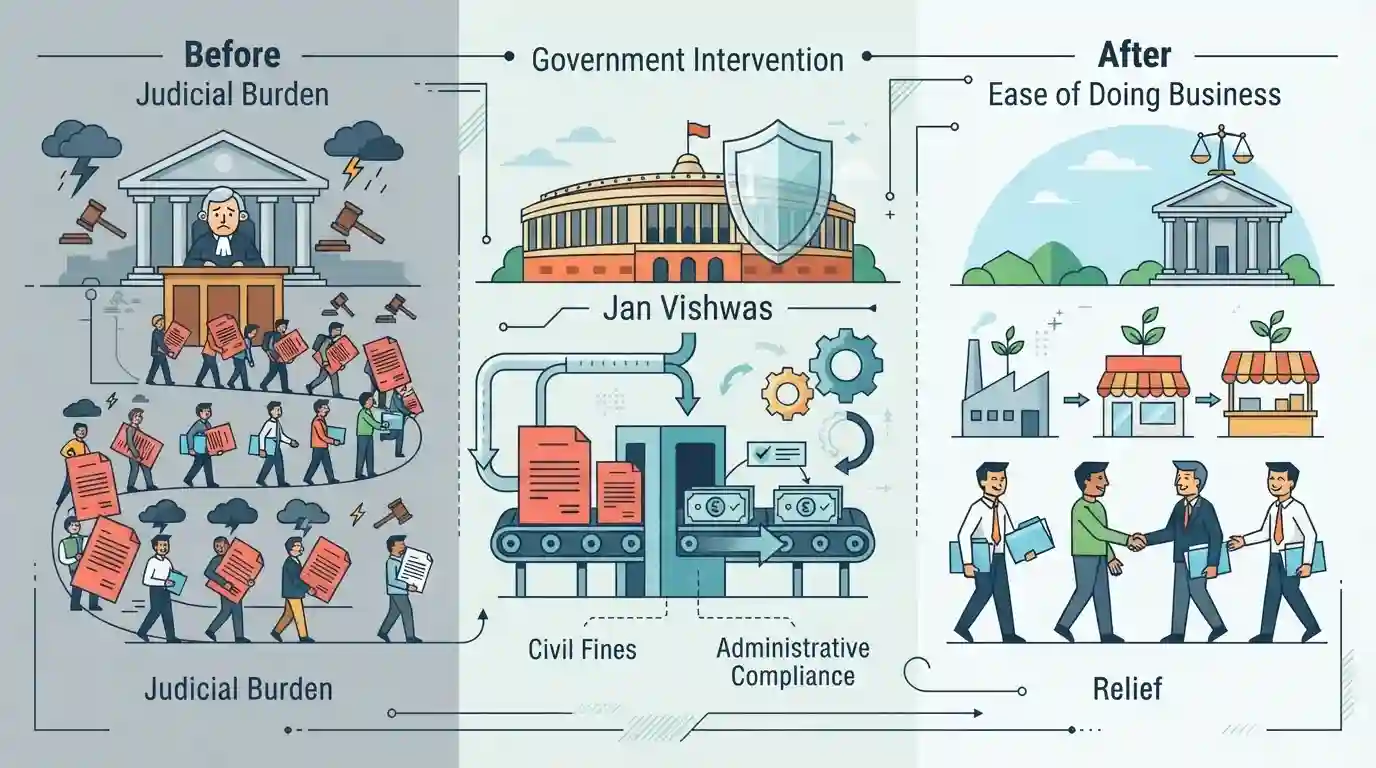
The Jan Vishwas Bill represents a major legislative push toward decriminalising minor offences, aiming to reduce compliance burdens, promote the ease of doing business, and alleviate pressure on the judicial system by replacing criminal penalties with civil fines or administrative measures for technical non-compliances.
ముఖ్య అంశాలు
- The Jan Vishwas Bill focuses on decriminalising minor technical and procedural defaults to reduce the compliance burden on businesses and citizens.
- It aims to improve the Ease of Doing Business in India by replacing imprisonment clauses with monetary penalties or administrative mechanisms for minor offences.
- The legislative approach marks a shift from criminal jurisprudence over trivial regulatory non-compliances to civil or administrative adjudication.
- It addresses judicial backlog by preventing unnecessary litigation over minor, compoundable, or technical regulatory breaches.
ముఖ్యమైన పదాలు
Jan Vishwas Bill

A legislative measure designed to decriminalise minor, technical, or procedural offences across multiple Central Acts by replacing criminal penalties with civil fines or administrative mechanisms, fostering ease of living and ease of doing business.
UPSC context
UPSC GS Paper II (Polity and Governance - Government Policies & Interventions). Tests understanding of regulatory reforms and reduction of judicial backlog.
Jan Vishwas (Amendment of Provisions) Act
An enabling legislative enactment that amends numerous existing central laws to eliminate imprisonment clauses for minor infractions, replacing them with graded monetary penalties and trust-based administrative measures.
UPSC context
UPSC GS Paper II (Governance and Legislative Process). Tests knowledge of legislative interventions aimed at improving the ease of doing business in India.
Parliament
The supreme legislative body of India comprising the President, Lok Sabha, and Rajya Sabha, responsible for enacting laws, policy oversight, and constitutional amendments.
UPSC context
UPSC GS Paper II (Indian Constitution - Parliament & State Legislatures). Tests structural and functional dynamics of law-making in India.
ప్రిలిమ్స్ ఉచ్చు
Decriminalisation of all regulatory offences across every central legislation without exception.
Aspirants often assume the Jan Vishwas Act completely decriminalises all offences across central legislations, whereas it targets only minor, technical, and procedural non-compliances.
అనుసంధానమైన స్థిర భావనలు
What is the difference between criminal liability and civil/administrative liability in regulatory governance?
- Criminal Liability:: Aim to punish moral wrongs or intentional harm, involving criminal trial procedures and potential imprisonment.
- Civil/Administrative Liability:: Aim to rectify non-compliance, restore status quo, or deter negligence through monetary fines and administrative adjudication.
- Governance Shift:: Reduces judicial burden, prevents investor harassment, and fosters an environment conducive to business growth.
అంతర-అంశ నమూనాలు
Judicial Backlog + Regulatory Decriminalisation
Jan Vishwas shifts trivial infractions from criminal courts to administrative adjudication, directly easing the massive case pendency burdening the Indian judicial hierarchy.
Ease of Doing Business + Trust-Based Governance
Transitioning from a punitive command-and-control governance model to trust-based civil compliance is central to improving India's global Ease of Doing Business rankings.

Jan Vishwas Act provisions replacing criminal imprisonment with civil fines for minor tech defaults will feature in matching-type prelims questions.
అనుసంధాన PYQలు · 2
అనుసంధాన PYQలు · 2
- 2024MainsGS2
What are the aims and objects of recently passed and enforced, The Public Examination (Prevention of Unfair Means) Act, 2024? Whether University/State Education Board examinations, too, are covered under the Act ?
- 2024MainsGS3
Discuss the merits and demerits of the four 'Labour Codes' in the context of labour market reforms in India. What has been the progress so far in this regard?
