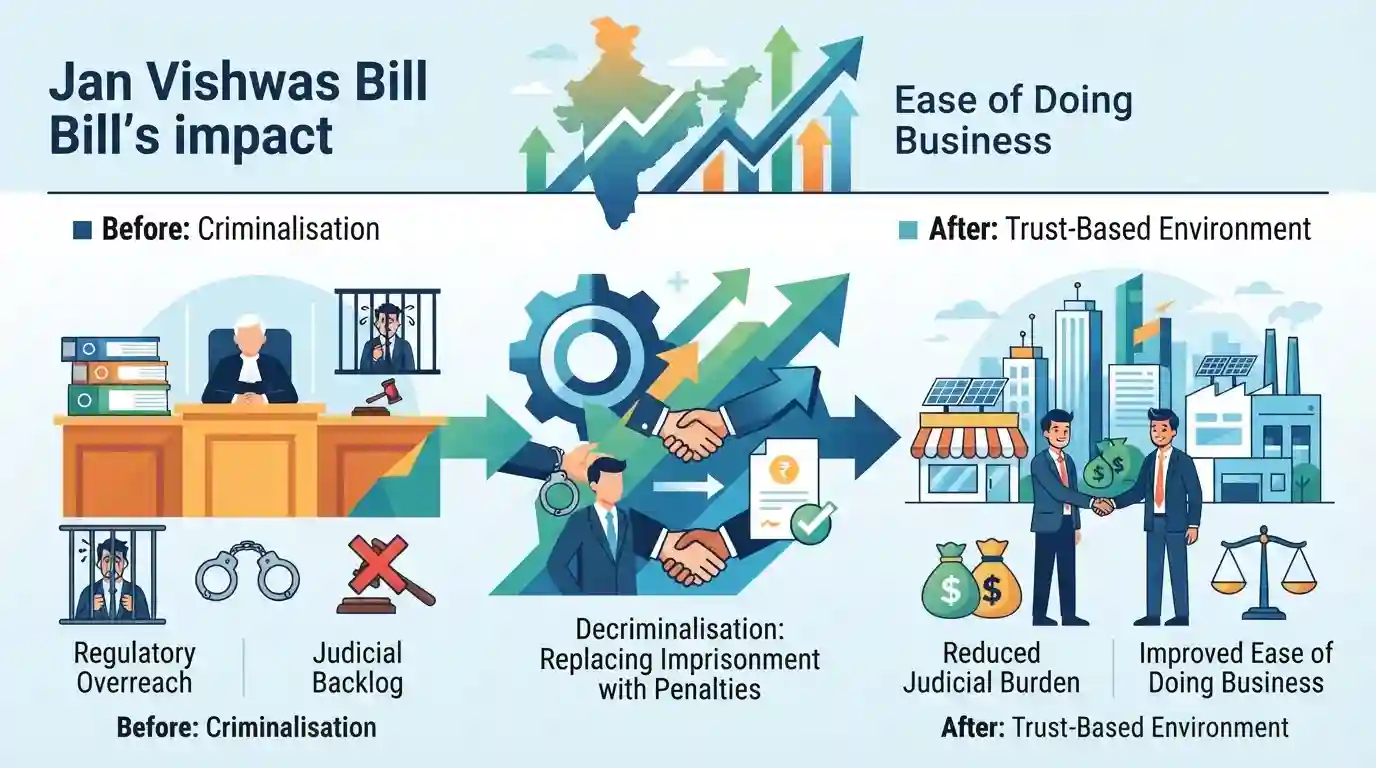
Jan Vishwas Bill advances ease of doing business via decriminalisation
Source:Indian Express ↗
આ શા માટે મહત્વનું છે
The Jan Vishwas legislative framework represents a paradigm shift in Indian regulation—moving away from punitive criminalization for minor procedural lapses toward trust-based civil compliance, which is critical for boosting manufacturing, entrepreneurship, and judicial efficiency.
સારાંશ
The Jan Vishwas Bill focuses on decriminalising minor offences to improve the ease of doing business and living in India. By replacing imprisonment clauses with financial penalties and administrative measures, the legislation addresses regulatory overreach, reduces judicial backlog, and fosters a trust-based business environment.
મુખ્ય મુદ્દા
- The Jan Vishwas Bill aims to promote ease of doing business and living by decriminalising minor, technical, or procedural offences across multiple legislations.
- It replaces criminal penalties such as imprisonment with monetary penalties, compounding of offences, or administrative mechanisms.
- The initiative seeks to reduce the burden on the Indian judiciary by preventing clogging of courts with trivial violations.
- It aligns with the government's objective of trust-based governance, removing fear of criminal liability for honest business operations and routine compliance lapses.
મહત્વપૂર્ણ શબ્દો
Jan Vishwas (Amendment of Provisions) Act

A landmark legislative initiative in India designed to improve ease of doing business and living by decriminalizing minor technical or procedural offenses across multiple central laws, replacing imprisonment clauses with financial penalties.
UPSC context
GS Paper II (Governance) & GS Paper III (Economy). Tests knowledge of regulatory reforms, ease of doing business, and reducing judicial backlog.
Parliament
The supreme legislative body of India responsible for enacting national laws, including significant economic and regulatory reform bills like the Jan Vishwas legislation.
UPSC context
GS Paper II (Indian Polity - Parliament and State Legislatures). Tests understanding of legislative procedures, law-making, and oversight powers.
Government of India
The executive authority of the Indian Union responsible for formulating and implementing national policies, economic reforms, and legislative bills to promote trust-based governance.
UPSC context
GS Paper II (Governance). Evaluates administrative policies, regulatory overreach reduction, and bureaucratic reforms.
પ્રિલિમ્સ ટ્રેપ
decriminalising all offences across central legislations and completely abolishing criminal penalties for any corporate default.
Aspirants often assume the Jan Vishwas Act completely repeals all penal provisions across central laws, whereas it specifically targets minor, technical, and procedural offences by substituting imprisonment with fines or administrative mechanisms.
સંલગ્ન સ્થિર ખ્યાલો
What is the difference between compounding of offences and civil penalties under Indian regulatory frameworks?
- Compounding:: Legal mechanism allowing an accused person to avoid prosecution by paying a specified monetary sum to the regulating authority or court.
- Civil Penalties:: Financial impositions levied directly by administrative tribunals or regulators for non-compliance without initiating criminal court proceedings.
- Objective:: Both instruments aim to decongest courts and shift the regulatory philosophy from punitive deterrence to trust-based compliance.
આંતર-વિષય પેટર્ન
Ease of Doing Business + Criminal Justice Reform
Decriminalisation measures mirror the broader push to replace colonial-era penal codes (e.g., Bharatiya Nagarik Suraksha Sanhita), linking administrative reform directly with criminal justice updates.
Regulatory Overreach + Investment Climate Linkages
Reduces administrative burdens on enterprises, complementing initiatives like PM GatiShakti and single-window clearances to attract FDI and domestic capital.

Jan Vishwas Act provisions replacing imprisonment with fines for minor offences will feature in a multi-statement prelims question.
સંલગ્ન PYQ · 2
સંલગ્ન PYQ · 2
- 2024MainsGS2
What are the aims and objects of recently passed and enforced, The Public Examination (Prevention of Unfair Means) Act, 2024? Whether University/State Education Board examinations, too, are covered under the Act ?
- 2024MainsGS3
Discuss the merits and demerits of the four 'Labour Codes' in the context of labour market reforms in India. What has been the progress so far in this regard?
