Decriminalisation Reforms and Trust-Based Governance Framework
Source:Indian Express ↗
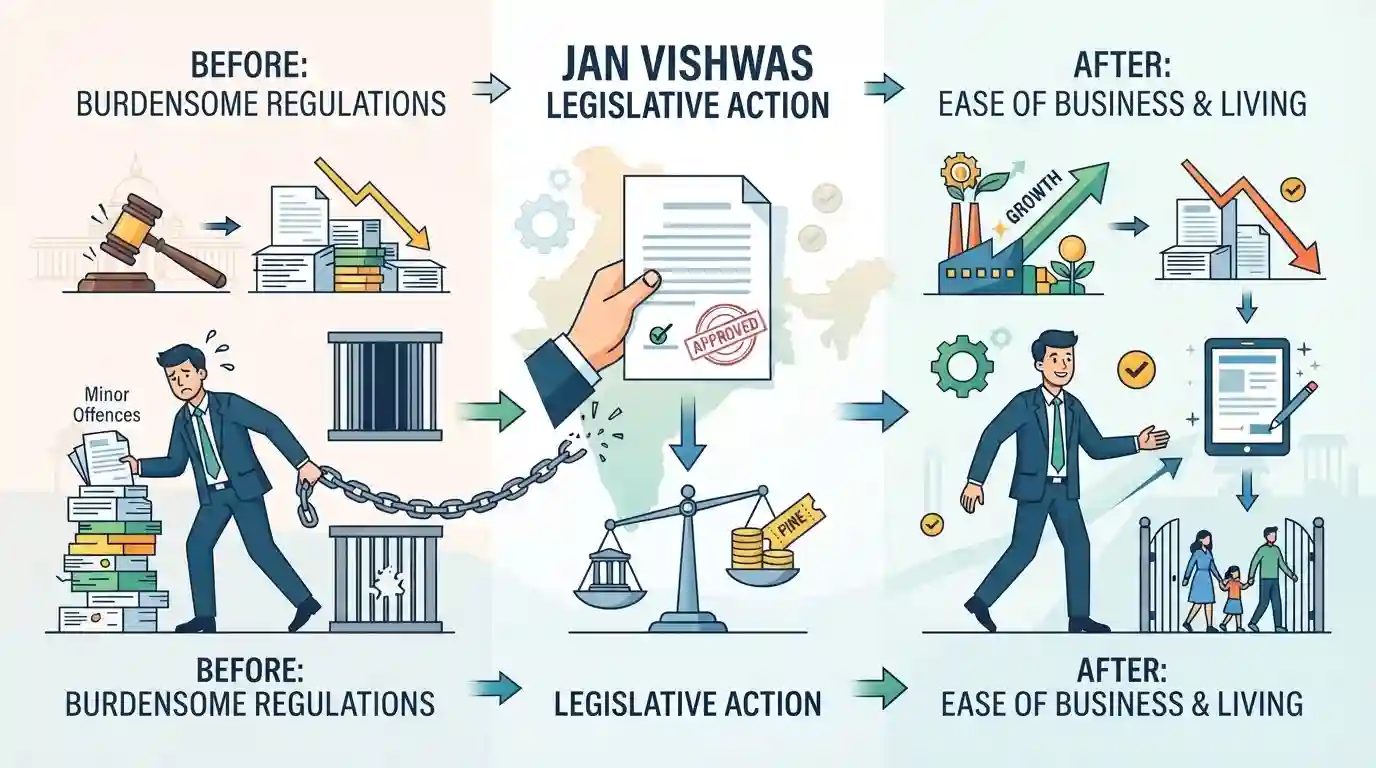
Why It Matters
The Jan Vishwas legislative framework is crucial for understanding India's regulatory shift from over-criminalisation and punitive control to trust-based governance, trust-based compliance, and ease of doing business, which directly impacts economic growth and judicial efficiency.
Summary
The Jan Vishwas Bill represents a major legislative effort by the Indian government to promote ease of doing business and ease of living by decriminalising minor technical or procedural offences, replacing jail terms with monetary penalties, and reducing judicial backlog.
Key Points
- The Jan Vishwas Bill aims to promote ease of doing business and ease of living by decriminalising minor, technical, or procedural defaults.
- It replaces imprisonment clauses with monetary penalties, fines, and administrative mechanisms for various minor offences across multiple central legislations.
- The initiative addresses the issue of over-criminalisation in legacy laws, reducing the burden on the judiciary and preventing harassment of citizens and businesses.
- It incorporates institutional mechanisms like adjudicating officers to decide penalties, ensuring speedy redressal and transparency.
Important Terms
Jan Vishwas (Amendment of Provisions) Act

A landmark Indian legislation designed to promote ease of doing business and living by decriminalising minor technical or procedural offences and replacing jail terms with monetary penalties across multiple central acts.
UPSC context
GS Paper II/III (Government Policies & Interventions, Ease of Doing Business, Criminal Justice Reforms). Tests knowledge of governance reforms and regulatory simplification.
Parliament
The supreme legislative body of India comprising the President, Lok Sabha, and Rajya Sabha, responsible for enacting laws, including significant reform measures like the Jan Vishwas Acts.
UPSC context
GS Paper II (Indian Constitution & Polity - Parliament Structure, Functioning, and Conduct of Business). Tests understanding of the legislative process and law-making powers.
Static Concepts Connected
What are the key mechanisms for reducing judicial backlog and promoting ease of doing business in India?
- Adjudicating Officers: Administrative adjudication replaces courts with specialized officers for minor technical violations to speed up dispute resolution.
- Civil Sanctions: Decriminalisation replaces custodial sentences with monetary penalties for technical or procedural defaults to prevent business harassment.
- Dynamic Penalties: Periodic escalation includes automatic upward revision of financial penalties (e.g., 10% every 3 years) to maintain deterrent value.
Cross-Topic Patterns
Ease of Doing Business + Judicial Backlog
Decriminalising minor commercial defaults supports the broader Ease of Doing Business framework while aligning with judicial reforms aimed at reducing Supreme Court and High Court backlog.
Administrative Tribunals + Regulatory Enforcement
Shifting from criminal prosecution to civil/monetary penalties in commercial laws requires parallel strengthening of regulatory tribunals and adjudicating officers.

Jan Vishwas Act provisions replacing criminal penalties with fines across legacy laws are high-yield for prelims matching statements.
Linked PYQs · 2
Linked PYQs · 2
- 2021MainsGS2
“Pressure groups play a vital role in influencing public policy making in India.” Explain how the business associations contribute to public policies.
- 2023MainsGS3
What is the status of digitalization in the Indian economy? Examine the problems faced in this regard and suggest improvements.
