Jan Vishwas Bill Focuses on Decriminalisation and Ease of Business
Source:Indian Express ↗
हे का महत्त्वाचे आहे
The Jan Vishwas legislation represents a major paradigm shift in Indian regulatory policy, moving away from a punitive colonial-era framework to trust-based governance, making it critical for GS2 (Governance/Legislation) and GS3 (Economy/Business environment).
सारांश
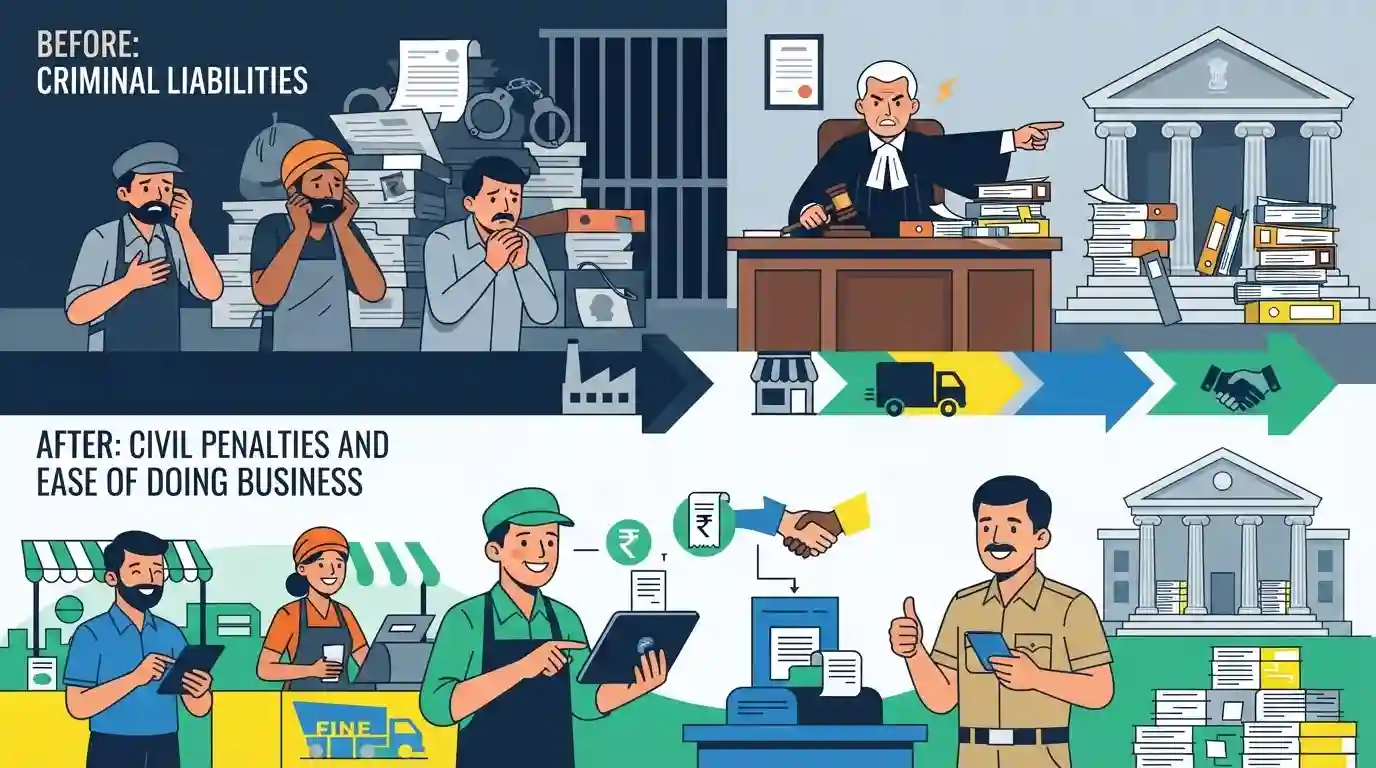
The Jan Vishwas Bill focuses on decriminalising minor offences and substituting criminal liabilities with civil penalties or administrative fines to improve ease of doing business and reduce the judicial backlog in India.
मुख्य मुद्दे
- The Jan Vishwas Bill aims to promote ease of doing business and living by decriminalizing minor, technical, or procedural defaults across multiple statutes.
- It replaces criminal penalties such as imprisonment with civil penalties, monetary fines, or administrative mechanisms.
- The move seeks to reduce the burden on the Indian judiciary by preventing clogging of courts with petty offences.
- It incorporates institutional safeguards like designated adjudicating officers and appellate mechanisms to ensure transparency and accountability.
महत्त्वाच्या संज्ञा
Jan Vishwas Bill

A landmark legislation in India aimed at improving the ease of doing business and living by decriminalising minor offences across multiple central acts and replacing criminal liabilities with civil penalties or administrative fines.
UPSC context
GS Paper II/III (Polity, Governance, Economy) — tests understanding of regulatory reforms, ease of doing business, and judicial backlog reduction.
Jan Vishwas (Amendment of Provisions) Act
An enactment designed to foster a trust-based governance model by amending numerous central statutes to remove imprisonment clauses for minor technical or procedural lapses.
UPSC context
GS Paper II (Government Policies and Interventions) — tests policy measures aimed at reducing compliance burdens and reforming criminal justice.
पूर्वपरीक्षा सापळा
The Jan Vishwas Bill completely abolishes all penalties and legal consequences for technical and procedural defaults under central statutes.
The Jan Vishwas Act does not abolish all penalties or legal consequences for violations; it replaces criminal imprisonment with civil penalties and monetary fines.
संबंधित स्थिर संकल्पना
What are the key mechanisms and constitutional considerations behind decriminalisation of minor offences in India?
- Constitutional Basis: Criminal law falls primarily in the Concurrent List (List III), while trade, commerce, and industry span Union and State lists.
- Statutory Shift: Replaces imprisonment with civil penalties, compounding of offences, and administrative fines to reduce criminal court pendency.
- Institutional Design: Appoints departmental adjudicating officers instead of magistrates, introducing structured administrative review and appellate mechanisms.
आंतर-विषय नमुने
Ease of Doing Business & Judicial Reform
Judicial reforms tackling pendency intersect with administrative law, where moving from criminal to civil liability redefines the state's coercive power and regulatory compliance costs.

Jan Vishwas Bill's shift from criminal to civil penalties will be tested via a multi-statement match on Ease of Doing Business & pendency.
