Decriminalisation Reforms and Ease of Doing Business in India
Source:Indian Express ↗
हे का महत्त्वाचे आहे
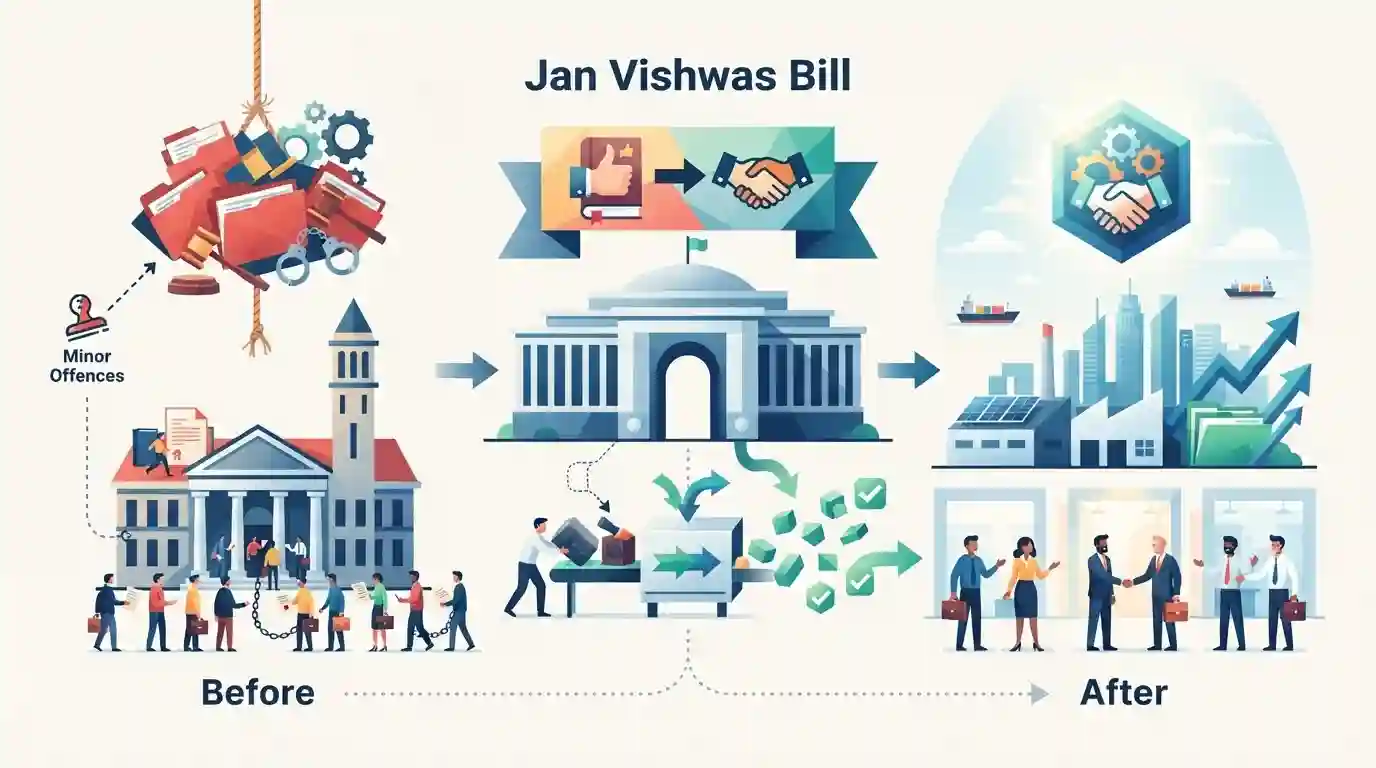
The Jan Vishwas Bill represents a major governance shift from coercive over-regulation to trust-based administration, directly impacting the ease of doing business, industrial investment climate, and judicial efficiency in India.
सारांश
The Jan Vishwas Bill initiative focuses on decriminalising minor technical and procedural violations across multiple legislations to foster an environment of trust-based governance, enhance the ease of doing business, and alleviate the burden on the judicial system.
मुख्य मुद्दे
- The Jan Vishwas Bill focuses on decriminalising minor technical and procedural offences to reduce compliance burdens and improve the ease of doing business in India.
- It replaces imprisonment clauses with monetary penalties, administrative compounding, and civil mechanisms for minor infractions.
- The legislative initiative aims to de-clog the Indian judicial system by reducing the burden of minor criminal cases on courts.
- It reflects a systemic shift from punitive governance and over-regulation toward trust-based governance and business facilitation.
महत्त्वाच्या संज्ञा
Jan Vishwas Bill

A legislative initiative aimed at decriminalising minor technical and procedural violations across multiple central acts to foster trust-based governance, improve ease of doing business, and reduce judicial backlogs.
UPSC context
UPSC GS Paper II (Governance) & GS Paper III (Economy). Tests understanding of regulatory reforms, ease of doing business, and judicial pendency.
Jan Vishwas (Amendment of Provisions) Act
An enactment that converts minor criminal offenses and imprisonment clauses into civil monetary penalties across numerous central legislations, promoting trust-based administration.
UPSC context
UPSC GS Paper II (Government Policies & Interventions). Evaluates legal reforms, regulatory compliance changes, and administrative efficiency.
पूर्वपरीक्षा सापळा
decriminalising minor technical and procedural violations across all penal statutes without exception
Aspirants often assume the Jan Vishwas Act completely repeals all penal provisions across all laws, whereas it specifically targets minor technical/procedural lapses while retaining criminal penalties for grave, fraudulent, or public-safety violations.
संबंधित स्थिर संकल्पना
What is the difference between criminal compounding of offenses and administrative compounding?
- Judicial Compounding:: Judicial approval required; involves compounding of compoundable criminal offenses under the Code of Criminal Procedure (CrPC/BNSS) through courts.
- Administrative Compounding:: Statutory boards or regulatory agencies levy monetary penalties for minor technical breaches without triggering criminal prosecution or court trials.
आंतर-विषय नमुने
Ease of Doing Business & Judicial Backlog
Decriminalisation of commercial laws bridges corporate governance reforms with judicial backlog reduction, echoing recommendations from the Economic Survey and Law Commission reports on transforming civil liabilities.

Jan Vishwas Act decriminalising minor offenses will likely feature in a multi-statement question on trust-based governance and judicial reforms.
संबंधित PYQ · 2
संबंधित PYQ · 2
- 2023MainsGS3
Faster economic growth requires increased share of the manufacturing sector in GDP, particularly of MSMEs. Comment on the present policies of the Government in this regard.
- 2017MainsGS3
Industrial growth rate has lagged-behind in the overall growth of Gross-Domestic-Product (GDP) in the post-reform period." Give reasons. How far the recent changes in Industrial-Policy are capable of increasing the industrial growth rate?
