Jan Vishwas Bill Decriminalisation and Ease of Doing Business
Source:Indian Express ↗
কেন এটি গুরুত্বপূর্ণ
The Jan Vishwas Bill represents a major policy shift toward trust-based governance, administrative streamlining, and judicial burden reduction, making it crucial for understanding Indian administrative and legal reforms.
সারসংক্ষেপ
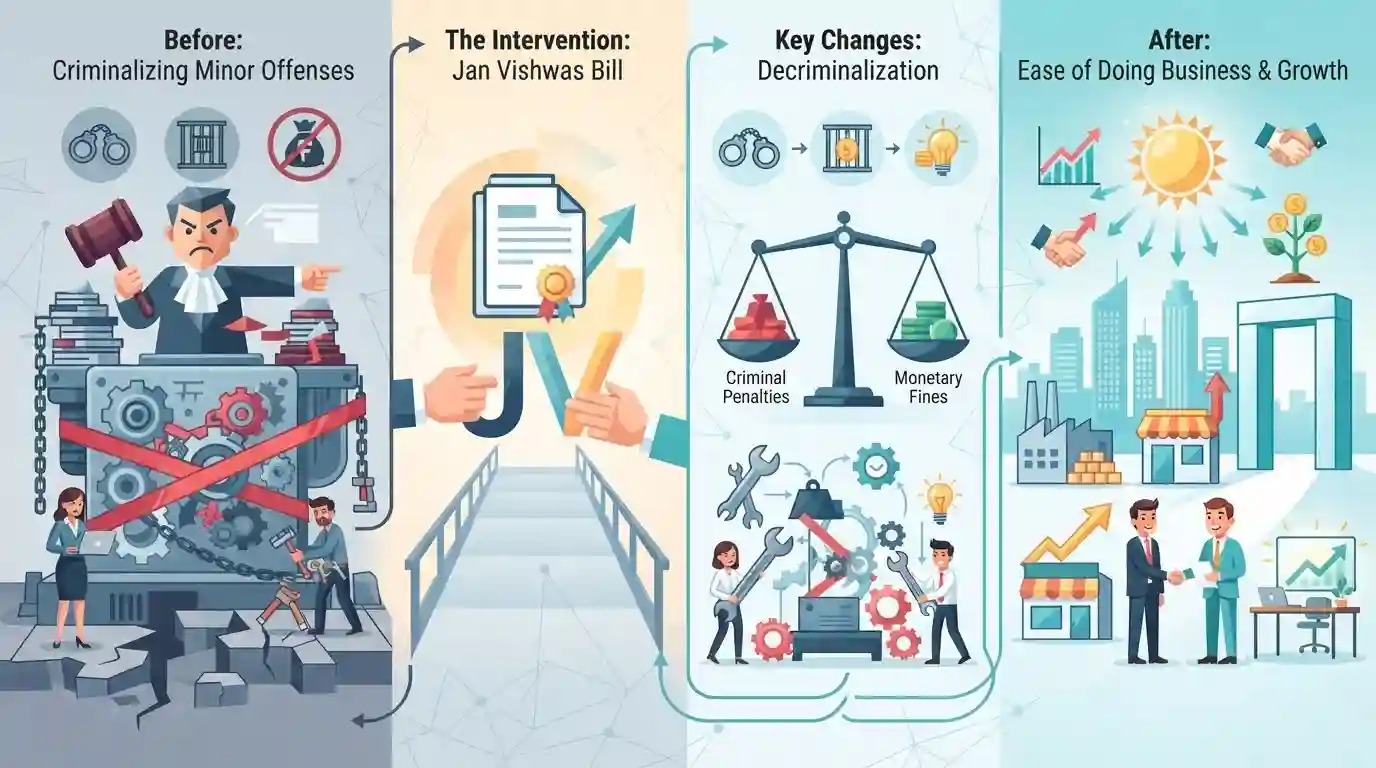
The article discusses the key changes and objectives of the Jan Vishwas Bill, which focuses on decriminalising minor offences to improve the ease of doing business and reduce compliance burdens in India.
মূল বিষয়
- The Jan Vishwas Bill aims to promote ease of living and ease of doing business by decriminalising minor technical or procedural defaults.
- It seeks to replace imprisonment clauses with monetary penalties or administrative mechanisms for various minor offences across multiple legislations.
- The legislation addresses over-regulation and reduces the burden on the Indian judicial system by preventing minor civil defaults from clogging courts.
- It emphasizes trust-based governance, shifting from punitive state control to civil liabilities and compounding of offences.
গুরুত্বপূর্ণ শব্দ
Jan Vishwas Bill 2026

A legislative reform aimed at enhancing ease of doing business and ease of living by decriminalizing minor offenses and rationalizing penalties across multiple Central Acts.
UPSC context
UPSC GS Paper II (Governance) & GS Paper III (Economy). Tests understanding of regulatory reforms, ease of doing business, and trust-based governance.
Jan Vishwas Act
An earlier landmark legislation enacted to decriminalize minor offenses across various central laws to reduce compliance burdens and improve business sentiment in India.
UPSC context
UPSC GS Paper II (Government Policies & Interventions). Evaluates legal reforms aimed at reducing judicial backlog and improving regulatory compliance.
Parliament
The supreme legislative body of India comprising the President, Lok Sabha, and Rajya Sabha, responsible for enacting laws and financial oversight.
UPSC context
UPSC GS Paper II (Indian Constitution & Polity). Tests knowledge of legislative procedures, law-making, and parliamentary accountability.
সংযুক্ত স্থির ধারণা
What is the difference between criminal liability and civil/administrative liability in Indian law?
- Criminal Liability: Punishment involves incarceration or criminal records, prosecuted by the State in criminal courts under the CrPC.
- Civil Liability: Involves fines, monetary penalties, or administrative mechanisms handled by departmental adjudicating officers rather than regular courts.
- Philosophical Shift: Focuses on retributive justice and deterrence through fear of imprisonment, contrasting with trust-based governance models.
আন্তঃবিষয় প্যাটার্ন
Ease of Doing Business + Economic Reforms
Decriminalisation of minor commercial defaults directly supports structural reforms aimed at lowering India's incremental capital-output ratio (ICOR) and attracting FDI.
Trust-Based Governance + Judicial Overburden
Shifting from criminal imprisonment to administrative adjudication highlights executive-led civil dispute resolution, altering the constitutional separation of powers debate.

Jan Vishwas trust-based governance + compounding vs criminalisation will feature in a multi-statement prelims Q on regulatory reforms.
